


Bastu Odoka: The Laboratory’s Role in Preventing RhD Disease
Bastu Odoka, Transfusion Scientist at Effia-Nkwanta Regional Hospital, shared a post on LinkedIn:
”The Laboratory’s Role in Preventing RhD Disease
When discussing prevention of RhD disease (HDFN), attention is often placed on:
- Anti-D injections
- Obstetric care
Clinical decision-making
But one critical part of the prevention chain is sometimes overlooked:
The laboratory.
In reality, the fight against RhD disease starts in the laboratory.
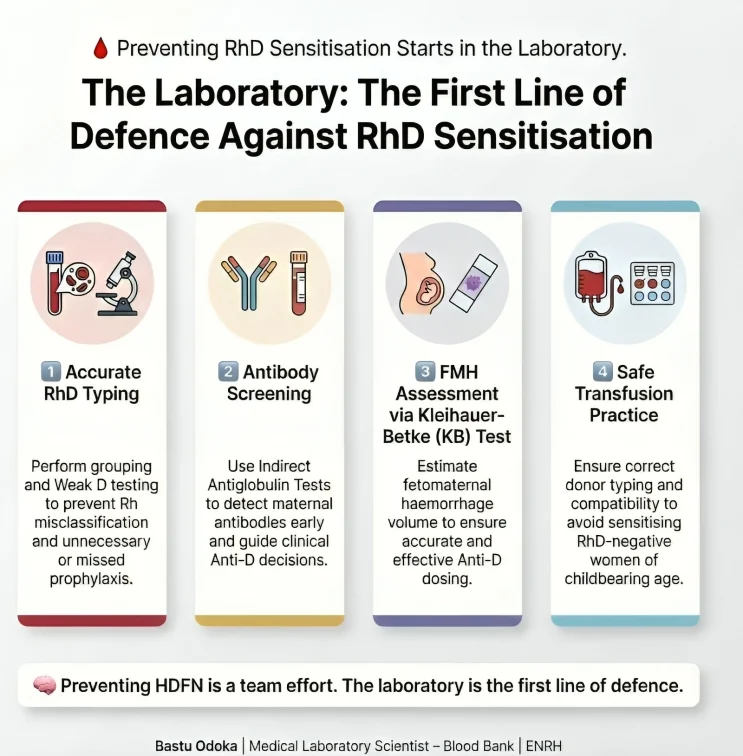
Accurate blood grouping is the first defence
ABO and RhD grouping may appear routine, but it is one of the most important steps in preventing sensitisation.
Laboratories should ensure:
- Proper RhD typing
- Weak D testing on samples initially typed RhD-negative, according to laboratory policy and testing algorithms
This helps prevent misclassification of RhD status.
Incorrect RhD typing can have serious consequences.
- Typing an RhD-positive mother as RhD-negative may lead to unnecessary use of Anti-D, placing pressure on an already limited resource.
- Typing an RhD-negative mother as RhD-positive may result in missed prophylaxis, increasing the risk of sensitisation and future HDFN and unnecessary financial burden on the mother.
Antibody screening helps identify sensitisation early
Routine antibody screening (Indirect Antiglobulin Test) plays a critical role in:
- Detecting clinically significant antibodies
- Identifying mothers who are already sensitised
- Guiding appropriate clinical management
Without antibody screening, sensitisation may remain undetected until complications occur.
Quantifying fetomaternal haemorrhage
Tests such as the Kleihauer-Betke (KB) test help estimate the volume of fetomaternal haemorrhage (FMH) by detecting fetal red cells in maternal circulation.
This information can guide the appropriate Anti-D dose, particularly when significant fetomaternal haemorrhage is suspected.
Safe transfusion also matters
Preventing RhD sensitisation is not only an obstetric issue.
Laboratories must ensure:
- Accurate typing of donor blood
- Proper compatibility testing
- Avoidance of RhD-positive transfusion to RhD-negative women of childbearing age whenever possible
Transfusion-related sensitisation can also lead to future HDFN.
In Ghana and similar resource-limited settings, routine antibody screening and fetomaternal haemorrhage testing are not consistently performed.
This is where laboratory professionals must take leadership.
Strengthening laboratory practices can significantly improve prevention of RhD disease.
Key message
Preventing RhD disease is a team effort.
The chain begins with:
- Accurate blood grouping
- Antibody screening
- FMH assessment when indicated
- Safe transfusion practices
When laboratories perform these steps well, future pregnancies can be protected from preventable disease.”
Stay updated with Hemostasis Today.
-
Sep 30, 2026, 11:16Christina Pohlman: Could aPL Levels Help Predict Stroke Recurrence?
-
Sep 30, 2026, 10:55Rana Al Hrout: Diagnostic Approach to Hypochromic Microcytic Anemia
-
Sep 30, 2026, 01:52Javed Anees: DADA2 – When a Young Stroke Is More Than a Stroke
-
Sep 30, 2026, 01:51How a Venous Thrombus Becomes Revascularized – ISTH
-
Sep 29, 2026, 22:45Victor Agunyego: Paracetamol – The Most Common Drug We Underestimate
-
Sep 29, 2026, 22:42Nova Sinclair: Advancing the Future of Hematology – Meet Our 2027 Organizing Committee
-
Sep 29, 2026, 22:41Lorenz Räber: Intracoronary Imaging in PCI – Why, When, How, and Which Modality?
-
Sep 29, 2026, 22:31Selma Turkovic: Pleased to Deliver the Opening Presentation at Kingston Hospital
-
Sep 29, 2026, 22:31Miguel Teran: Ultrasound and Simulation in Arterial Blood Sampling