


Bastu Odoka: Jehovah’s Witness News on Transfusion… and a Question Worth Asking
Bastu Odoka, Transfusion Scientist at Effia-Nkwanta Regional Hospital, shared a post on LinkedIn:
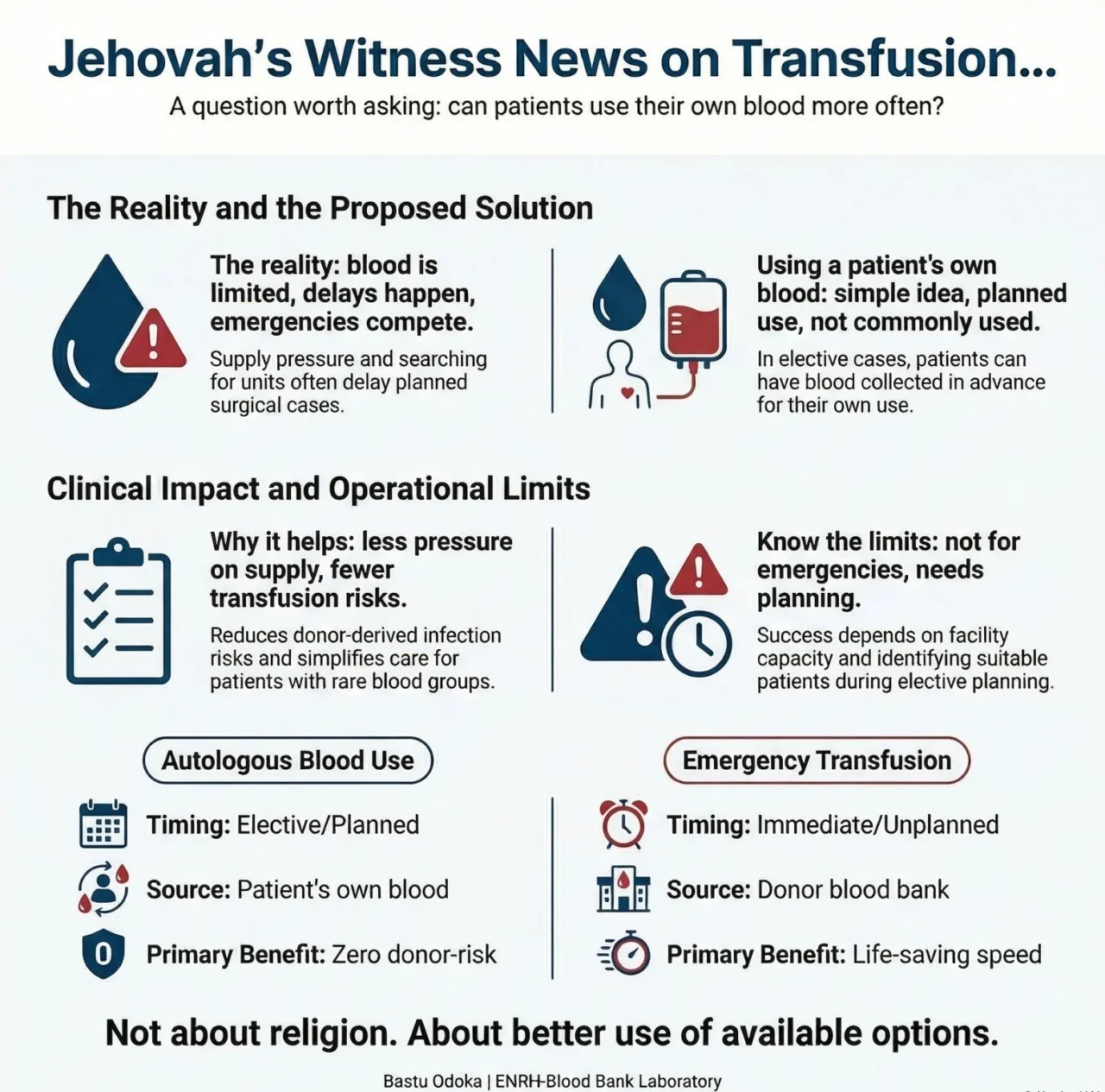
“Jehovah’s Witness News on Transfusion… and a Question Worth Asking
There has been recent discussion about how Jehovah’s Witness patients approach blood transfusion.
Recent reports say members may now choose whether their own blood can be drawn, stored, and later used in planned care.
But beyond the headlines, there is a broader question for us in practice:
Are we making enough use of a patient’s own blood when we have the chance?
Let’s bring it home
In many of our hospitals, blood is not always readily available.
We see it every day:
- Delays while searching for units
- Pressure on limited supply
- Emergencies competing with planned cases
Yet for some planned procedures, there is time to prepare.
One option we do not talk about enough.
In selected elective cases, a patient may have blood collected in advance for their own use.
If needed, that same blood is given back.
Simple idea.
Not commonly used.
Why it makes sense
- Reduces demand on the blood bank
- Avoids exposure to donor-derived transfusion-transmitted infections
- Avoids red-cell alloimmunisation from donor exposure
- May be useful in selected patients with rare blood groups or multiple antibodies
- Gives more room to plan in elective care
Where this fits
This is not for emergencies.
It works when there is time:
- Elective surgeries
- Orthopaedic cases
- Planned gynaecological procedures
- Patients with rare blood groups
- Patients with known antibodies
What we must be honest about
- It requires planning
- It depends on facility capacity
- Not all patients are suitable
- It will not replace donor blood
What this should trigger
When a surgery is being planned, we should be asking:
‘Can this patient safely have blood collected for their own use?’
Not for every case.
But for the right cases.
Final thought
This is not about religion.
It is about not missing opportunities.
In settings where blood is often limited, small shifts in practice can make a real difference.”
Other posts featuring Bastu Odoka on Hemostasis Today.
-
Sep 24, 2026, 06:33Benjamin Vipler: Optimal Oral Anticoagulation Choice in Atrial Fibrillation and Advanced CKD
-
Sep 24, 2026, 06:08Christopher Salerno: AI-Powered At-Home Anemia Screening Advances Telehealth Access
-
Sep 24, 2026, 05:38Aya Qattan: When a Normal CBC Does Not Mean Normal Iron Status
-
Sep 24, 2026, 05:11Mastering Warm Autoimmune Hemolytic Anemia Diagnosis and Practice – ASH Education
-
Sep 23, 2026, 16:04Monia Ezzalfani: Advancing Patient-Centered Care in Hemophilia A and B
-
Sep 23, 2026, 15:49Bilge Başak: How Activated PRP Modulates Osteoarthritic Chondrocyte Function
-
Sep 23, 2026, 14:50Mbonjo Bitsie Dora: Strengthening Sickle Cell Care Through Education, Awareness and Innovation
-
Sep 23, 2026, 13:58The New B12 Diagnostic Algorithm: From Serum Cobalamin to Functional Deficiency
-
Sep 23, 2026, 13:56Noha Soror: Preparing for Hematology and Medical Oncology Board Certification