


Claudiu Stoicescu: Are We Starting Cardiovascular Risk Assessment Too Late?
Claudiu Stoicescu, University Lecturer at Carol Davila University of Medicine and Pharmacy, shared a post on LinkedIn:
”Are we starting cardiovascular risk assessment too late?
One of the most interesting shifts in the 2026 AHA Scientific Statement is not a new drug or a new biomarker.
It is when we should begin assessing cardiovascular risk.
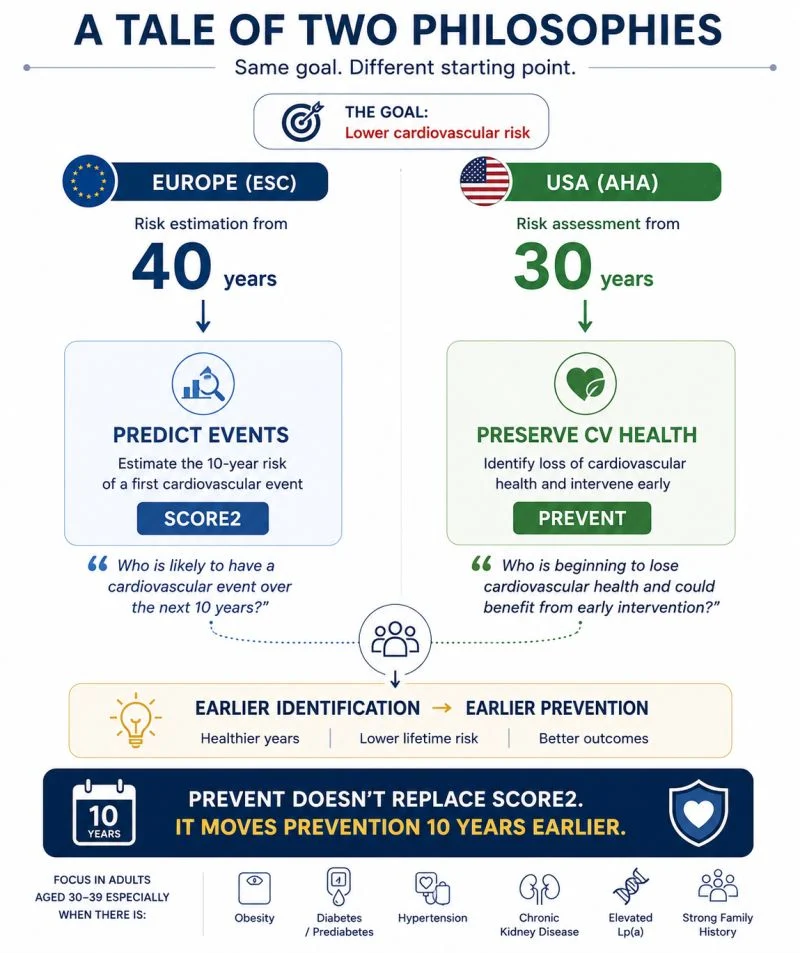
ESC recommends formal cardiovascular risk estimation from the age of 40 years, using the SCORE2 model.
AHA, with the new PREVENT equations, extends risk assessment to adults as young as 30 years.
At first glance, this may seem like a simple difference in age thresholds.
It isn’t.
It reflects two different philosophies of prevention.
The European approach asks:
‘Who is likely to experience a cardiovascular event over the next 10 years?’
The PREVENT approach asks:
‘Who is beginning to lose cardiovascular health—and could benefit from intervention before disease becomes clinically apparent?’
This evolution reflects today’s reality:
- Obesity develops earlier.
- Type 2 diabetes is increasingly diagnosed in younger adults.
- Hypertension often starts before the age of 40.
- Chronic kidney disease remains silent for years.
- Atherosclerosis is driven by cumulative lifetime exposure to risk factors—not simply by age.
In daily practice, I don’t see PREVENT as replacing SCORE2.
I see it as moving prevention approximately 10 years earlier.
If you also calculate PREVENT, it often provides additional insight because it incorporates heart failure and kidney disease risk
For adults between 30 and 39 years, particularly those with obesity, diabetes, hypertension, CKD, elevated Lp(a), or a strong family history, prevent may identify patients who would otherwise appear ‘low risk’ using traditional 10-year models.
Perhaps the question is no longer: ‘Which calculator is better?’
But rather: ‘How early should we start protecting cardiovascular health?’ ”
Stay updated with Hemostasis Today.
-
Nov 8, 2026, 12:22Marc Carrier: Advancing Catheter-Related Thrombosis Prevention Through Factor XI Inhibition
-
Nov 8, 2026, 11:56Why Genetic Predisposition Does Not Always Lead to Thrombosis – Stork Genetics
-
Nov 8, 2026, 11:45Sher-Lu Pai: Investigating Intracardiac Thrombosis and Its Management in Liver Transplantation
-
Nov 8, 2026, 11:25Mehmet Cilingiroglu: Navigating Anticoagulation Choices in Acute Coronary Syndrome PCI
-
Nov 8, 2026, 07:16Gilberto de lima Lopes Junior: The Cardiovascular Consequences of Cancer in Younger Patients
-
Nov 8, 2026, 06:51Haney Mallemat: Key Principles and Pitfalls of LVAD Emergencies
-
Nov 8, 2026, 06:31Maria Omer: Clinical Recognition and Management of Cavernous Sinus Thrombosis
-
Nov 8, 2026, 06:16Natasha Jolakoski: University of New Mexico Hospital Promotes PGY-2 Thrombosis and Hemostasis Management Pharmacy Residency
-
Nov 8, 2026, 05:47Safaa Hilal: POCUS in the Evaluation of Perioperative Troponin Elevation