


Cynthia Alejandra Pastor Alvarez: aPTT or Anti-Xa to Monitor Unfractionated Heparin?
Cynthia Alejandra Pastor Alvarez, Clinical Pathologist at Almar Laboratories of arec Tecamachalco, shared a post on LinkedIn about a recent article by Isabelle Gouin-Thibault et al., published in Journal of Thrombosis and Haemostasis.
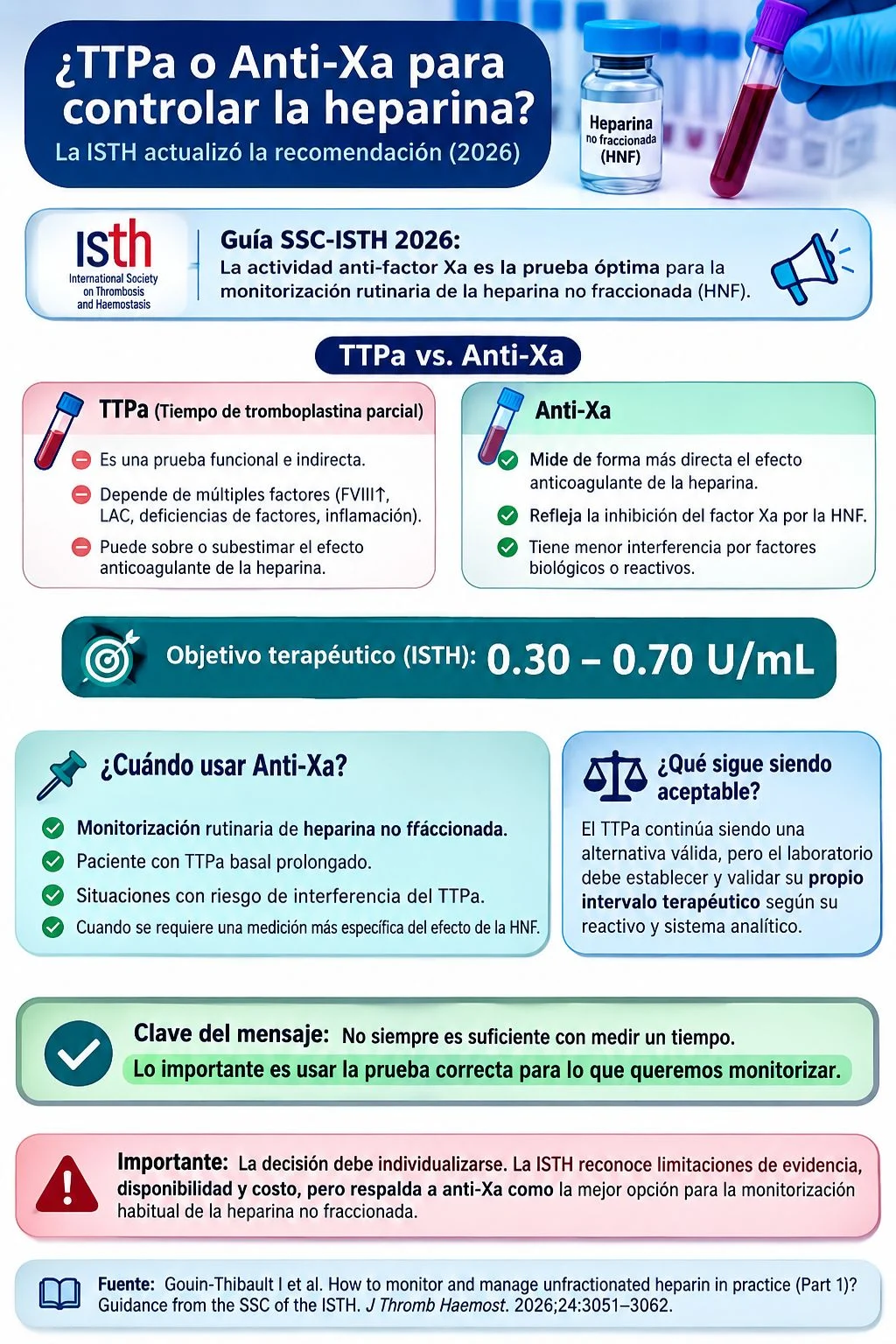
”TTaP or anti-Xa to monitor unfractionated heparin?
Monitoring of unfractionated heparin (UFH) continues to evolve.
The 2026 SSC guideline of the International Society on Thrombosis and Haemostasis (ISTH) considers the anti-factor Xa activity as the optimal test for routine monitoring of UFH, maintaining TTaP as an acceptable alternative.
Why is it relevant to the laboratory?
The aPTT is a functional test influenced by multiple variables independent of heparin concentration, including factor VIII, lupus anticoagulant, factor deficiencies, inflammation, and the characteristics of the reagent itself.
The determination of anti-Xa provides a more direct assessment of the anticoagulant effect of UFH, with a recommended therapeutic range of 0.30–0.70 U/mL for most indications.
This does not mean that the aPTT is no longer useful. When used, each laboratory must establish and validate its own therapeutic interval according to its analytical and reactive system.
An update that once again highlights the role of the clinical laboratory not only in the generation of results, but also in the selection and standardization of the methodology that best represents the patient’s condition.
Reference: Gouin-Thibault I, et al. How to monitor and manage unfractionated heparin in practice (Part 1)? Guidance from the SSC of the ISTH. J Thromb Haemost. 2026; 24:3051–3062.
Infographic made with the support of generative AI. Scientific content reviewed based on the SSC-ISTH 2026 guideline.”
Title: How to monitor and manage unfractionated heparin in practice (Part 1)? Guidance from the SSC of the ISTH
Authors: Isabelle Gouin-Thibault, Corinne Frere, Lana A Castellucci, Jean M Connors, Adam Cuker, Jerrold H Levy, Thomas Lecompte, Francois Mullier
Stay updated with Hemostasis Today.
-
Oct 6, 2026, 03:13Patrick Taylor: Glow Stack Trend What the Evidence Really Shows
-
Oct 6, 2026, 02:59Preventing Hospital Associated Venous Thromboembolism – Thrombosis Canada
-
Oct 6, 2026, 02:42Treatment of Iron Deficiency With and Without Anemia – American Society of Hematology
-
Oct 6, 2026, 02:36Mouna Sassi: When Clinical and Laboratory Perspectives Meet in Thrombosis Care
-
Oct 6, 2026, 02:35Lucia Stefanini: Platelet Dysfunction and Oxidized Phospholipids in MASLD
-
Oct 6, 2026, 02:18Pablo Corral: Association of Lp(a) With Coronary Atherosclerosis and CV Events
-
Oct 5, 2026, 22:55Steve Humphreys: A Big Thank You to BSHT for Providing Me With a Recent Skills Exchange Award
-
Oct 5, 2026, 22:52William McKeown: Great to Be in Istanbul for the Opening of the EHC 2026
-
Oct 5, 2026, 22:48Laura Quintas Lorenzo: A New Approach to Healthcare for von Willebrand Disease at EHC 2026