


Edward Lee Carter: Why ‘Never Again’ Might Be the Wrong Instinct After Intracerebral Hemorrhage
Edward Lee Carter, Clinical Pharmacist Practitioner at U.S. Department of Veterans Affairs, shared a post on LinkedIn:
“After intracerebral hemorrhage in a patient with AF, is stopping anticoagulation actually the safer choice?
Few decisions in anticoagulation feel more uncomfortable than this one.
The patient has already lived through the complication we fear most.
The instinct to stop for good and never look back is completely understandable.
But the randomized evidence says the calculus is more complicated than that instinct suggests.
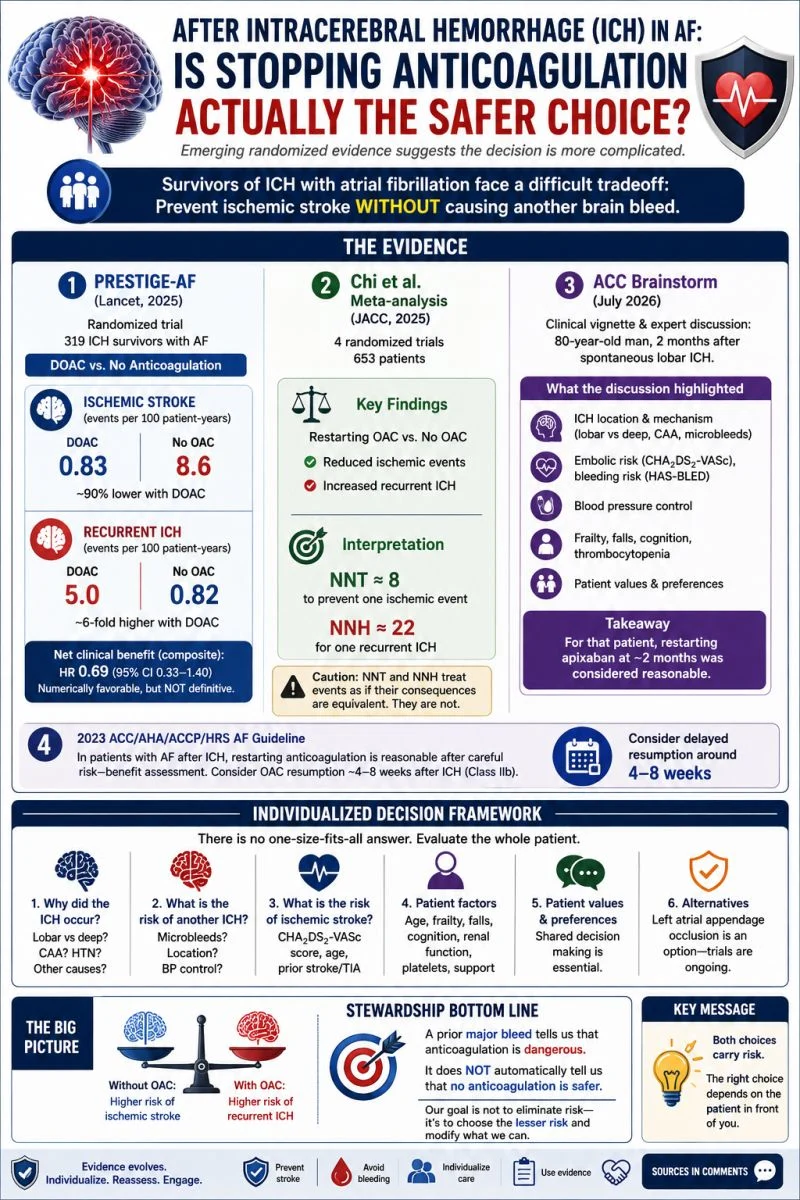
PRESTIGE-AF (Lancet, 2025) randomized 319 ICH survivors with AF to a DOAC or no anticoagulation.
The trade-off was stark: ischemic stroke occurred at 0.83 per 100 patient-years on a DOAC versus 8.6 with no anticoagulation.
Recurrent ICH ran the opposite direction — 5.0 versus 0.82. Anticoagulation dramatically cut ischemic events while raising the risk of the exact complication everyone is trying to avoid.
A pooled meta-analysis of four RCTs (JACC, 2025; n=653) added NNT and NNH to the picture — roughly 8 to prevent one ischemic event, 22 to cause one recurrent ICH.
Those numbers sound reassuring on their face, but they come with a real caveat: NNT and NNH treat every event as equally severe, and a recurrent lobar ICH doesn’t carry the same odds of death or lasting disability as an ischemic stroke.
Averaging them together flattens a distinction that matters enormously to the patient in front of you.
That’s what makes ACC’s discussion of this case useful — it isn’t really ‘restart, yes or no.’
It’s what caused the original bleed, lobar or deep, evidence of amyloid angiopathy or microbleeds, blood pressure control, embolic risk, and the geriatric layer trials don’t capture well — frailty, falls, cognition, thrombocytopenia, and what the patient actually values.
Worth remembering too that ICH isn’t the only bleeding risk in this conversation — COMBINE-AF recently flagged how common extracranial bleeding is with OAC use in AFib more broadly.
There’s also a third pathway.
A3ICH, STROKECLOSE, and CLEARANCE are all enrolling now to compare left atrial appendage occlusion against DOAC therapy and against no anticoagulation in this exact population.
The real stewardship lesson: a major bleed tells us anticoagulation is dangerous.
It doesn’t automatically tell us that no anticoagulation is safer.
After ICH, both paths carry risk. The job isn’t to eliminate it — it’s to figure out which risk is greater for this particular patient, and which of those risks we can actually modify.”
Stay updated with Hemostasis Today.
-
Sep 30, 2026, 01:52Javed Anees: DADA2 – When a Young Stroke Is More Than a Stroke
-
Sep 30, 2026, 01:51How a Venous Thrombus Becomes Revascularized – ISTH
-
Sep 29, 2026, 22:45Victor Agunyego: Paracetamol – The Most Common Drug We Underestimate
-
Sep 29, 2026, 22:42Nova Sinclair: Advancing the Future of Hematology – Meet Our 2027 Organizing Committee
-
Sep 29, 2026, 22:41Lorenz Räber: Intracoronary Imaging in PCI – Why, When, How, and Which Modality?
-
Sep 29, 2026, 22:31Selma Turkovic: Pleased to Deliver the Opening Presentation at Kingston Hospital
-
Sep 29, 2026, 22:31Miguel Teran: Ultrasound and Simulation in Arterial Blood Sampling
-
Sep 29, 2026, 22:28Mohammad Refaei: Navigating Your Career in Hematology From Training to Practice
-
Sep 29, 2026, 22:27Matteo Foschi: 10 Clinical Pearls for Antithrombotic Therapy in Secondary Stroke Prevention