

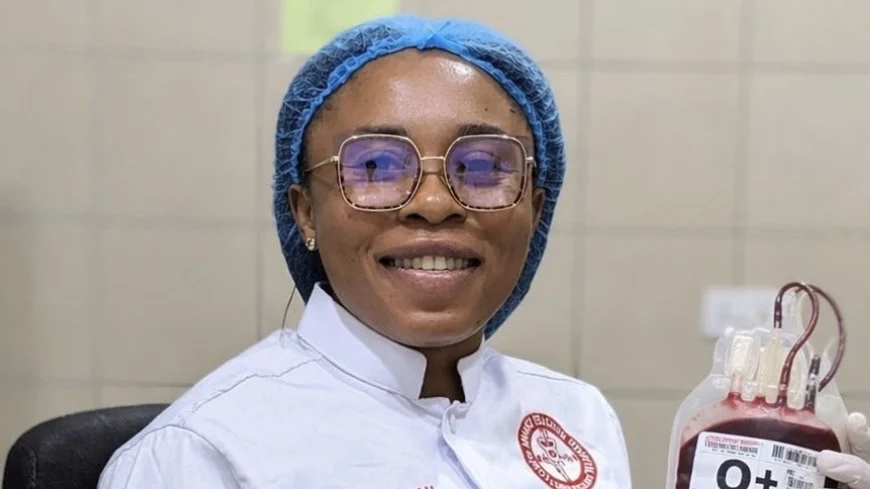
Gloria Duah: Can a Blood Transfusion Change Your Blood Type?
Gloria Duah, Doctor of Medical Laboratory Science at Komfo Anokye Teaching Hospital, Gender Children and Social Protection Minister of United Nations Youth Association-Ghana (UNYA-GH), shared a post on LinkedIn:
“Can a Blood Transfusion Change Your Blood Type?
The short answer is No, a blood transfusion does not permanently change your blood type.
Your blood type (A, B, AB, or O, and Rh positive or negative) is determined by genes inherited from your parents. These genetic markers are present on your red blood cells and are produced continuously by your body.
So what happens when you receive a blood transfusion?
When donor blood is transfused, those donor red blood cells temporarily circulate in your bloodstream alongside your own cells. For a short period, laboratory tests may detect both your cells and the donor’s cells, creating what we call a mixed-field reaction.
However, donor red blood cells have a limited lifespan. Over time, they are naturally removed from the circulation, and your body continues producing its own red blood cells with your original blood type.
For example….
A person with blood group O receives blood from a compatible donor during a transfusion.
Immediately after the transfusion, both the recipient’s and donor’s red blood cells are present in the bloodstream. But as the donor cells age and are cleared from the body, only the recipient’s own cells remain.
The person’s blood type is still the same as before the transfusion.
Now is there any exception?……mmmh yes
In very rare cases, such as a bone marrow or stem cell transplant, when a patient receives a transplant from a donor with a different blood type, their body produces both their original cells and the donor’s cells
In conclusion, a routine blood transfusion alone does not permanently change your blood type.
Have you ever heard someone say their blood type changed after receiving blood?”
Stay updated with Hemostasis Today.
-
Sep 19, 2026, 01:53Thomas Dayspring: Understanding Genome and Lipid Interactions in Lipidology
-
Sep 19, 2026, 01:47Abdurrahman Tufan: Combination Targeted Therapy in Refractory Systemic Autoinflammatory Diseases
-
Sep 19, 2026, 01:44Patrick James Lynch: Mother of a Thousand Sons Premieres at BDC 2026
-
Sep 19, 2026, 01:41Genetic Fate Mapping Reveals Endothelial Cells During Venous Thrombus Resolution – RPTH Journal
-
Sep 19, 2026, 01:39Mostafa Hammam: Three Different Platelet Defects – One Common Symptom
-
Sep 19, 2026, 01:38Jeff Sternlicht: A Heart Attack Should Not Be the Starting Line
-
Sep 19, 2026, 01:28Luis Oliverio Ambriz Garcia: Key Points From the ASH 2026 Guidelines on Iron Deficiency
-
Sep 19, 2026, 01:27Farjah Algahtani: A New Era in the Treatment of Transfusion-Dependent Thalassaemia
-
Sep 19, 2026, 01:24Aravind Palraj: 2025 EULAR Behçet’s Syndrome Update – 5 Practical Take-Home Points