

Hananiya Daniel: JAK2 V617F and the Molecular Diagnosis of Polycythemia Vera
Hananiya Daniel, Medical Laboratory Scientist at Federal Medical Center Keffi, shared a post on LinkedIn:
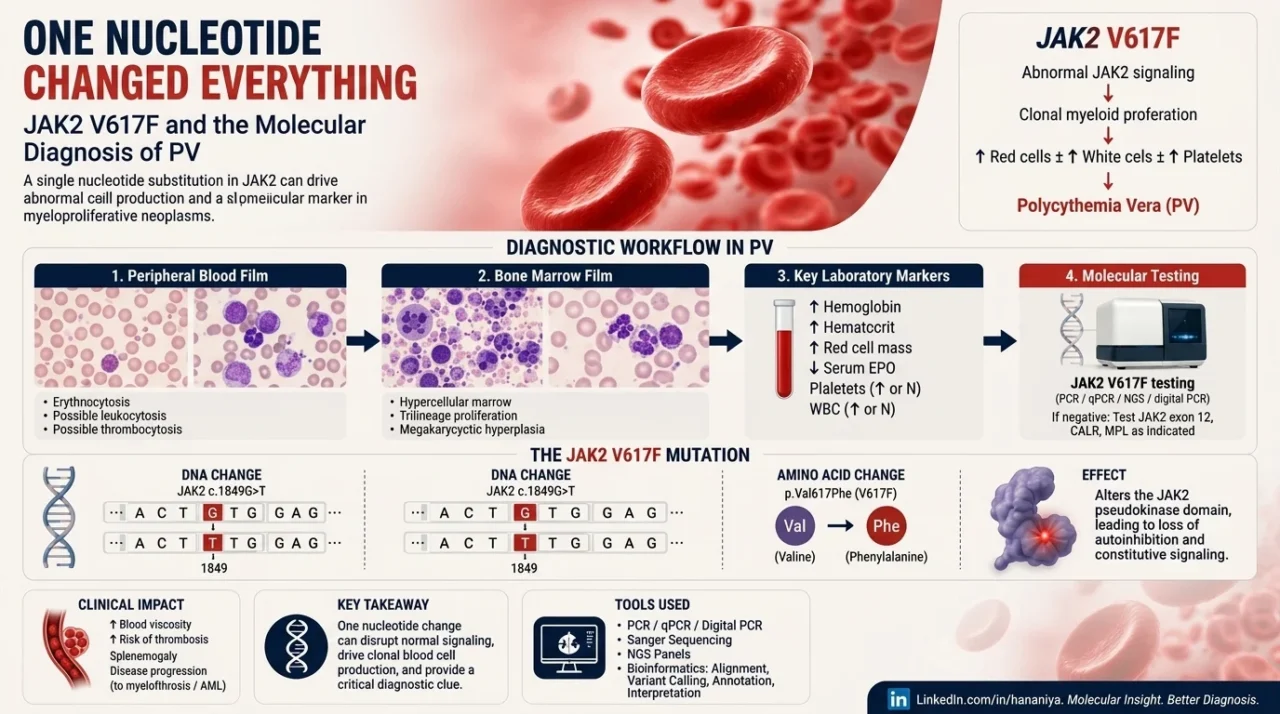
“One Nucleotide Changed Everything: JAK2 V617F and the Molecular Diagnosis of Polycythemia Vera
What if a single change in DNA could alter the way blood cells are produced?
One example in hematology is the JAK2 V617F mutation.
At the DNA level, it is a G>T substitution at JAK2 c.1849, resulting in a change in the protein from valine to phenylalanine at position 617 — V617F.
One of the most important diseases associated with JAK2 V617F is polycythemia vera (PV).
PV is a chronic myeloproliferative neoplasm in which the bone marrow produces excessive blood cells, particularly red blood cells. It can also involve increased white blood cells and platelets.
The abnormal JAK2 signaling promotes blood-cell production even when normal regulatory signals should limit it.
The result can be erythrocytosis, increased blood viscosity and an increased risk of complications such as thrombosis and bleeding.
The important biomarkers
- Elevated Hemoglobin (Hb)
- Elevated Hematocrit (Hct)
- Red-cell mass, where available
- Serum erythropoietin (EPO) — often reduced
- JAK2 V617F
- JAK2 exon 12 mutations in appropriate JAK2 V617F-negative cases
Bone-marrow morphology
Where does molecular biology come in?
JAK2 V617F can be investigated using molecular techniques such as:
- Allele-specific PCR (AS-PCR)
- Real-time quantitative PCR
- Digital PCR
- NGS panels
- Sanger sequencing in appropriate applications
The WHO has evaluated reference materials for JAK2 V617F testing across approaches including allele-specific quantitative PCR, digital PCR, ARMS-PCR and NGS.
And if JAK2 V617F is not detected, the investigation does not necessarily stop.
Depending on the clinical and laboratory picture, additional molecular testing may include JAK2 exon 12, CALR and MPL variants.
Bioinformatics can help with:
Sequence quality control – alignment – variant calling – annotation – variant interpretation
NGS-based approaches can identify variants across multiple genes and help characterize the molecular landscape of myeloid neoplasms.
This is where laboratory medicine and computational biology increasingly converge.
The laboratory tells us what is happening in the blood.
Molecular biology helps explain what may be happening at the genetic level.
Bioinformatics helps us interpret the genomic information.
And hematopathology helps put the findings into their biological and diagnostic context.
The bigger lesson
The fascinating thing about JAK2 V617F is not simply that we can detect a mutation.
It is that we can trace a biological pathway:
DNA substitution
JAK2 V617F protein alteration
Abnormal JAK2 signaling
Clonal myeloid proliferation
Erythrocytosis more or less leukocytosis/thrombocytosis
Clinical and laboratory investigation
Molecular evidence supporting MPN diagnosis
One nucleotide. One molecular change. A much bigger biological story.”
Stay updated with Hemostasis Today.
-
Oct 11, 2026, 12:11Carmine Siniscalchi: Could LDL Cholesterol Help Us Better Predict Bleeding Risk in Patients with VTE?
-
Oct 11, 2026, 12:03What is ITP? Raising Awareness for Immune Thrombocytopenia – ITP Australia and New Zealand
-
Oct 11, 2026, 11:55Gauri Jayasinghe: Privileged to Serve as Resource Person for the Blood Transfusion Essentials Programme
-
Oct 11, 2026, 11:49Toby Richards: New Definitions for Iron Deficiency Delighted to Be in the USA with the New ASH Guidelines
-
Oct 11, 2026, 11:44Lesley Van Wyk: ASCP High-Yield Review – Essential Thalassemia Concepts and Differential Diagnosis
-
Oct 11, 2026, 11:37Susanne Pass: Key Takeaways from ESVS 2026 Workshops in Belgrade
-
Oct 11, 2026, 10:44Logesh. M: Managing Warfarin-Associated Recurrent Epistaxis and Anticoagulant Safety
-
Oct 11, 2026, 10:28Sébastien Béland: Validating RUDAS for Detecting Neurocognitive Impairment in Sickle Cell Disease
-
Oct 10, 2026, 17:58Archo Farzana Batool: Exploring Medical Writing Through an Article on Iron Deficiency Anemia