


Ifeanyichukwu Ifechidere: DOAC Interference in Coagulation Tests – Are You Spotting It?
Ifeanyichukwu Ifechidere, Specialist Biomedical Scientist at Sheffield Teaching Hospitals NHS Foundation Trust, shared a post on LinkedIn:
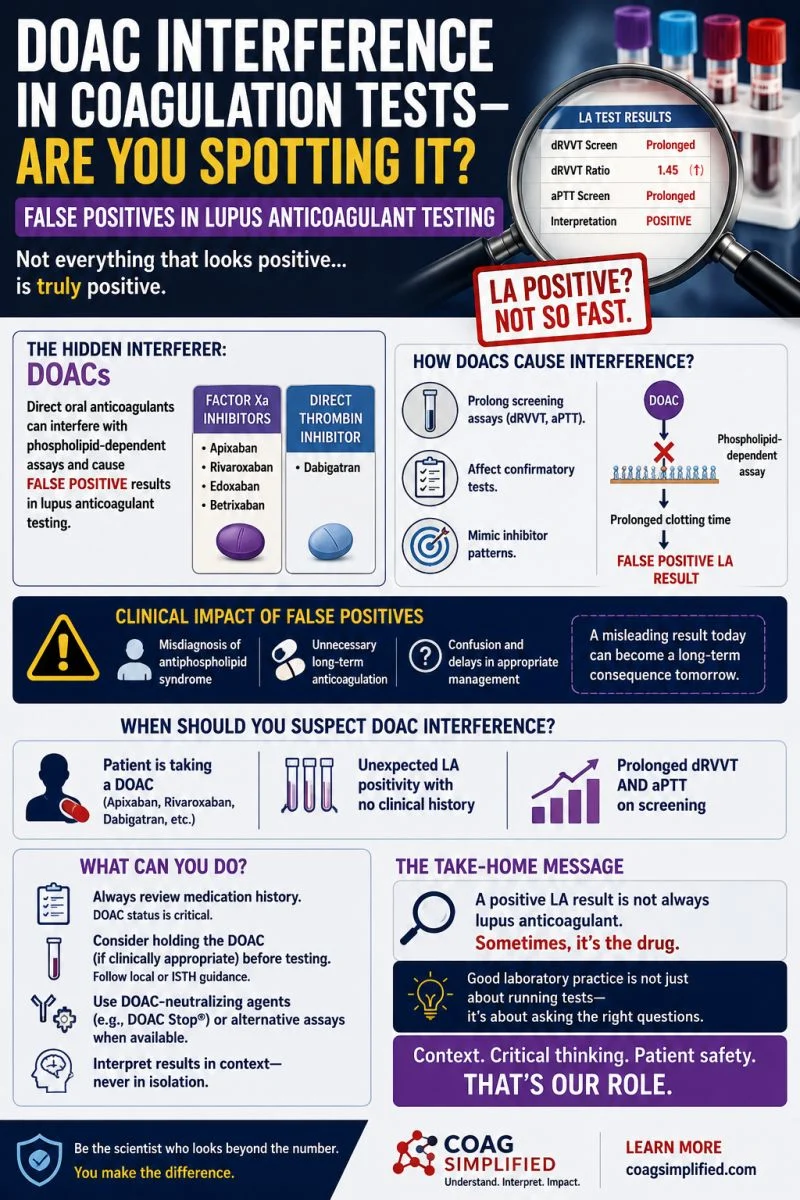
“That ‘positive’ lupus anticoagulant result… might not be real.
And if you don’t catch it, you could be part of a misdiagnosis.
Let me talk to you — the biomedical scientist reviewing that coag screen. You run a lupus anticoagulant panel.
dRVVT ratio? – Prolonged.
APTT-based test? – Also prolonged.
‘Positive for LA,’ right?
Not so fast.
Is the patient on a DOAC?
Because here’s what many don’t realise:
Direct oral anticoagulants (DOACs) — especially factor Xa inhibitors and direct thrombin inhibitors — can significantly interfere with phospholipid-dependent assays.
And the result? – False positives in lupus anticoagulant testing
I’ve seen it happen:
- Patients labelled as having antiphospholipid syndrome
- Unnecessary long-term anticoagulation decisions
- Clinical confusion…
All based on a misleading lab result
Here’s what should trigger your suspicion:
- Unexpected LA positivity with no clinical history
- Prolonged dRVVT and APTT in a patient on apixaban, rivaroxaban, or dabigatran
- Inconsistent confirmatory testing patterns
Because DOACs can:
- Prolong screening assays
- Affect confirmatory steps
- Mimic inhibitor patterns
And suddenly, your ‘LA positive’ isn’t a lupus anticoagulant at all…
It’s drug interference.
So before you validate that result, ask:
- ‘Do I know the anticoagulation status of this patient?’
- ‘Should this test have been performed while on a DOAC?’
- – ‘Do we need DOAC-neutralisation or alternative strategies?’
Because in coagulation…
Context isn’t optional — it’s everything.
This is the level of thinking that separates running tests from truly understanding them.
If you want to get better at spotting interferences, interpreting complex results, and protecting patients from misleading data…
I break it down with real case studies Simple, practical interpretation frameworks. No jargon. Just clarity. Because not every abnormal result is pathology. Sometimes… it’s the test being fooled.”
Other posts featuring Ifeanyichukwu Ifechidere on Hemostasis Today.
-
Sep 19, 2026, 14:17Abdul Mannan: What Exactly Is a Platelet?
-
Sep 19, 2026, 13:39Keisuke Goda: Decoding Platelet Phenotypes in COVID-19 With Optofluidic Imaging
-
Sep 19, 2026, 13:30Targeted Thrombolysis Beyond tPA
-
Sep 19, 2026, 13:21Paul Armstrong: From Summer Studentship to Young Researcher
-
Sep 19, 2026, 13:06Rabiya Masood: Breaking the Cycle of Thalassemia Through Screening
-
Sep 19, 2026, 10:52Consuela A. Albright: The Critical Role of Black Blood Donors in Sickle Cell Treatment
-
Sep 19, 2026, 10:47Amber Yates: Inside Agios’ Partnership with the Sickle Cell Community
-
Sep 19, 2026, 10:46Anton Farkas: Mechanical Thrombectomy for Acute PE in Early Pregnancy
-
Sep 19, 2026, 10:40Marjolein Smidt: ASH Raises Ferritin Thresholds for Iron Deficiency