


Ifeanyichukwu Ifechidere: Nobody Talks About Thrombosis in Sickle Cell Disease
Ifeanyichukwu Ifechidere, Specialist Biomedical Scientist at Sheffield Teaching Hospitals NHS Foundation Trust, shared a post on LinkedIn:
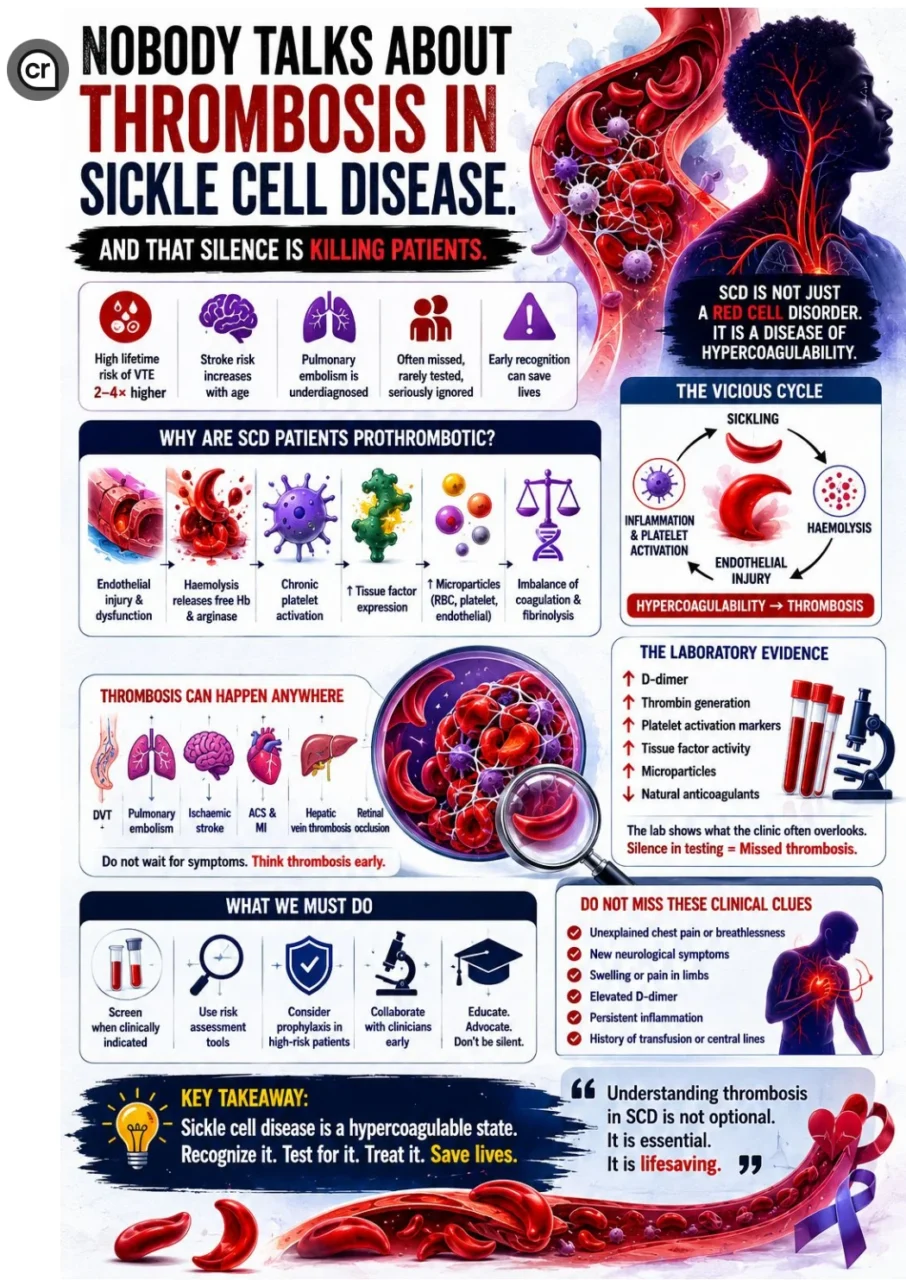
“Nobody talks about thrombosis in sickle cell disease. And that silence is killing patients.
We obsess over the vaso-occlusive crisis. The pain. The anaemia. The sickling.But the hypercoagulable state quietly running underneath?
Undertested.
Underreported.
Frequently missed until it’s catastrophic.
Let’s fix that.
Why Sickle Cell Disease Is a Pro-Thrombotic Disease?
Sickle cell disease (SCD) is not just a haemoglobin disorder— it is a chronic inflammatory, pro-coagulant state baked into the pathophysiology.
Multiple mechanisms drive thrombosis risk simultaneously:
Endothelial dysfunction— repeated sickling events damage the vascular endothelium, shifting it from anticoagulant to procoagulant.
Exposed subendothelial collagen activates platelets. Von Willebrand Factor (vWF) release skyrockets.
Phosphatidylserine externalisation— sickled RBCs flip their membrane asymmetry, exposing phosphatidylserine on the outer leaflet. This is a potent surface for tenase and prothrombinase complex assembly— accelerating thrombin generation dramatically.
Chronic haemolysis — intravascular haemolysis releases free haemoglobin and arginase, scavenging nitric oxide (NO). Without NO, vasodilation fails, platelet activation increases, and procoagulant deepens.
Platelet activation— SCD patients have chronically activated platelets, even at baseline.
P-selectin expression is elevated. Platelet-neutrophil aggregates form and fuel immunothrombosis.
Tissue Factor upregulation— circulating monocytes and microparticles shed TF, amplifying the extrinsic coagulation pathway beyond normal physiological bounds.
What the Laboratory Sees
In SCD patients, routine coagulation screens are frequently normal or shortened— not prolonged. This confuses clinicians who expect abnormality.
Thrombin-antithrombin (TAT) complexes, D-dimer, and prothrombin fragments 1+2 are often high at baseline— evidence of ongoing thrombin generation even between crises.
TEG/ROTEM typically shows a hypercoagulable trace: shortened clot initiation time, increased clot strength, reduced fibrinolysis.
This is not a bleeding disorder waiting to happen.
This is a smouldering thrombotic engine.
The Clinical Consequences
Stroke affects up to 11% of SCD patients by age 20
PE is a leading cause of death in adults with SCD
Silent cerebral infarcts occur in over 35% of children— with normal neurological exams DVT rates are 25–50× higher than the general population
And yet— thromboprophylaxis strategies in SCD remain poorly standardised. Anticoagulation decisions are often reactive, not proactive.
The Takeaway for Laboratory Scientists and Clinicians
When you receive a coagulation request on a sickle cell patient, think beyond the PT and APTT.
Ask: Is this patient in a hypercoagulable state?
What is the context— baseline, crisis, post-surgical?
Sickle cell disease deserves the same haemostasis literacy we apply to APS, DIC, and liver disease.
The mechanisms are there. The evidence is there.
Now it’s time for the awareness to catch up.”
Find more posts featuring Ifeanyichukwu Ifechidere on Hemostasis Today.
-
Sep 18, 2026, 01:35Matthew Hazell: From Platelet Refractoriness to Protecting Transplanted Organs
-
Sep 18, 2026, 01:23Apple Joy A. Valenzuela: Exploring How Neutrophil Develops from the Myeloblast to the Mature Segmented Neutrophil
-
Sep 18, 2026, 01:13Su Someh: Gaps and Variation in Global Plasma Donor Protection Policies
-
Sep 18, 2026, 01:03Joseph R. Shaw: Study Questions Blanket “No-Bridging” Strategy for Mechanical Heart Valves
-
Sep 17, 2026, 20:38Konstantinos Bistas: Reduced Circulating Tregs in Pediatric Chronic Neutropenia
-
Sep 17, 2026, 15:33Gopal Patidar: Honoured to Contribute to the ASFA 2026 Guidelines for Therapeutic Apheresis
-
Sep 17, 2026, 20:36Cosima C. Hoch: Developing a 3D Organotypic Co-Culture Model for Pleomorphic Adenoma
-
Sep 17, 2026, 20:19Riten Kumar: Boston Children’s Hospital Ranked No. 1 in Seven Pediatric Specialties
-
Sep 17, 2026, 20:17Katrina Snow: Whole Blood or Component Therapy – Which Would You Choose?