


Ifeanyichukwu Ifechidere: DOAC Monitoring – What To Order, When, And Why
Ifeanyichukwu Ifechidere, Specialist Biomedical Scientist at Sheffield Teaching Hospitals NHS Foundation Trust, shared a post on LinkedIn:
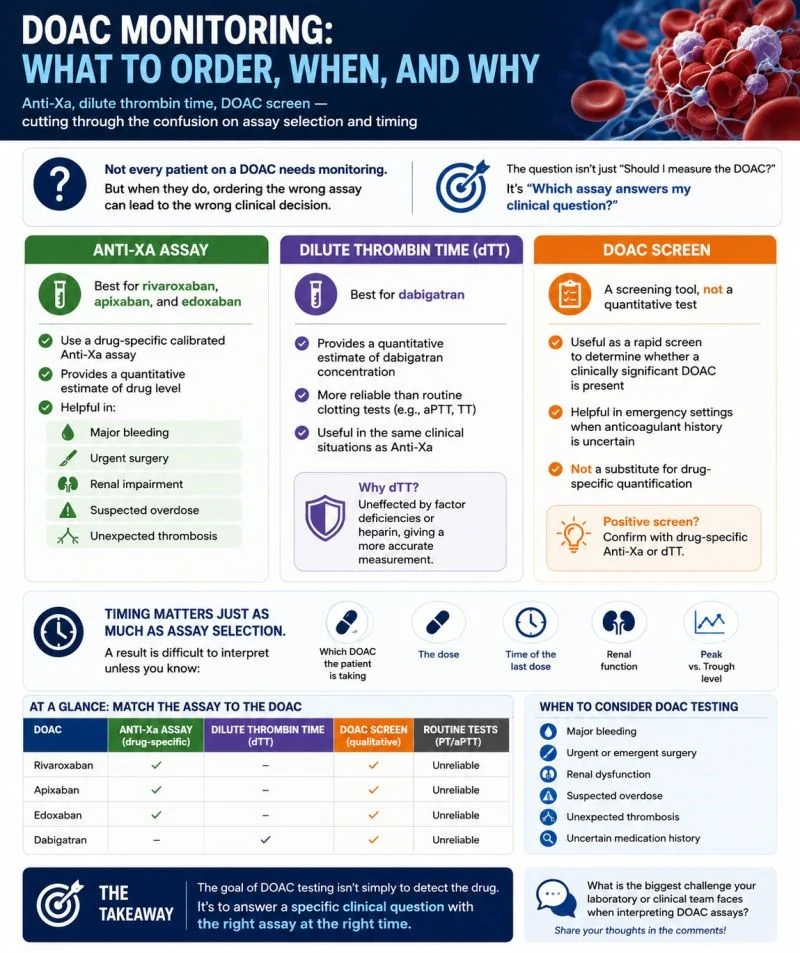
“Not every patient on a DOAC needs monitoring.
But when they do, ordering the wrong assay can lead to the wrong clinical decision.
This is where many clinicians-and even laboratories-get caught out.
The question isn’t just ‘Should I measure the DOAC?’
It’s ‘Which assay answers my clinical question?’
Here’s a simple way to think about it:
- Anti-Xa assay
- Best for rivaroxaban, apixaban, and edoxaban
- Use a drug-specific calibrated Anti-Xa assay
- Helpful in major bleeding, urgent surgery, suspected overdose, renal impairment, or unexpected thrombosis.
Dilute Thrombin Time (dTT)
- Best for dabigatran
- Provides a quantitative estimate of dabigatran concentration.
- More reliable than routine clotting tests.
DOAC Screen
- Useful as a rapid screening tool to determine whether a clinically significant DOAC is present.
- Helpful in emergency settings when the anticoagulant history is uncertain.
- It is not a substitute for drug-specific quantification.
And here’s the part that’s often overlooked…
Timing matters just as much as assay selection.
A result is difficult to interpret unless you know:
- Which DOAC the patient is taking
- The dose
- The time of the last dose
- Renal function
- Whether you’re measuring a peak or trough level
Without that context, even the ‘right’ test can produce a misleading interpretation.
The takeaway:
The goal of DOAC testing isn’t simply to detect the drug.
It’s to answer a specific clinical question with the right assay at the right time.
What is the biggest challenge your laboratory or clinical team faces when interpreting DOAC assays?”
Find more posts featuring Ifeanyichukwu Ifechidere on Hemostasis Today.
-
Sep 30, 2026, 15:58Bernhard Merget: New Frontiers in Thrombosis and Stroke Research
-
Sep 30, 2026, 15:39Ifeanyichukwu Ifechidere: The Molecular Orchestra of Primary Hemostasis
-
Sep 30, 2026, 15:28Reassessing the Benefit–Risk Balance of Extended Anticoagulation in Cancer Patients – ESC Working Group on Cardiovascular Pharmacotherapy
-
Sep 30, 2026, 15:07Chiranjeev Sharma: Targeting Factor XIa with the Synthetic Inhibitor SB-01
-
Sep 30, 2026, 14:41Bruna Gigante: Balancing Thrombosis and Bleeding in Cardiovascular Care
-
Sep 30, 2026, 14:13Ashok Choudhury: Portal Vein Thrombosis and Outcomes in Cirrhosis
-
Sep 30, 2026, 13:57Leslye Conde Bazán: When Conventional Imaging Is Not Enough – The Role of IVUS
-
Sep 30, 2026, 13:41Huda Salah Eldin: The Challenge of Balancing Antithrombotic Therapy After PCI
-
Sep 30, 2026, 13:29Abdus Salam: What Can CT Venography Reveal About the Veins?