


Kate Grushetzkaya: The Essential Flow Cytometry Checklist – 6 Steps to Better Data
Kate Grushetzkaya, Flow Cytometry Specialist at Fred Hutch, shared a post on LinkedIn:
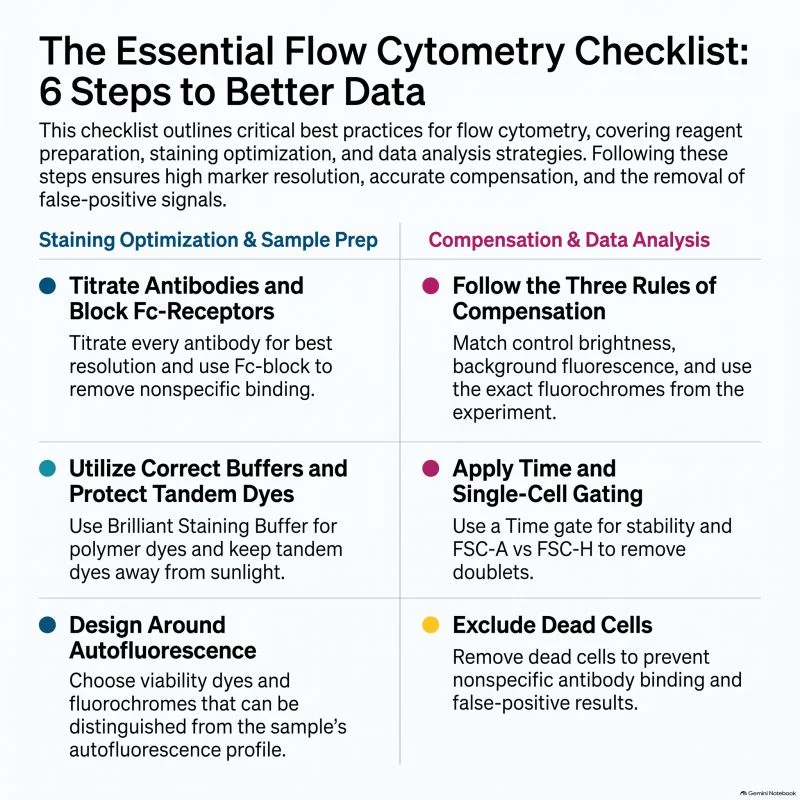
“Planning Flow Cytometry experiment? There is a checklist for you.
1. Titrate every antibody, don’t rely on the vial recommendation. Calculate Stain index and chose the best marker resolution for every color.
2. Block before you stain: use an Fc-receptor block rteagent to remove Fc-mediated nonspecific antibody binding.
3. When using more than one multiple Brilliant Violet (polymer) dyes in your panel, include an appropriate Brilliant Staining Buffer in the workflow.
4. Protect tandem dyes from sunlight: tandem-dye degradation can compromise compensation or unmixing.
5. Follow the three rules of compensation:
- Single-stained positive controls should be at least as bright as the corresponding signal in the experimental sample or brighter.
- Match background fluorescence between the positive and negative populations: bead controls should have negative beads, and cell controls should have matched negative cells.
- For single stained control, use the exact fluorochrome used in the experiment.
6.Design around autofluorescence, especially in myeloid samples: choose viability dyes and marker fluorochromes with signatures that can be distinguished from the autofluorescence profile.
7.Make the ‘Time gate’ your first quality-control gate: before interpreting biology, inspect the time parameter and gate on the stable interval.
8.Gate on single cells FSC-A vs. FSC-H plot: remove doublets from the analysis as they can cause false-positive signals or skewed populations.
9.Exclude dead cells: dead cells bind antibodies nonspecifically and can appear falsely positive across multiple parameters.
Did I miss something?”
Stay updated with Hemostasis Today.
-
Sep 20, 2026, 16:32New Episode of The Hematologist Podcast – ASH
-
Sep 20, 2026, 16:26Thomas Schinecker: A New Era for Health Innovation – Inside the Roche Genentech Innovation Center
-
Sep 20, 2026, 16:19Astha Srivastava: The Missing Megakaryocytes in Amegakaryocytic Thrombocytopenia
-
Sep 20, 2026, 16:19Heghine Khachatryan: An Elegant Example of Precision Thrombolysis – Targeting the Scaffold of Microvascular Thrombosis
-
Sep 20, 2026, 16:01Mohamed Ismail: Managing Extensive Iliofemoral and Inferior Vena Cava DVT
-
Sep 20, 2026, 15:58Can αIIbβ3 Receptor Play a Role in Platelet Production – Glanzmann’s Research Foundation
-
Sep 20, 2026, 15:46Alexsander Santiago: Evaluating Clinical Harm from Missing versus Overdiagnosing HIT
-
Sep 20, 2026, 15:28Nico Gagelmann: iMTSS to Dissect the Drivers of Post-Transplant Outcomes
-
Sep 20, 2026, 15:10Ashenafi Tazebew Amare: Building the Future of Blood and Specialized Healthcare