


Luis Tam։ New CDC Global Health Security Funding Opportunities
Luis Tam, Global health and business development consultant for FBOs and NGOs, shared a post on LinkedIn:
“Nigeria, Ethiopia, Ghana, Tanzania, Senegal, Sierra Leone, and Indonesia: Global Health Security funding opportunities from US Centers for Disease Control
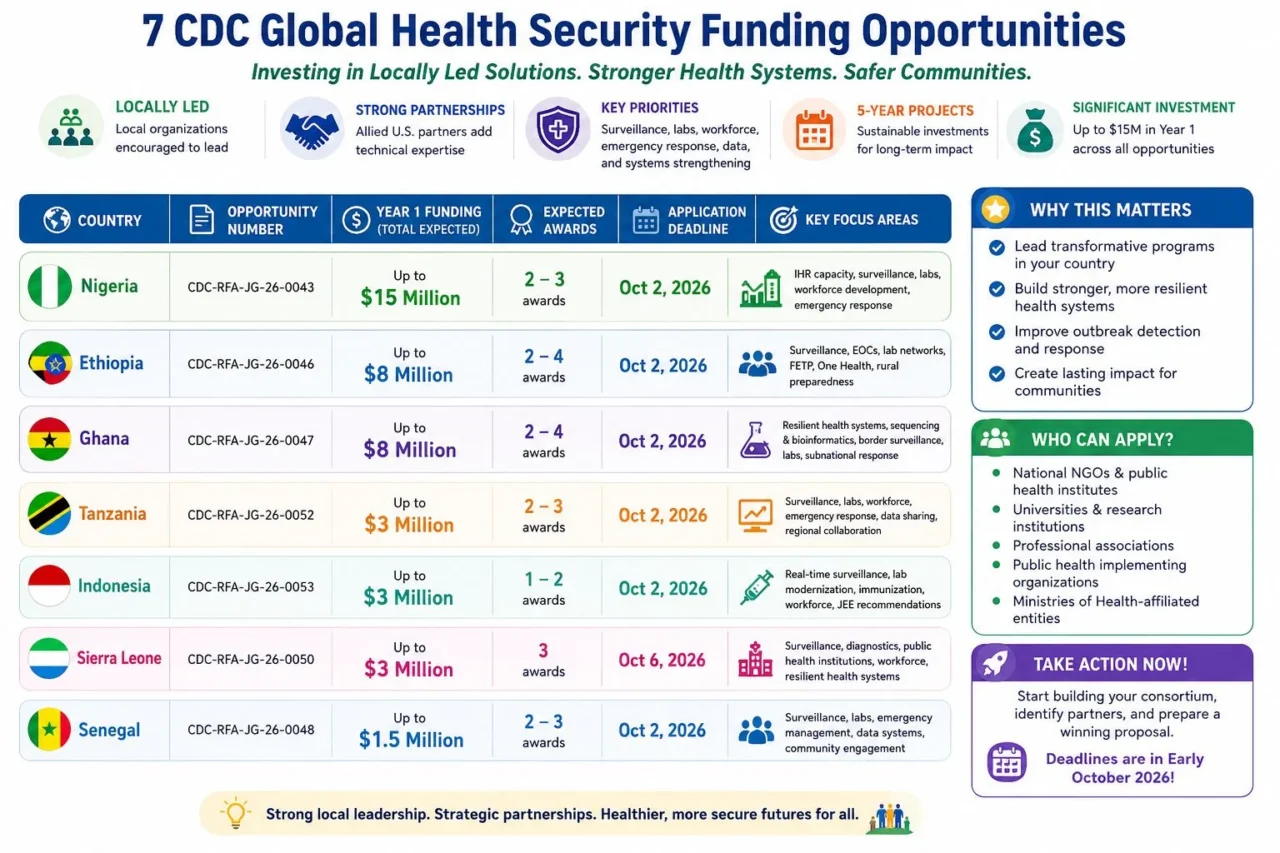
The U.S. CDC has just released seven new Global Health Security funding opportunities for organizations in Nigeria, Ethiopia, Ghana, Tanzania, Senegal, Sierra Leone, and Indonesia.
Together, these five-year cooperative agreements represent a significant investment in strengthening national public health systems-and, most importantly, they place local leadership at the center.
Attached is a summary of these 7 opportunities. You can find each of the 7 country-specific notices.
For organizations that have long demonstrated their ability to deliver results, this is a chance to move beyond being implementing partners and become lead applicants.
The grants focus on priorities that are critical for every country’s health system: strengthening disease surveillance, modernizing laboratories, developing the public health workforce, improving emergency preparedness and response, enhancing health information systems, and building stronger partnerships across sectors.
Funding is substantial. Nigeria alone offers up to US$15 million in first-year funding, while Ethiopia and Ghana each offer US$8 million.
Tanzania, Indonesia, and Sierra Leone each provide approximately US$3 million, and Senegal offers US$1.5 million.
Most opportunities will support projects over five years, providing the stability needed to build sustainable capacity rather than short-term interventions.
Moreover, CDC provides 15 bonus points – which add to the maximum of 100 – to consortia led by local organizations.
I believe one of the most important messages in these announcements is that local organizations should lead whenever possible.
International partnerships remain valuable, but they are strongest when they complement local expertise rather than replace it.
Universities, NGOs, research institutions, and technical organizations headquartered in the United States can add tremendous value through specialized expertise in laboratory systems, digital health, workforce development, monitoring and evaluation, implementation science, and grants management.
For local organizations considering these opportunities, now is the time to identify strategic partners, strengthen consortiums, and begin proposal development.
The application deadlines are in early October 2026, leaving only a short window to prepare competitive submissions.”
David McIntosh, Founder and Chair of United Plasma Action, shared this post on LinkedIn, adding:
“With tight timeliness, this is an opportunity that probably needs swift responses…”
Other posts featuring David McIntosh on Hemostasis Today.
-
Sep 21, 2026, 03:49Jessica Lee: Walking Together for a Stronger Bleeding Disorders Community
-
Sep 21, 2026, 03:36Syed Asif Ali Shah: From Pakistan to Australia – A Clinical Haematology Milestone
-
Sep 21, 2026, 03:22Katie Baca-Motes: Estradiol Fluctuations May Help Explain Menstrual Migraine
-
Sep 21, 2026, 03:00Family History Can Reveal Hidden Risk of Aortic Dissection – The Marfan Foundation
-
Sep 21, 2026, 02:47Transitioning from Paediatric to Adult Haemophilia Care – Haemophilia Foundation Australia
-
Sep 21, 2026, 02:29Diana Castro Paupério: A New Era for Patient Blood Management
-
Sep 21, 2026, 00:29Iheanyichukwu Ike: Childhood Anaemia in Nigeria Through an Analysis of the 2018 NDHS
-
Sep 21, 2026, 00:27Nicole De Vita: The Global Burden of Iron Deficiency and Anemia in Women at SABM
-
Sep 21, 2026, 00:25Giuseppe Panuccio: IVUS and OCT Guidance Reduce MACE and Stent Thrombosis in Calcified Coronary Lesions