


Meghanath Yenni/LinkedIn
Aug 4, 2026, 17:03
Meghanath Yenni: Anticoagulant Reversal in Clinical Practice
Meghanath Yenni, Consultant Physician at Medicover Hospitals, shared a post on LinkedIn:
”Anticoagulant Reversal in Clinical Practice:
As anticoagulant use continues to increase, clinicians are encountering more patients with major bleeding, intracranial hemorrhage, and urgent procedures requiring rapid reversal.
A recent 2026 New England Journal of Medicine review provides a practical, evidence-based update on the currently available antidotes and how they should be used.
- Reserve reversal agents for life-threatening or uncontrolled bleeding, or when emergency surgery cannot be delayed.
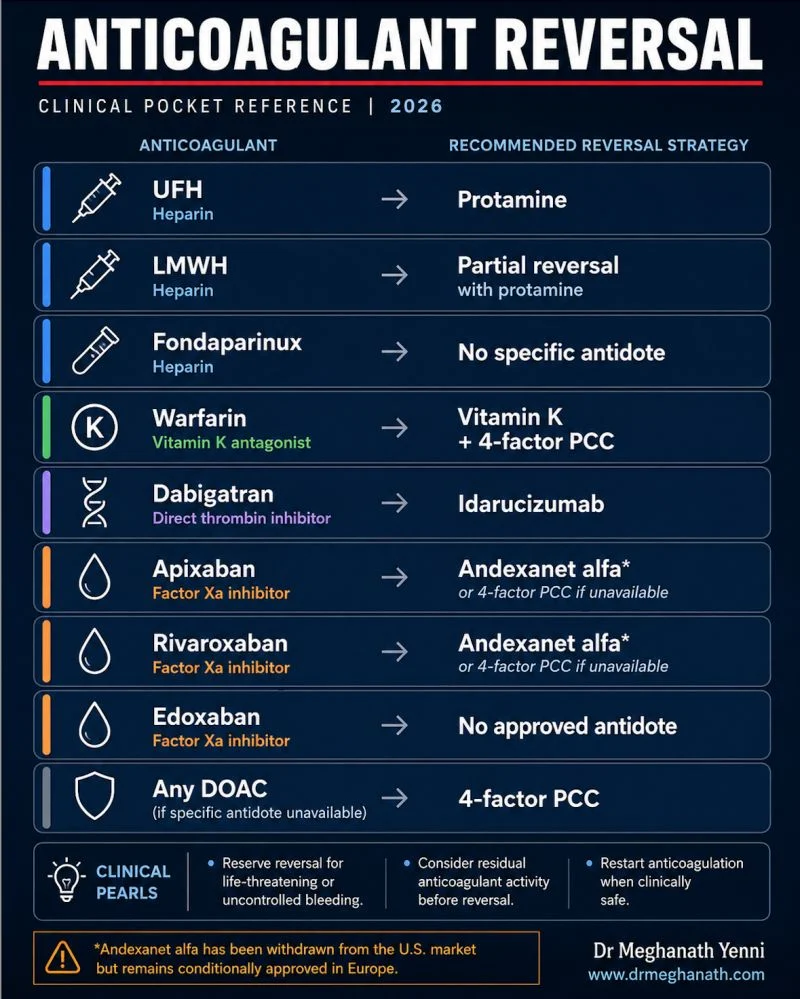
- Warfarin: Rapid reversal requires IV vitamin K plus 4-factor prothrombin complex concentrate (4F-PCC).
- Unfractionated heparin: Protamine remains the antidote of choice. It partially reverses LMWH and has no effect on fondaparinux.
- Dabigatran: Idarucizumab provides rapid, specific reversal, although delayed dabigatran rebound may occur in some patients.
- Factor Xa inhibitors (apixaban/rivaroxaban): Andexanet alfa provides targeted reversal in carefully selected patients but should be used judiciously because of thrombotic risk, cost, and limited indications. 4F-PCC remains the most widely used nonspecific alternative when andexanet is unavailable or unsuitable.
Before administering any antidote, ask four essential questions:
- Is the bleeding truly life-threatening?
- Is clinically significant anticoagulant still present?
- Can the procedure safely be delayed?
- Does the patient’s thrombotic risk outweigh the benefit of reversal?
As newer anticoagulants become increasingly common, understanding when—and when not—to reverse anticoagulation is becoming just as important as knowing which antidote to use.”
Stay updated with Hemostasis Today.
-
Sep 29, 2026, 12:02Hajra Malik: Bridging Language Gaps in Hematology With AI
-
Sep 29, 2026, 11:57Joan Montaner: Can Blood Test Identify Intracerebral Hemorrhage Within Minutes?
-
Sep 29, 2026, 11:43From Years Without Answers to Life With Hemophilia Care – WFH
-
Sep 29, 2026, 11:32Sara Al Dallal: Transforming Hemophilia Care Across the Gulf
-
Sep 29, 2026, 11:21Richard Davis: Rapid Rescue in Massive Pulmonary Embolism
-
Sep 29, 2026, 11:14Nissan Brown: Every Step Counts for the Hemophilia Community
-
Sep 29, 2026, 11:03Zain Khalpey: SINGLE AF Adds New Evidence to the Anticoagulation Debate
-
Sep 29, 2026, 10:54How Does Haemophilia Affect Motor Development in Infants? – EAHAD
-
Sep 29, 2026, 10:49Alison Davey: The Vital Role of Community Support in Bleeding Disorders