

Miguel Brito: Newborn Screening and Challenges in Follow-Up Care for Sickle Cell Disease in Angola
Miguel Brito, Research Coordinator at H&TRC – Health and Technology Research center, shared post on LinkedIn about a recent article he and his colleagues co-authored, adding:
”Highlights
Newborn screening of 13,000+ infants in Luanda, Angola, identified a sickle cell disease prevalence of 1.38%.
Sickle cell trait was common, affecting 20.31% of screened newborns.
Follow-up of diagnosed patients is challenging due to low disease literacy and socioeconomic barriers.
With: Catarina Ginete , Baba Inusa, Jocelyne Neto de Vasconcelos NBS and paper with the support of Arise Initiative.
And the support of Revvity for Diagnostics and H&TRC – Health and Technology Research Center”
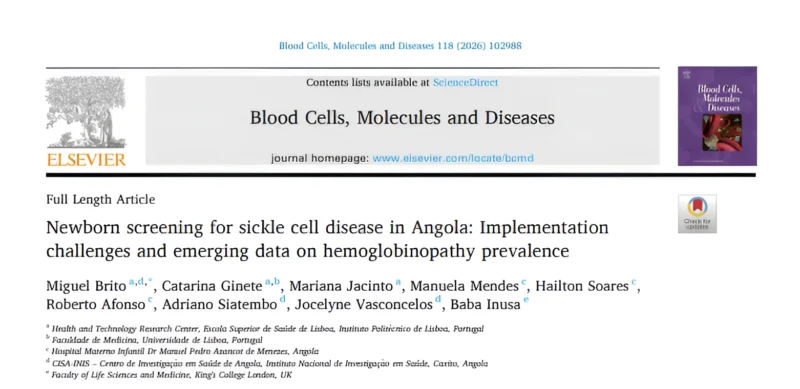
Title: Newborn screening for sickle cell disease in Angola: Implementation challenges and emerging data on hemoglobinopathy prevalence
Authors: Miguel Brito, Catarina Ginete, Mariana Jacinto, Manuela Mendes, Hailton Soares, Roberto Afonso, Adriano Siatembo, Jocelyne Vasconcelos, Baba Inusa
Read the Full Article on Blood Cells, Molecules and Diseases
Stay updated with Hemostasis Today.
-
Oct 11, 2026, 22:40Bahram Alamdary Badlou: Platelets as First Responders in Hemostasis, Immunity, and Inflammation
-
Oct 11, 2026, 22:22Vipin Singh: New Publication on Hippo-YAP Signaling and Platelet Activation
-
Oct 11, 2026, 22:21Trygve Berge: New AFNOR Paper on AF-related Stroke in Norway
-
Oct 11, 2026, 22:09Omar Alomari: Our New Publication on Apixaban vs Rivaroxaban for VTE
-
Oct 11, 2026, 21:22Shayan Roshan: Happy to Share Two Research Milestones in Trauma Care and Pancreatic Cancer
-
Oct 11, 2026, 21:16Chokri Ben Lamine: Anemia in Myelofibrosis – Multiple Mechanisms, Limited Responses
-
Oct 11, 2026, 21:03Carmela Walker: Supporting Warriors Living With SCD Through Dental Care and Advocacy
-
Oct 11, 2026, 21:00Rishdha Roshad: Intraoperative Cell Salvage – Turning Blood Loss into an Opportunity for Recovery
-
Oct 11, 2026, 20:59Anthony R. Sloan: Honored to Share Our Work at the 20th Midwest Platelet Conference