


Mike R.։ VTE Thrombectomy – Defining What Success Really Means
Mike R., Sales Executive and National Trainer at Argon Medical Devices, Inc., Board Member at Concinnity Labs AI, shared a post on LinkedIn:
“VTE thrombectomy exploded over the last decade. Three things still haven’t caught up, and they stack on each other.
I’ve been in close to a 1,000 VTE cases, PE and DVT both. I’ve watched patients walk out of the hospital who I don’t believe historically would have otherwise.
That part is meaningful progress. But here is what I keep running into when speaking with phsyicians.
First, we haven’t defined success. In my experience for both PE and DVT, restoring some flow isn’t enough. In DVT, neither is opening the outflow alone.
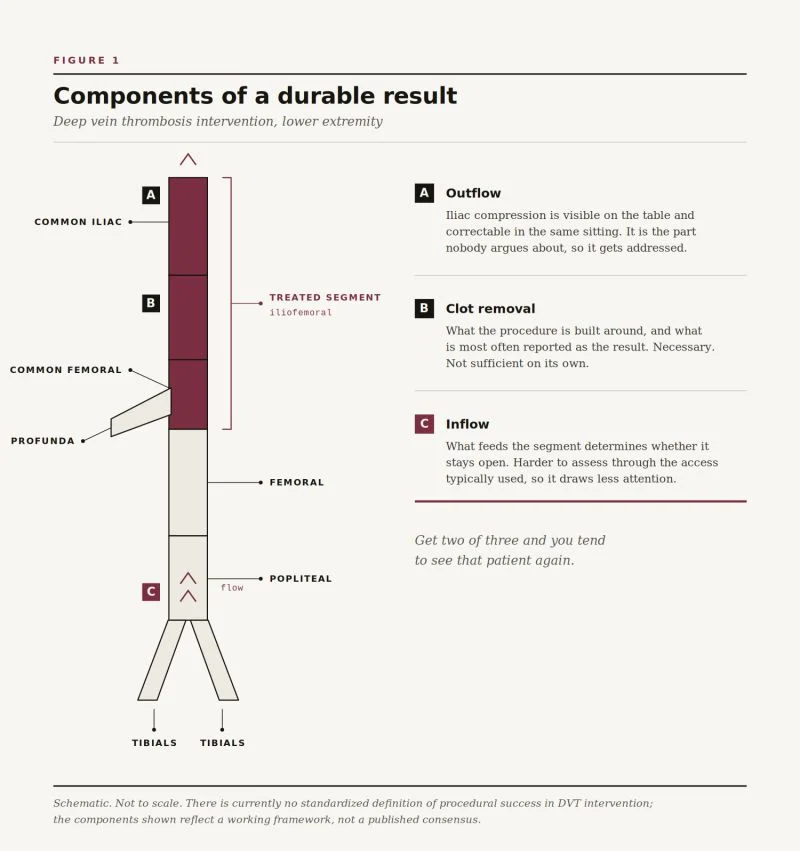
Focusing on DVT: Long term patency and PTS reduction come from three things together. Clearing the clot. Restoring outflow. Confirming inflow. Get two of three and you tend to see that patient again.
None of that is standardized. There’s no common language for it, which means two operators can describe the same case as a success and mean entirely different things.
Second, the evidence hasn’t caught up. Nearly a decade into treating this aggressively, the first randomized comparison of mechanical thrombectomy against anticoagulation alone still hasn’t reported.
The randomized evidence we do have comes from lytic-based approaches and it’s mixed. The rest is registry and retrospective data.
Which means hospitals have little solid ground to build protocols on, and practice stays operator dependent.
Third, there’s almost no comparative data. A lot of devices are competing for the same patients now, and there is very little head to head evidence on the three things that actually drive durability.
Device selection often comes down to familiarity, contracting, and who happens to be in the room.
Those aren’t three separate problems. They’re sequential.
You can’t build evidence without agreeing what you’re measuring.
You can’t compare devices without evidence.
And you can’t write a protocol on any of it until the first two exist.
Cardiology went through this. TIMI flow gave every operator a shared scale for describing what happened in the case. It wasn’t perfect.
Reproducibility between readers was soft enough that the field built more objective measures on top of it.
But those measures were built on that foundation, and having a common language is what let results be compared at all.
VTE still needs that foundation.
A defined standard of success built on what actually gets a patient back to baseline.
Clot removal.
Outflow.
And in my experience, equally important, inflow.”
Stay updated with Hemostasis Today.
-
Oct 9, 2026, 13:11Ayshathul Noora։ Carbetocin vs Oxytocin in Preventing Postpartum Hemorrhage
-
Oct 9, 2026, 13:07The Rebalanced Patient: New Therapies and New Thrombotic Risks in Hemophilia
-
Oct 9, 2026, 12:48Santiago Cepeda Chafla: CereBleed Simplifies Brain Hemorrhage Assessment
-
Oct 9, 2026, 12:34Abdul Muqtadir Abbasi: Pancytopenia Is a Finding, Not a Diagnosis
-
Oct 9, 2026, 12:24Mercy Lung’aho: When Diet Quality and Nutritional Biomarkers Tell Different Stories
-
Oct 9, 2026, 12:22Eugene Fan: Bridging Therapeutic Breakthroughs and Equitable Thalassaemia Care
-
Oct 9, 2026, 12:14Brittany Busse: A New Focus on Iron Deficiency Before Anemia
-
Oct 9, 2026, 12:13Akshat Jain: A New Textbook Bringing Global Perspectives on Sickle Cell Disease
-
Oct 9, 2026, 12:03Heather Case: Bridging Awareness and Action in Women’s Hemophilia Care