


Santiago Cepeda Chafla: CereBleed Simplifies Brain Hemorrhage Assessment
Santiago Cepeda Chafla, Neurosurgery Consultant at Río Hortega University Hospital, shared a post on LinkedIn։
”Many thanks to Christopher Kellner and Jack Haslett for inviting me to write a short piece for the News section of World Neurosurgery.
Most scales for intracerebral hemorrhage rely on subjective elements.
Deep learning methods, on the other hand, classify the type of bleed or measure its volume.
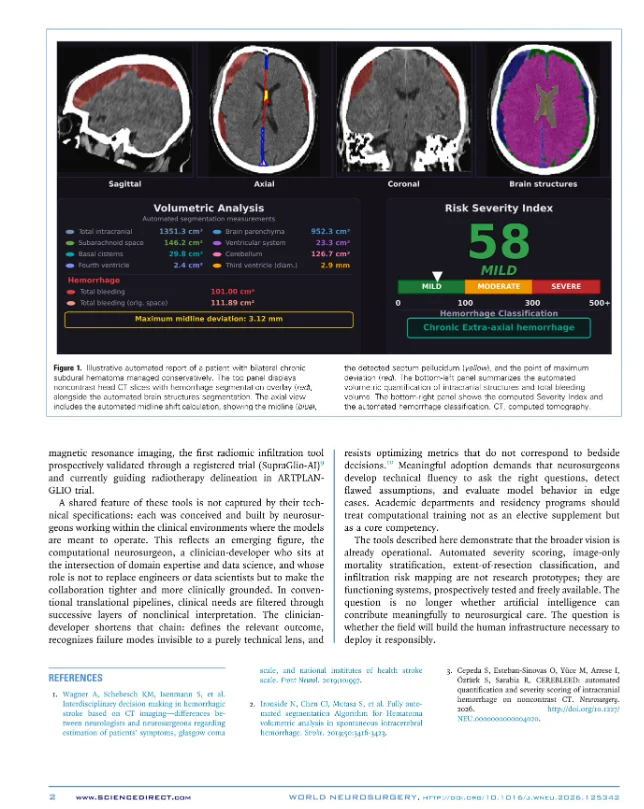
CereBleed goes one step further: it turns hemorrhage severity into a single number.
In a way, it is the Glasgow scale of imaging.
A common language for emergency physicians, radiologists, intensivists and neurosurgeons.
This is especially useful when the neurosurgeon is on call from home. It can also help avoid unnecessary transfers.
No more long narrative reports.
No more ambiguous wording.
No more subjectivity.
- Severity index above 300: surgery is likely.
- Around 200: hospital admission.
- Below 100: observation is probably enough.
Each value reflects how severe the bleed is and how urgently we need to act. Simple and practical.”
Stay updated with Hemostasis Today.

-
Oct 9, 2026, 12:34Abdul Muqtadir Abbasi: Pancytopenia Is a Finding, Not a Diagnosis
-
Oct 9, 2026, 12:24Mercy Lung’aho: When Diet Quality and Nutritional Biomarkers Tell Different Stories
-
Oct 9, 2026, 12:22Eugene Fan: Bridging Therapeutic Breakthroughs and Equitable Thalassaemia Care
-
Oct 9, 2026, 12:14Brittany Busse: A New Focus on Iron Deficiency Before Anemia
-
Oct 9, 2026, 12:13Akshat Jain: A New Textbook Bringing Global Perspectives on Sickle Cell Disease
-
Oct 9, 2026, 12:03Heather Case: Bridging Awareness and Action in Women’s Hemophilia Care
-
Oct 9, 2026, 11:58Brandon Luu: Can Iron Deficiency Cause Fatigue Without Anemia?
-
Oct 9, 2026, 11:51Sumaiya Dickens: Marginal Zone B Cells in Transfusion Medicine and Hemophilia A Research
-
Oct 9, 2026, 11:44Ayyappan V Nair: PRP and Rehabilitation – Can It Help Athletes with Partial Rotator Cuff Tears?