

Mohamed Sikkander Abdul Razak: Addressing Underdiagnosis of Bleeding Disorders in Women With Heavy Menstrual Bleeding
Mohamed Sikkander Abdul Razak, Professor at GKM College of Engineering Technology, shared Heghine Khachatryan’s post on LinkedIn:
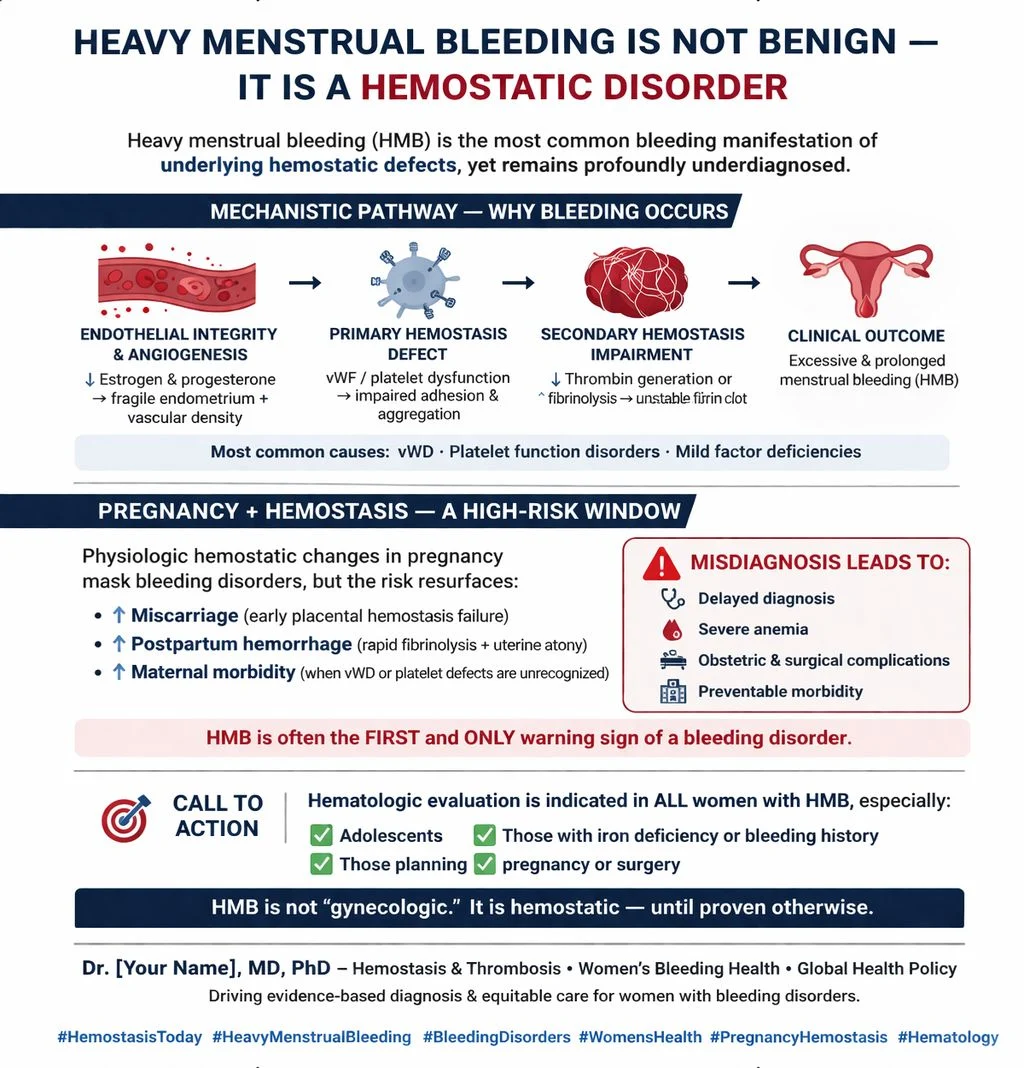
“1. Heavy menstrual bleeding (HMB) is described as:
The most common bleeding manifestation of underlying hemostatic defects, often underdiagnosed.
2. The mechanistic pathway explaining why bleeding occurs involves:
- Endothelial integrity and angiogenesis: estrogen and progesterone cause a fragile endometrium with increased vascular density.
- Primary hemostasis defect: von Willebrand factor (vWF) or platelet dysfunction – impaired adhesion and aggregation.
- Secondary hemostasis impairment: reduced thrombin generation or fibrinolysis – unstable fibrin clot.
- Clinical outcome: excessive and prolonged menstrual bleeding (HMB).
3. Most common causes of HMB are:
- von Willebrand disease (vWD).
- Platelet function disorders.
- Mild factor deficiencies.
4. During pregnancy, hemostatic changes:
- Mask bleeding disorders, but risks resurface as:
- Increased miscarriage (early placental hemostasis failure).
- Postpartum hemorrhage (rapid fibrinolysis plus uterine atony).
- Maternal morbidity (unrecognized vWD or platelet defects).
5. Misdiagnosis of HMB can lead to:
- Delayed diagnosis.
- Severe anemia.
- Obstetric and surgical complications.
- Preventable morbidity.
6. HMB is often the:
First and only warning sign of a bleeding disorder.
7. Call to action for HMB management:
Hematologic evaluation is indicated in ALL women with HMB, especially:
- Adolescents.
- Those with iron deficiency or bleeding history.
- Those planning pregnancy or surgery.
8. Key message about HMB:
It is not a ‘gynecologic’ issue; it is a hemostatic disorder until proven otherwise.”
Heghine Khachatryan, Editor-in-Chief of Hemostasis Today, Head of Hemophilia and Thrombosis Center at Yeolyan Hematology and Oncology Center, shared a post on LinkedIn:
“Heavy menstrual bleeding is not ‘normal’ — it is often missed pathology.
For too long, heavy menstrual bleeding (HMB) has been normalized, underestimated, and frequently misdiagnosed.
Behind what is often dismissed as a ‘gynecological issue’, there may be an underlying hemostatic disorder — including von Willebrand disease, platelet function defects, or other coagulation abnormalities.
The clinical reality is concerning:
Many women remain undiagnosed for years, presenting later with anemia, perioperative bleeding, or complications during pregnancy and childbirth.
Pregnancy introduces an additional layer of complexity.
Hemostasis is dynamically altered, and in women with unrecognized bleeding disorders, this may result in:
- increased risk of miscarriage
- postpartum hemorrhage
- preventable maternal morbidity
Misdiagnosis is not benign — it is systemic failure.
We must shift from symptom-based reassurance to structured hemostatic evaluation, especially in:
- adolescents with HMB
- women with iron deficiency
- patients with bleeding history prior to surgical or reproductive interventions
This is not only a clinical issue — it is a matter of health equity, awareness, and diagnostic capacity.
The time has come to integrate hemostasis into routine women’s health assessment — not as an exception, but as a standard.”
Other posts featuring Mohamed Sikkander Abdul Razak on Hemostasis Today.
-
Oct 4, 2026, 06:12David McIntosh: 900 Plasma Donations One Patient One Lifeline
-
Oct 4, 2026, 06:00Aadil Sheikh: Menopausal Hormone Therapy and Thrombosis Rethinking Route Dose and Risk
-
Oct 4, 2026, 05:39Alicja Urbaniak: Targeting CD148 for Novel Antithrombotic Therapy
-
Oct 4, 2026, 05:27Nirali Thakkar: Influenza and Myocardial Infarction An Unexpected Cardiovascular Connection
-
Oct 4, 2026, 05:03Hisham Fahmi: Thromboprophylaxis in Children With ALL A Risk Adapted Approach
-
Oct 4, 2026, 05:00Mary Cushman: Erin Michos Highlights Rising Heart Disease Mortality Among Younger Women in the US
-
Oct 4, 2026, 04:48Liv Tybjærg Nordestgaard: Is Fasting Necessary Before Blood Sampling?
-
Oct 4, 2026, 04:31Sonal Sonu: Gen Z doesn’t just set trends – Gen Z saves lives
-
Oct 4, 2026, 04:22Registration Opens for 2027 Highlights of ASH – American Society of Hematology