


Edward Lee Carter: Are All DOACs Truly Interchangeable in Real-World Practice?
Edward Lee Carter, Clinical Pharmacist Practitioner at U.S. Department of Veterans Affairs, shared a post on LinkedIn:
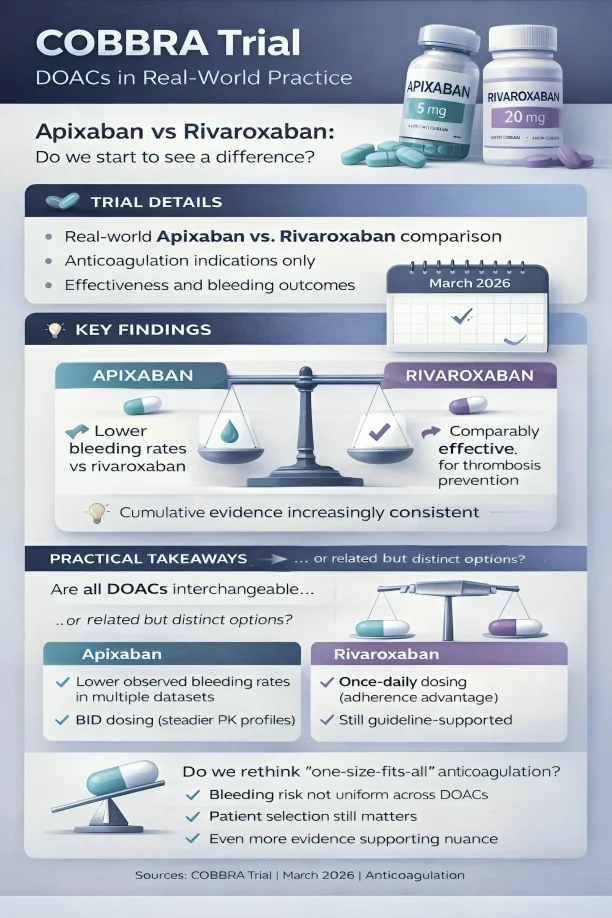
”Apixaban vs Rivaroxaban — are we starting to see separation?
The COBBRA trial (March 2026) adds another important data point to a question many of us deal with daily:
Are all DOACs truly interchangeable in real-world practice?
COBBRA compared Apixaban vs Rivaroxaban in a contemporary patient population, focusing on both effectiveness and bleeding risk.
Key takeaway (high-level):
Apixaban demonstrated a more favorable bleeding profile, while maintaining comparable effectiveness for thromboembolic prevention.
That signal is not entirely new—but it’s becoming more consistent.
Why this matters in practice:
We often think of DOACs as a class.
But clinically, they behave more like related—but distinct—tools.
What COBBRA reinforces:
- Bleeding risk is not uniform across DOACs
- Patient selection still matters (renal function, age, weight, comorbidities)
- ‘One-size-fits-all anticoagulation’ continues to fall short
Practical considerations:
Apixaban
- Lower observed bleeding rates in multiple datasets
- BID dosing (may improve peak/trough stability)
Rivaroxaban
- Once-daily dosing (adherence advantage for some patients)
- Still a strong, guideline-supported option
The bigger picture:
We’re seeing convergence from:
- RCTs
- Real-world data
- Now additional comparative trials like COBBRA
And the trend is fairly consistent:
- Apixaban often emerges with a bleeding advantage
- Effectiveness remains comparable
For clinicians:
This isn’t about declaring a ‘winner.’
It’s about refining decisions at the bedside.
Matching the right anticoagulant to the right patient
Balancing bleeding risk vs adherence vs comorbidity profile
Bottom line:
DOACs may share a mechanism – but they do not share identical clinical outcomes.”
Stay updated with Hemostasis Today.
-
Sep 24, 2026, 05:11Mastering Warm Autoimmune Hemolytic Anemia Diagnosis and Practice – ASH Education
-
Sep 23, 2026, 16:04Monia Ezzalfani: Advancing Patient-Centered Care in Hemophilia A and B
-
Sep 23, 2026, 15:49Bilge Başak: How Activated PRP Modulates Osteoarthritic Chondrocyte Function
-
Sep 23, 2026, 14:50Mbonjo Bitsie Dora: Strengthening Sickle Cell Care Through Education, Awareness and Innovation
-
Sep 23, 2026, 13:58The New B12 Diagnostic Algorithm: From Serum Cobalamin to Functional Deficiency
-
Sep 23, 2026, 13:56Noha Soror: Preparing for Hematology and Medical Oncology Board Certification
-
Sep 23, 2026, 13:46Ugochi Ogu: What Can Platelet Proteomics Reveal about Pain and Neurocognitive Vulnerability in Sickle Cell Disease?
-
Sep 23, 2026, 13:42Melissa Hollo: Connecting Obesity and Anemia for Earlier Maternal Risk Intervention
-
Sep 23, 2026, 13:16Beverley Hunt: Advances in Haemostatic Management of Postpartum Haemorrhage