


Nabil Tabish: The Paradox of Zero – Investigating Extreme VWF Discordance
Nabil Tabish, Regional Medical Director at Kaiser Permanente, shared a post on LinkedIn:
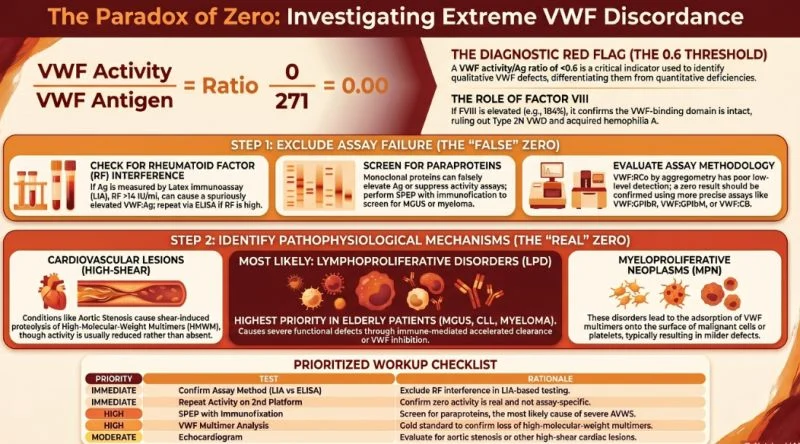
“The infographic highlights the investigation of extreme VWF discordance, specifically when a patient presents with a severe qualitative defect yielding a VWF activity/Ag ratio of 0.00.
It emphasizes that clinicians must first rule out potential assay failures, such as rheumatoid factor or paraprotein interference, before confirming a true diagnosis.
It details the primary causes of Acquired von Willebrand Syndrome (AVWS), illustrating pathophysiological mechanisms like antibody-mediated clearance, high-shear proteolysis, and tumor cell adsorption.
It identifies lymphoproliferative disorders as the most likely mechanism causing such a severe, near-zero VWF activity defect in elderly patients.
Lastly, it demonstrates how an elevated FVIII level helps confirm the defect is isolated to specific VWF domains by completely ruling out conditions like Type 2N VWD and acquired hemophilia A.”
Stay updated with Hemostasis Today.
-
Sep 28, 2026, 19:14Aditya Sharma: An Outstanding Start to the Final Day of VSS 2026!
-
Sep 28, 2026, 19:07Dhargam Aljebouri: AIHA Subclassification Research Presented at the 14th Iraqi Society of Hematology Conference
-
Sep 28, 2026, 19:02William Wallace: Your Cholesterol Test is Missing a Particle that May Matter More than the One it Measures
-
Sep 28, 2026, 18:57Indu Thakur: Honoring Sickle Warriors and Advancing Diverse Blood Donation at Sickle Ball 2026
-
Sep 28, 2026, 18:48Orly Leiva: Rethinking JAK Inhibitor Cardiovascular Safety in MPNs
-
Sep 28, 2026, 18:42Wael Saad: Honored to Be Part of Portal and Mesenteric Vein Thrombosis Session at CIRSE 2026
-
Sep 28, 2026, 18:35Alejandro González Veliz: The Unbroken Connection Between Heart and Brain
-
Sep 28, 2026, 16:43Scott Sutton: Community and Connection in Immune Thrombocytopenia
-
Sep 28, 2026, 16:24Pankti Solanki: ISBT Recognized JAMA as the 49th Human Blood Group System