


Natalie Arnold: The Lp(a) Puzzle – Why Lower Levels May Not Tell the Whole Story
Natalie Arnold, Preventive Cardiologist at University Heart and Vascular Center Hamburg, shared a post on LinkedIn:
“The wait is almost over. Lp(a)HORIZON – what comes next?
Tomorrow, November 7, the detailed results of the Lp(a)HORIZON trial will be presented in two consecutive presentations at AHA 2026 (15:50 and 16:00 CET).
The topline results announced in September were undoubtedly disappointing for many of us working in Lp(a) research.
Despite substantial Lp(a) lowering with pelacarsen, the trial did not meet its primary cardiovascular endpoint.
But could a neutral trial ultimately teach us more about Lp(a) than we initially expected?
One thing I have learned from my clinical practice is that elevated Lp(a) is a remarkably heterogeneous phenotype.
Patients with similarly high Lp(a) concentrations do not necessarily have the same cardiovascular risk, atherosclerotic burden, or clinical trajectory. Perhaps this heterogeneity deserves much more attention.
I don’t want to speculate whether HORIZON enrolled the wrong population, whether secondary prevention was simply too late, whether optimal control of other risk factors was sufficient, whether a second hit is required for Lp(a) to exert its full atherogenic potential, or about the many other possible explanations for the neutral results.
Let’s first see the data.
What I find particularly important is how the scientific community responds to these findings. A neutral trial should stimulate more detailed and thoughtful research into the atherogenicity of this unique molecule.
And the discussion will certainly not end at AHA.
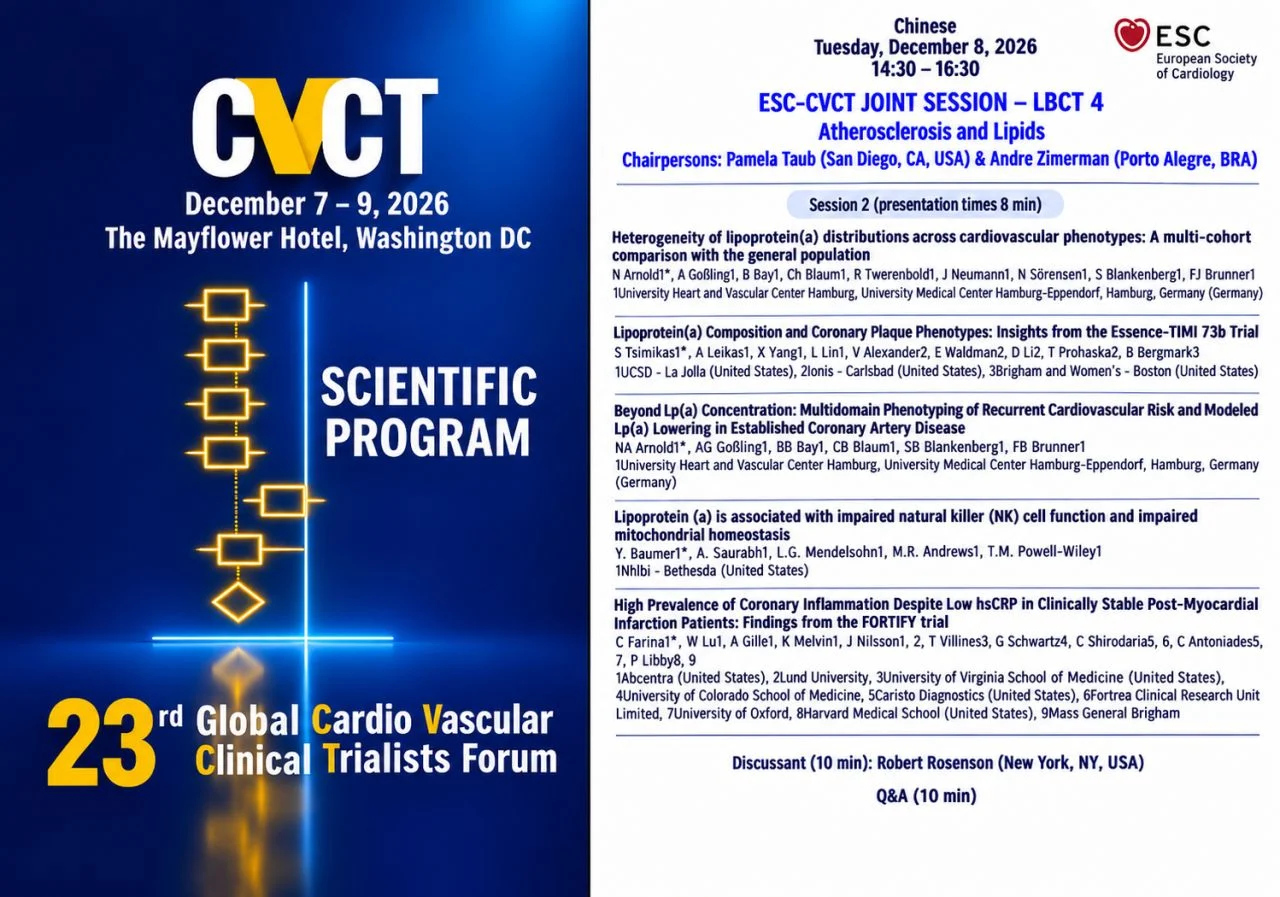
At CVCT2026 in Washington, DC, this December, dedicated sessions will explore the implications of HORIZON and the future of Lp(a)-targeted therapies.
In this context, I’m pleased to contribute two late-breaking clinical trial (LBCT) presentations featuring our latest research on Lp(a) distributions across different cardiovascular populations and the heterogeneity of recurrent cardiovascular events among patients with established CAD.
There is still so much to understand. The story of Lp(a) is far from over.”
Stay updated on all scientific advances with Hemostasis Today.
-
Nov 9, 2026, 10:22ISBT Opens Applications for the I TRY IT Programme 2027
-
Nov 9, 2026, 10:08Ibrahim Mansoor: Rare Tests, Common Diseases – Rethinking Autoimmune Diagnostics
-
Nov 9, 2026, 09:29Veronica Sanchez: A Framework for Woman’s Health
-
Nov 8, 2026, 19:31Anna Kajaste-Rudnitski: Presenting AAV-Induced p53 Signalling in Human CNS Cells at ESGCT 26
-
Nov 8, 2026, 19:29David McIntosh: Cybersecurity Matters, but Blood Availability Remains the Bigger Challenge
-
Nov 8, 2026, 19:26Wenxue Ma: An Integrative Framework for Macrophage-Mediated Therapeutic Resistance in Cancer
-
Nov 8, 2026, 19:25Yildiz Yigit: Presenting a Polycythemia Vera Case at the MPN Subcommittee Session
-
Nov 8, 2026, 18:56Denis Oduor: Strengthening the Regulation and Delivery of Blood Transfusion and Transplantation Services
-
Nov 8, 2026, 18:28Raghavendra Rao: A Narrative Review on Chronic Venous Disease during Pregnancy