


Omar Adwan: Rule of Three in Complete Blood Count
Omar Adwan, Medical Laboratory Technologist at Modawah Lab Center, shared a post on LinkedIn:
“Rule of Three in Complete Blood Count (CBC)
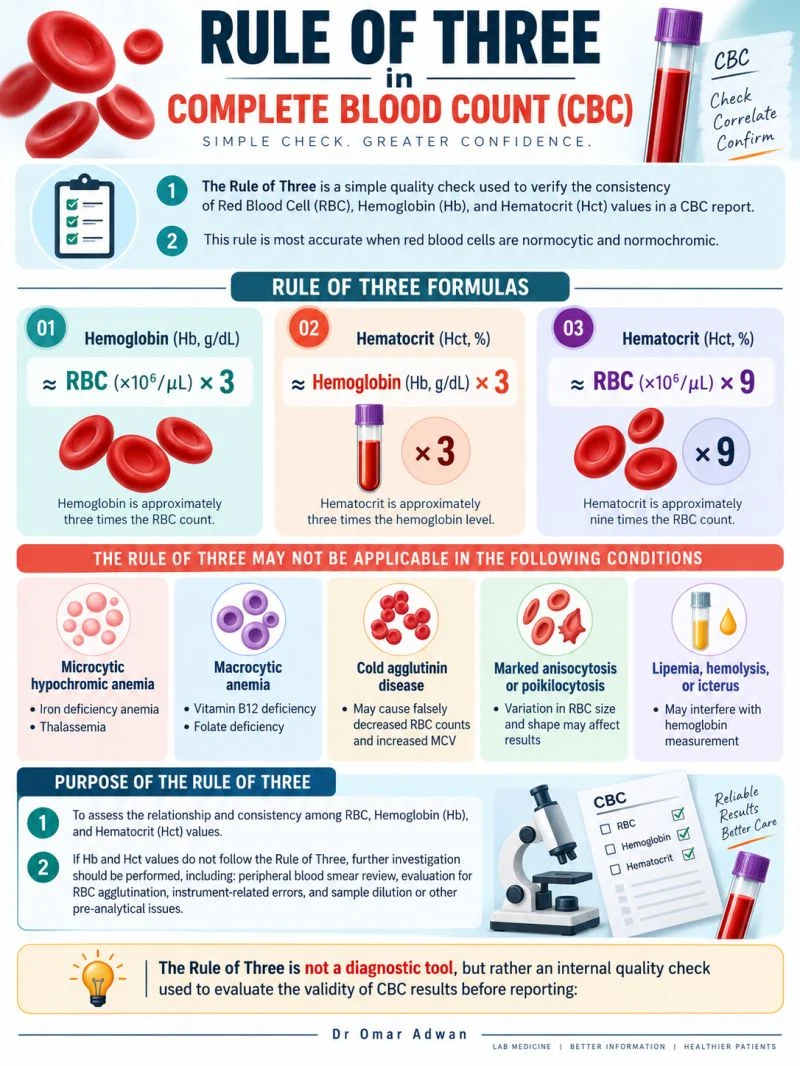
The Rule of Three is a simple quality check used to verify the consistency of Red Blood Cell (RBC), Hemoglobin (Hb), and Hematocrit (Hct) values in a CBC report.
This rule is most accurate when red blood cells are normocytic (normal size) and normochromic (normal hemoglobin content).
Rule of Three formulas
- Hemoglobin (Hb, g/dL) approximately equals RBC (×10⁶/µL) × 3
- Hematocrit (Hct, %) approximately equals Hemoglobin (Hb, g/dL) × 3
- Hematocrit (Hct, %) approximately equals RBC (×10⁶/µL) × 9
The Rule of Three may not be applicable in the following conditions:
Microcytic hypochromic anemia
- Iron deficiency anemia
- Thalassemia
Macrocytic anemia
- Vitamin B12 deficiency
- Folate deficiency
Cold agglutinin disease
- May cause falsely decreased RBC counts and increased MCV
Marked anisocytosis or poikilocytosis
Lipemia, hemolysis, or icterus
- May interfere with hemoglobin measurement
Purpose of the Rule of Three
- To assess the relationship and consistency among RBC, Hemoglobin (Hb), and Hematocrit (Hct) values.
If Hb and Hct values do not follow the Rule of Three, further investigation should be performed, including:
- Peripheral blood smear review
- Evaluation for RBC agglutination
- Instrument-related errors
- Sample dilution or other pre-analytical issues
The Rule of Three is not a diagnostic tool, but rather an internal quality check used to evaluate the validity of CBC results before reporting.
Therefore, the Rule of Three remains a valuable guideline used by Medical Technologists and Hematology professionals to assess the plausibility of CBC results before releasing patient reports.”
Other posts featuring Omar Adwan on Hemostasis Today.
-
Sep 19, 2026, 09:26Kerry Taylor-Smith: Cold or Flu? – How to Tell the Difference
-
Sep 19, 2026, 09:13Stand with Bleeding Disorder Patients This World Patient Safety Day – WFH
-
Sep 19, 2026, 09:09Stefanie Dimmeler: How the Lymphatic System Shapes Heart Aging
-
Sep 19, 2026, 08:51Zia Ullah Shah: Advancing Early Diagnosis of Wilson Disease With AI and Biomarkers
-
Sep 19, 2026, 03:15Paulus Kirchhof: Europe’s Safe Hearts Plan to Reduce Cardiovascular Mortality
-
Sep 19, 2026, 03:10James Smith: Brain Training and Exercise for Cognitive Recovery After Stroke
-
Sep 19, 2026, 03:03Lesley Van Wyk: ASH Releases New Iron Deficiency Diagnosis Guidelines
-
Sep 19, 2026, 02:53Francisco Chacón-Lozsán: Acute Ischemic Stroke in 2026 – Expanding the Treatment Window
-
Sep 19, 2026, 01:53Thomas Dayspring: Understanding Genome and Lipid Interactions in Lipidology