

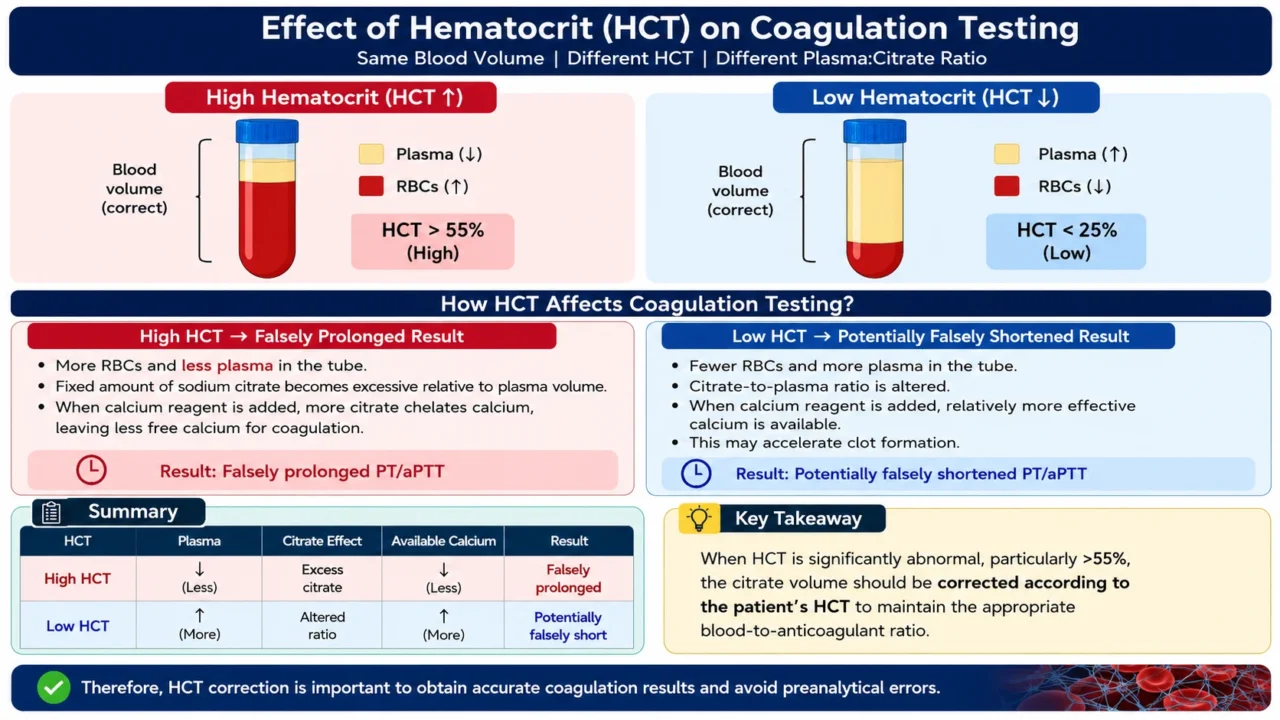
Omnia Ahmed: Effect of Hematocrit (HCT) on Coagulation Testing
Omnia Ahmed, Laboratory Technologist at Faculty of Medical Laboratory Sciences at University of Gezira, shared a post on LinkedIn:
”Effect of Hematocrit (HCT) on Coagulation Testing
What is HCT?
Hematocrit (HCT) is the percentage of whole blood volume occupied by red blood cells (RBCs).
When is HCT increased or decreased?
High HCT: Increased RBC volume
Can be seen in conditions such as dehydration, chronic hypoxia, smoking, or polycythemia.
Low HCT: Decreased RBC volume
Can occur due to blood loss, iron deficiency, nutritional deficiencies, chronic disease, or other causes of anemia.
How does this affect coagulation tests?
Assuming the blood volume was collected correctly, coagulation tubes normally maintain a 9:1 blood-to-sodium citrate ratio.
High HCT (Falsely Prolonged Result):
High HCT means more RBCs and less plasma. Therefore, the fixed amount of citrate becomes excessive relative to the plasma volume.
When calcium reagent is added during the test, the excess citrate can chelate more calcium, leaving less calcium available for coagulation.
Result: Falsely prolonged PT/aPTT.
Low HCT (Potentially Falsely Shortened Result):
Low HCT means fewer RBCs and more plasma. This changes the citrate-to-plasma relationship.
When calcium reagent is added, the altered citrate/plasma ratio can result in greater effective calcium availability, potentially accelerating clot formation.
Result: Potentially falsely shortened PT/aPTT.
Key Point:
The problem is not necessarily incorrect blood collection. The issue is the altered plasma-to-citrate ratio caused by an abnormal HCT.
What should we do?
When HCT is significantly abnormal, particularly greater than 55 percent, the citrate volume should be corrected according to the patient’s HCT to maintain the appropriate blood-to-anticoagulant ratio.
Therefore, HCT correction is important to obtain accurate coagulation results and avoid preanalytical errors.”
Stay updated with Hemostasis Today.
-
Oct 18, 2026, 08:02Neda Ashayeri: Global Perspectives on Hemophilia and Rare Bleeding Disorders in Abu Dhabi
-
Oct 18, 2026, 07:55Anu Thomas: A Stepwise Laboratory Approach to Positive IAT and Pretransfusion Compatibility
-
Oct 18, 2026, 07:49Matthew Hazell: Molecular Matching and the Future of Transfusion Practice
-
Oct 18, 2026, 07:05Behnood Bikdeli: Vasculearn Network Highlights Expert Perspectives on PE Risk Stratification and Advanced Therapies
-
Oct 18, 2026, 06:27Gregory Makris: NEJM Study Supports Earlier Catheter-Directed Intervention in Intermediate-High–Risk PE
-
Oct 18, 2026, 06:26Danny Hsu: BLOOD 2026 Return to Aotearoa
-
Oct 18, 2026, 02:43Priya Sriskandarajah: Diagnosis and Management of PV and JAK2-Unmutated Erythrocytosis
-
Oct 18, 2026, 02:41C. Michael Gibson: A Meta-Analysis of DOACs and DAPT After Left Atrial Appendage Closure
-
Oct 18, 2026, 02:27What Hematologists Should Remember About the Person Behind the Platelet Count – ASH