


Pablo Corral: Viewing Lp(a) as a Multidimensional Particle
Thomas Dayspring, Fellow of the American College of Physicians (FACP) and the National Lipid Association (FNLA), shared a post on X:
“Question Sam: if one has an Lp(a)-P, why would Lp(a)-C matter?
Is not the danger of Lp(a) more related to its particle concentration or its oxidized PL content rather than its cholesterol mass.”
Sam Tsimikas, Professor of Medicine and Director of Vascular Medicine at the University of California, San Diego School of Medicine, shared Thomas Dayspring‘s post on X, adding:
“Hi Tom, the main goal of this method is to derive a more accurate LDL-C in people with elevated Lp(a). Its not to replace Lp(a) molar conc.
That being said, we can now measure Lp(a)-risk 5 ways: Lp(a) molar conc, OxPL-apoB, OxPL-apo(a), Lp(a)-C and and Lp(a)-TG.
We have a paper being reviewed where we measured all 5 and correlated to both plaque vulnerability by IVUS/NIRS and 4-yr MACE.
It will be presented at ESC. The findings will not be intuitive. This is somewhat analogous to LDL-C- what component is most associated with risk: cholesterol, TG, particle number or apoB.”
Pablo Corral, Pharmacology Professor at FASTA University, Past President of Argentine Lipid Society, shared Sam Tsimikas’ post on X, adding:
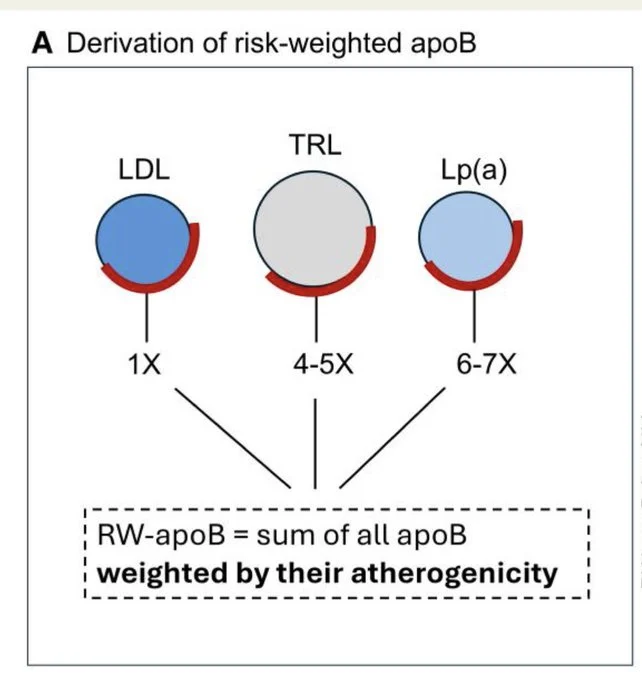
“Very interesting. If different components of Lp(a) carry different prognostic information, it further supports moving beyond simple particle counting toward biologically weighted metrics.
This is conceptually aligned with the rationale behind RW-apoB, where apoB particles are weighted according to their relative atherogenicity rather than treated as equivalent.
Looking forward to ESC.”
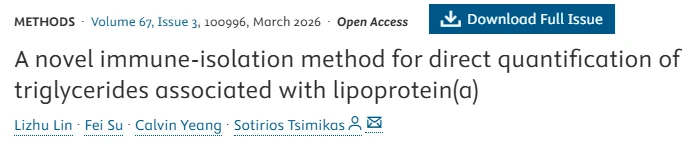
Sam Tsimikas replyed by sharing a recent article by Lizhu Lin et al., published in Journal of Lipid Research:
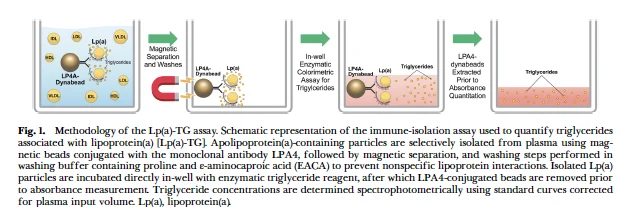
“We have recently developed a method to measure triglyceride content of Lp(a), ‘Lp(a)-TG’.
More to come on this in next few months.
Both Lp(a)-C and Lp(a)-TG may be very useful in mechanistically understanding role of CETP inhibitors.
For example, it would be interesting if the Lp(a) chol and Tg content changes post treatment due to transfer activity, and is this related to any potential clinical benefit.”
Title: A novel immune-isolation method for direct quantification of triglycerides associated with lipoprotein(a)
Authors: Lizhu Lin, Fei Su, Calvin Yeang, Sotirios Tsimikas
Pablo Corral replyed:
“Perhaps Lp(a) should be viewed as a multidimensional particle: apo(a) contributing to thrombosis, Lp(a)-C to atherogenesis, OxPL to inflammation, and Lp(a)-TG potentially representing an additional inflammatory axis through the generation of bioactive lipolytic products. An exciting hypothesis to explore.”
Stay updated on all scientific advances with Hemostasis Today.
-
Sep 10, 2026, 10:53A New Era of Hemophilia Screening and Diagnosis in Women and Girls – ISTH
-
Sep 10, 2026, 10:03Investing in Youth, Transforming Hemophilia Care – WFH
-
Sep 10, 2026, 09:51Ronke Oke BEM: 20 Years of Newborn Sickle Cell Screening in England
-
Sep 10, 2026, 09:41Seunghwan Song: Hemlibra and the Science That Changed Hemophilia A Care
-
Sep 10, 2026, 09:20Mark Dawson: A Radical Rethink of Hemophilia Treatment
-
Sep 10, 2026, 07:26Carly Newton: Every Donation Helps Save Lives
-
Sep 10, 2026, 07:152023 ACR/EULAR APS Classification Criteria – APS Foundation of America
-
Sep 10, 2026, 07:03When Platelet Function Matters More Than Platelet Count – Glanzmann’s Research Foundation
-
Sep 10, 2026, 06:54Diego López Santos: Young Blood Donors Unite at the 23rd International Youth Forum in Tirana