

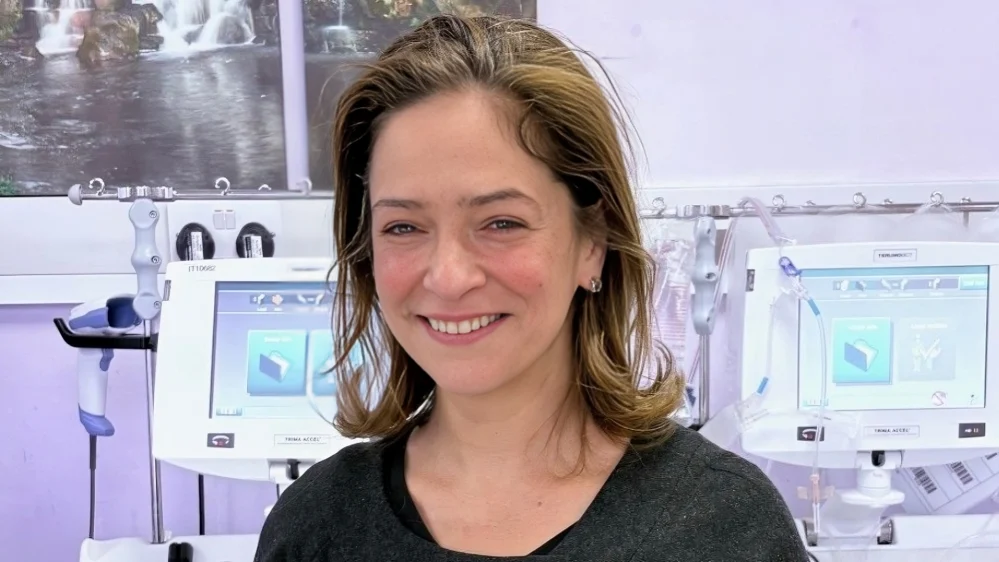
Sara Trompeter: Improving Transfusion Safety Through Advanced Blood Matching in SCD
Sara Trompeter, Consultant Haematologist and Paediatric Haematologist at University College London Hospitals NHS Foundation Trust, Consultant Haematologist at HCA Healthcare, shared NHS Blood and Transplant‘s post on LinkedIn, adding:
“Very excited to start this study with colleagues at NHS Blood and Transplant – a potential real step in improving transfusion safety.
So grateful for the support of the wider collaboration and funders.”
NHS Blood and Transplant shared a post on LinkedIn:
“NHS Blood and Transplant (NHSBT) is leading an innovative study exploring how advanced algorithms and genomic data can transform blood matching, improving both patient safety and the use of valuable donor resources.
While current transfusion practice focuses on matching major blood groups, patients who receive frequent transfusions – including many living with sickle cell disorder – may develop immune responses to less commonly matched minor blood groups. This can lead to complications, including transfusion reactions and increasing difficulty in finding compatible blood over time.
This new feasibility study introduces bloodMatcher, an advanced algorithm that uses DNA-based genotyping from both donors and patients to enable more precise matching across a broader range of blood groups. By incorporating this genomic data, the approach aims to reduce the risk of alloimmunisation and make more effective use of rare blood units.
Led by NHSBT in partnership with University College London Hospitals NHS Foundation Trust (UCLH) and the NIHR UCLH Biomedical Research Centre, the study will evaluate the algorithm in a clinical setting, supporting around 40 patients with sickle cell disorder who require regular transfusions. Importantly, all established safety protocols will remain in place, alongside additional clinical oversight.
Dr Sara Trompeter, Consultant Haematologist at NHS Blood and Transplant and UCLH, said:
‘Currently, given the numbers of units available and orders to fulfil, it’s not practical to consider many blood types – the blood types are too complex, and the number of units too numerous , for humans to compute the best unit to send.
‘This new technology hopes to reduce the potential mismatch between donor and recipient minor blood groups. Mismatches can cause the formation of a blood group antibody (alloimmunisation) which makes it hard to find blood the patient can safely receive or even severe transfusion reactions.
‘The population cohort that most struggles with the complications of alloimmunisation is the study population of interest in this study — adults with sickle cell disorder. Around 17% of adults with sickle cell are alloimmunised.
‘The new bloodMatcher algorithm will – combined with the new genomic blood data we have available– be able to select units in a faster, far more advanced way. The goal is to improve donor to patient antigen matching and thus reduce the risk of alloimmunisation and the risk of severe transfusion reactions for patients needing blood. By improving matching, we will de facto also reduce ‘waste’, caused by giving valuable rare units to people who don’t need them.’
By combining cutting-edge AI with genomic science, this research has the potential to pave the way for a larger, multi-centre trial and, ultimately, a step change in how blood is matched for patients across the NHS.”
Stay updated with Hemostasis Today.
-
Oct 11, 2026, 12:11Carmine Siniscalchi: Could LDL Cholesterol Help Us Better Predict Bleeding Risk in Patients with VTE?
-
Oct 11, 2026, 12:03What is ITP? Raising Awareness for Immune Thrombocytopenia – ITP Australia and New Zealand
-
Oct 11, 2026, 11:55Gauri Jayasinghe: Privileged to Serve as Resource Person for the Blood Transfusion Essentials Programme
-
Oct 11, 2026, 11:49Toby Richards: New Definitions for Iron Deficiency Delighted to Be in the USA with the New ASH Guidelines
-
Oct 11, 2026, 11:44Lesley Van Wyk: ASCP High-Yield Review – Essential Thalassemia Concepts and Differential Diagnosis
-
Oct 11, 2026, 11:37Susanne Pass: Key Takeaways from ESVS 2026 Workshops in Belgrade
-
Oct 11, 2026, 10:44Logesh. M: Managing Warfarin-Associated Recurrent Epistaxis and Anticoagulant Safety
-
Oct 11, 2026, 10:28Sébastien Béland: Validating RUDAS for Detecting Neurocognitive Impairment in Sickle Cell Disease
-
Oct 10, 2026, 17:58Archo Farzana Batool: Exploring Medical Writing Through an Article on Iron Deficiency Anemia