


Seth Green: Testosterone Replacement Therapy and VTE Risk When Is the Risk Highest
Seth Green, Owner at Capital Performance Solution, shared a post on LinkedIn:
“Most men start TRT in January and think about the clot risk in December.
The data runs the other way. If the risk is there at all, it is front loaded.
Martinez, BMJ 2016. Population case control, 19,215 men with confirmed venous thromboembolism against 909,530 matched controls.
- Current treatment vs none: rate ratio 1.25 (0.94 to 1.66). Not significant.
- First six months of treatment: 1.63 (1.12 to 2.37).
- After six months: 1.00 (0.68 to 1.47).
- After stopping: 0.68.
In absolute terms, the data shows 10 extra events per 10,000 man years on a base rate of 15.8.
TRAVERSE, NEJM 2023. 5,246 hypogonadal men with existing or high cardiovascular risk, mean 33 months of follow up. Heart attack, stroke and cardiovascular death came back flat.
- Venous thromboembolic events: 44 (1.7percent) on testosterone vs 30 (1.2percent) on placebo, hazard ratio 1.46 (0.92 to 2.32).
- Pulmonary embolism specifically: 24 vs 12.
Walker, JAMA Internal Medicine 2020. Case crossover, 39,622 men who had a clot, each man compared against himself six to twelve months earlier.
Odds ratio 2.32 in men with hypogonadism, 2.02 in men without it.
The mechanism, plainly:
Testosterone suppresses hepcidin and raises erythropoietin, so red cell mass climbs and blood thickens (Bachman, JCEM 2010). That part is measurable. What nobody has shown is that the thicker blood is what throws the clot. The warning FDA made class wide in June 2014 was written to cover men whose hematocrit never moved at all.
Easy ways to manage this:
Fix 1: Measure Hematocrit before the first dose. Endocrine Society guidance is to hold therapy if baseline sits above 50 percent until you know why.
Fix 2: Recheck at 3 and 6 months, not once a year. AUA puts the intervention line at 54 percent, with dose adjustment as the first move rather than a standing phlebotomy habit.
Fix 3: Tell your surgeon. An elective knee, shoulder or hernia inside your first six months on therapy deserves the conversation, and so does any personal or family clot history. Guidelines say do not start at all with known thrombophilia.
Fix 4: One sided calf swelling or new shortness of breath is a same day call. Pulmonary embolism was the single component that separated in TRAVERSE.
Your monitoring should be heaviest in month one and lightest in month twenty. For most the difference is negligible, which is why the black box warning was removed from testosterone last year.”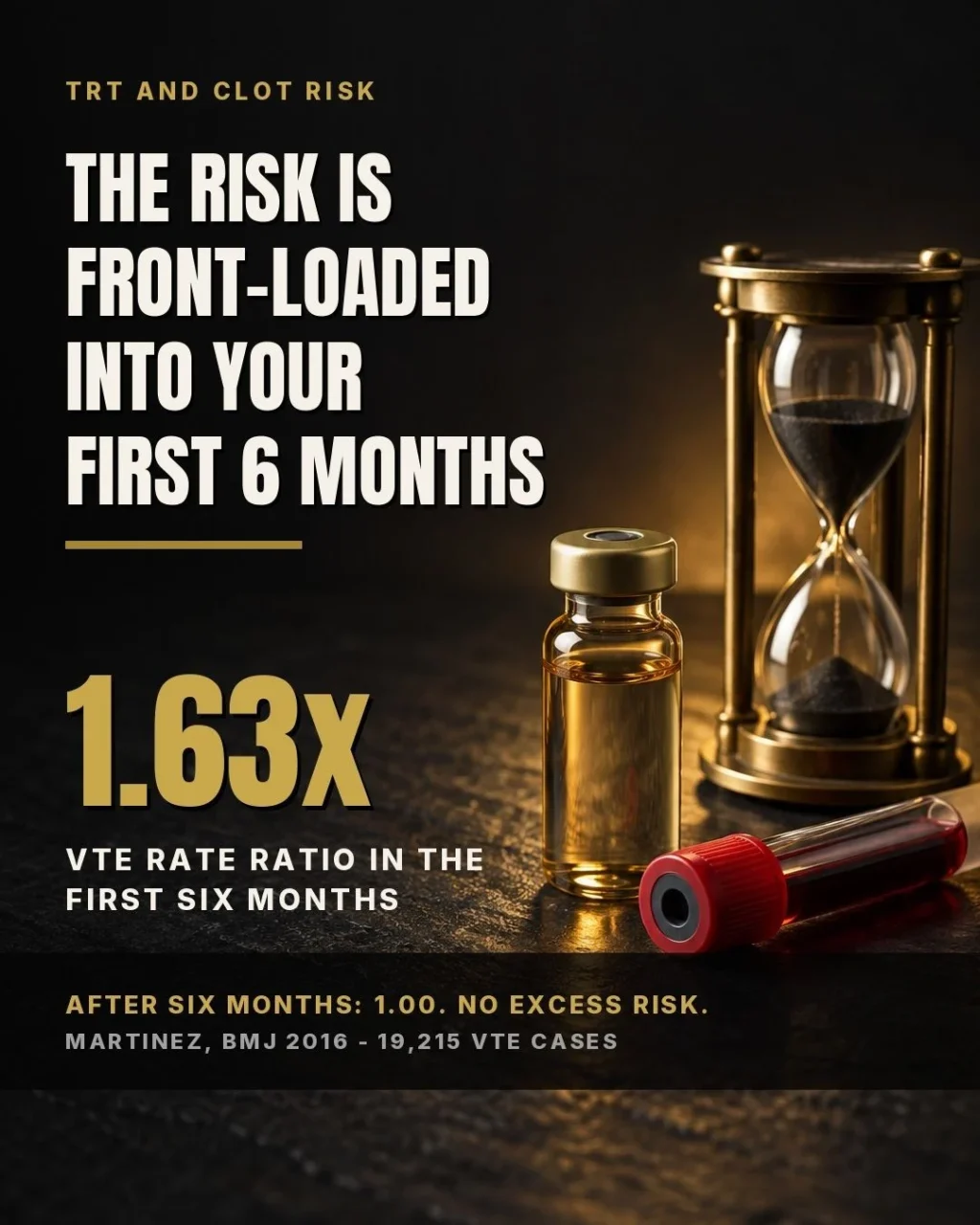
Stay updated with Hemostasis Today.
-
Sep 10, 2026, 13:56Sumyea Kabir: Wet Hijama and Blood Donation Why Deferral Matters
-
Sep 10, 2026, 11:56William Pao: Celebrating a Landmark Breakthrough in Hemophilia Care
-
Sep 10, 2026, 11:25Andreas Glenthøj: New Sickle Cell Trait Data in UpToDate
-
Sep 10, 2026, 10:53A New Era of Hemophilia Screening and Diagnosis in Women and Girls – ISTH
-
Sep 10, 2026, 10:03Investing in Youth, Transforming Hemophilia Care – WFH
-
Sep 10, 2026, 09:51Ronke Oke BEM: 20 Years of Newborn Sickle Cell Screening in England
-
Sep 10, 2026, 09:41Seunghwan Song: Hemlibra and the Science That Changed Hemophilia A Care
-
Sep 10, 2026, 09:20Mark Dawson: A Radical Rethink of Hemophilia Treatment
-
Sep 10, 2026, 07:26Carly Newton: Every Donation Helps Save Lives