


Shiny K. Kajal: Why Blood from First-Degree Relatives is Not Recommended for Transfusion
Shiny K. Kajal, Senior Resident at Adesh University, shared a post on LinkedIn:
” ‘Have you ever heard blood banks say that directed donation from immediate family members is not accepted?’
Here’s why
- It’s not about mistrust.
- It’s not about infection.
- It’s about immunology.
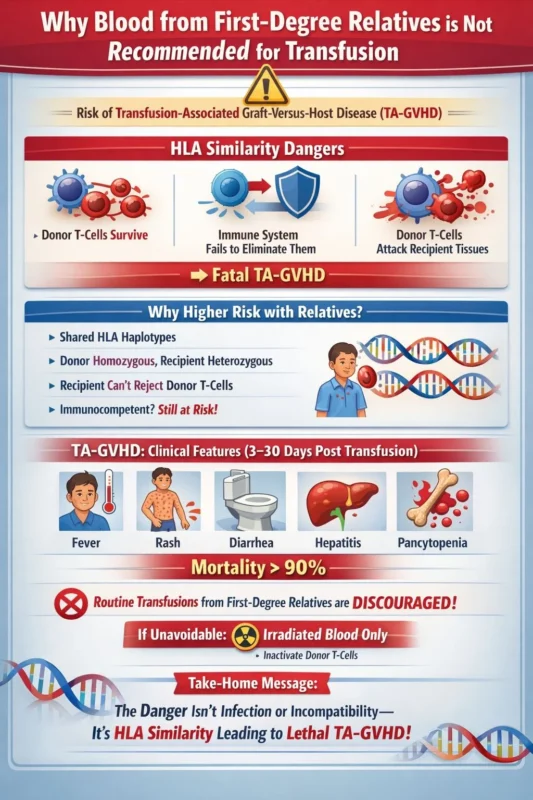
First-degree relatives share HLA haplotypes.
When such blood is transfused:
- Donor viable T-lymphocytes enter the recipient
- Due to partial HLA similarity, the recipient’s immune system may fail to recognize them as foreign
- These donor T-cells engraft, proliferate, and attack host tissues
This leads to Transfusion-Associated Graft-Versus-Host Disease (TA-GVHD) —
a rare but often fatal (>90% mortality) complication.
Even an immunocompetent person is at risk if HLA similarity allows donor cells to escape rejection.
That is why blood banks avoid directed donation from immediate family.
If unavoidable, irradiated blood components are mandatory to inactivate donor T-cells.
The issue is not compatibility —it is HLA similarity leading to lethal immune attack.”
Find more posts featuring Shiny K. Kajal on Hemostasis Today.
-
Oct 4, 2026, 05:39Alicja Urbaniak: Targeting CD148 for Novel Antithrombotic Therapy
-
Oct 4, 2026, 05:27Nirali Thakkar: Influenza and Myocardial Infarction An Unexpected Cardiovascular Connection
-
Oct 4, 2026, 05:03Hisham Fahmi: Thromboprophylaxis in Children With ALL A Risk Adapted Approach
-
Oct 4, 2026, 05:00Mary Cushman: Erin Michos Highlights Rising Heart Disease Mortality Among Younger Women in the US
-
Oct 4, 2026, 04:48Liv Tybjærg Nordestgaard: Is Fasting Necessary Before Blood Sampling?
-
Oct 4, 2026, 04:31Sonal Sonu: Gen Z doesn’t just set trends – Gen Z saves lives
-
Oct 4, 2026, 04:22Registration Opens for 2027 Highlights of ASH – American Society of Hematology
-
Oct 4, 2026, 04:06Konstantinos Stavroulakis: Vessel Preparation in Lower Limb Revascularization
-
Oct 4, 2026, 03:34Liselotte Hyveled: Exploring Opportunities to Improve Hemophilia and Sickle Cell Care in Ghana