


Simon Senanu: ‘Within Range’ Is Not the Same as ‘Safe’ in Laboratory Medicine
Simon Senanu, Medical Laboratory Scientist at Perkins Medical Centre, shared a post on LinkedIn.
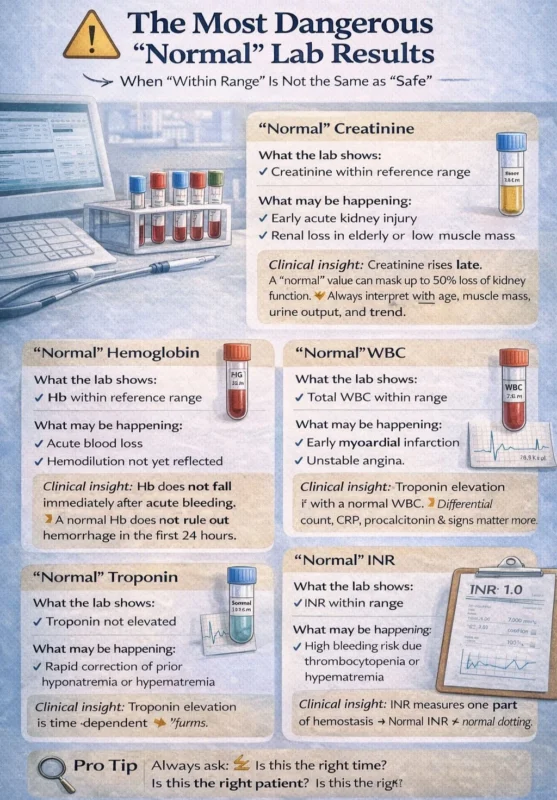
“The Most Dangerous ‘Normal’ Lab Results – When ‘Within Range’ Is Not the Same as ‘Safe’
Some of the most dangerous lab results are… normal.
Because normal ranges don’t know:
- the patient
- the timeline
- the clinical context
‘Normal’ Creatinine
What the lab shows: Creatinine within reference range.
What may be happening:
- Early acute kidney injury
- Significant renal loss in elderly or low-muscle patients
Clinical insight: Creatinine rises late. A ‘normal’ value can mask up to 50% loss of kidney function.
Always interpret with:
- age
- muscle mass
- urine output
- and trend
‘Normal’ Hemoglobin (Hb)
What the lab shows: Hb within reference range.
What may be happening:
- Acute blood loss
- Hemodilution not yet reflected
Clinical insight: Hemoglobin does not fall immediately after acute bleeding.
A normal Hb does not rule out hemorrhage in the first 24 hours.
‘Normal’ White Blood Cell Count (WBC)
What the lab shows: Total WBC within range.
What may be happening:
- Sepsis (especially in elderly, neonates, immunocompromised)
Clinical insight: Sepsis can exist with a normal WBC.
Differential count, CRP, procalcitonin, and clinical signs matter more.
‘Normal’ Troponin
What the lab shows: Troponin not elevated.
What may be happening:
- Early myocardial infarction
- Unstable angina
Clinical insight: Troponin elevation is time-dependent.
A single normal troponin does not exclude ACS – serial testing is essential.
‘Normal’ Sodium
What the lab shows: Sodium within reference range.
What may be happening:
- Rapid correction of previous hyponatremia or hypernatremia
Clinical insight: The rate of change is often more dangerous than the value itself.
Normal today doesn’t mean safe yesterday.
‘Normal’ INR
What the lab shows: INR within range.
What may be happening:
- High bleeding risk due to thrombocytopenia
- Liver disease with balanced factor loss
Clinical insight: INR measures one part of hemostasis.
Normal INR does not mean normal clotting.
Clinical Reality
Reference ranges describe populations – not patients.
‘Normal’ values can still hide:
- early disease
- rapid deterioration
- life-threatening pathology
Pro Tip
Always ask:
- Is this the right time?
- Is this the right patient?
- Is this the right trend?
Single numbers mislead. Patterns save lives.
Which ‘normal’ lab result has caused the most harm in your clinical experience?”
Stay updated with Hemostasis Today.
-
Oct 4, 2026, 15:06Vasiliki Gkalea: Journal of Clinical Medicine Launches Special Issue on Hematologic Thrombosis and Bleeding
-
Oct 4, 2026, 14:55Quentin Brebant: What Defines a High-Quality Red Blood Cell Concentrate?
-
Oct 4, 2026, 14:47Rana Al-Hrout: Recognizing Non-Anemic Iron Deficiency – Why Iron Matters Beyond Hemoglobin
-
Oct 4, 2026, 14:41David McIntosh: International Plasma Awareness Week 2026 – Closing the Global Plasma Gap
-
Oct 4, 2026, 14:33Pete Stibbs: CleanerVac Real-World Study Presented at VIVA and The VEINS 2026
-
Oct 4, 2026, 13:56Maria Elisa Mancuso: EHC 2026 Highlights the Unmet Needs of Women with Bleeding Disorders
-
Oct 4, 2026, 13:53Nirmal Shaji George: Individualizing Anticoagulation in Complex APS and Thrombocytopenia
-
Oct 4, 2026, 13:5210 Posts Not to Miss This Week
-
Oct 4, 2026, 13:45Suswapna Singh Rawat: The Clinical Significance of Coronary Plaque Stability