


Christoph B. Olivier: Can We Stay Ahead of Valve Thrombosis?
Christoph B. Olivier, Head of the Clinical Trials Unit, UHZ Freiburg, shared RPTH Journal‘s post on LinkedIn, adding:
”Early signals in TAVR: Can we stay ahead of valve thrombosis?
I am proud to share this latest work from our Antithrombotic Research Group, now featured in RPTH Journal.
The question is critical: Can we identify which patients will develop HALT before it even shows up on a CT scan?
This study highlights the complexity of finding definitive clinical predictors.
Excellent work by Dr. David Hesselbarth and the entire team.”
Quoting RPTH Journal‘s post:
”Can we predict valve leaflet thrombosis before it shows up on CT after TAVR?
Hypoattenuated leaflet thickening (HALT) happens in up to one-third of TAVR patients, yet we still don’t know how to identify who’s at risk early.
This new prospective cohort study asked a simple but powerful question:
Can early post-procedure blood biomarkers signal future HALT?
Researchers followed TAVR patients and performed advanced hemostasis testing (TEG, platelet function, inflammation markers) shortly after the procedure, then checked CT scans 6 months later.
What they found:
- Moderate-to-severe HALT occurred in 20% of patients
- Early signals of hypercoagulability and inflammation emerged:
- Shorter clot formation time (TEG R-time)
- Higher platelet counts
- Elevated protein S
- Higher CRP levels
But, here’s the critical nuance: After correction for multiple testing, none remained statistically significant.
Translation:
We’re seeing biological signals, not definitive predictors… yet.
This study is a perfect example of how science moves forward:
From exploratory signals to hypothesis to larger trials to clinical tools.
Big questions for the field:
- Will functional coagulation testing become part of TAVR risk stratification?
- Is HALT partly driven by inflammation plus hypercoagulability?
- Could early biomarker profiling guide post-TAVR antithrombotic therapy?”
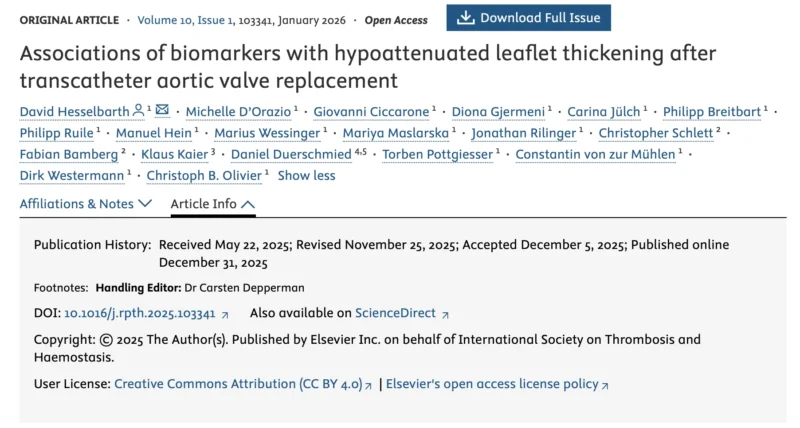
Title: Associations of biomarkers with hypoattenuated leaflet thickening after transcatheter aortic valve replacement
Authors: David Hesselbarth, Michelle D’Orazio, Giovanni Ciccarone, Diona Gjermeni, Carina Jülch, Philipp Breitbart, Philipp Ruile, Manuel Hein, Marius Wessinger, Mariya Maslarska, Jonathan Rilinger, Christopher Schlett, Fabian Bamberg, Klaus Kaier, Daniel Duerschmied, Torben Pottgiesser, Constantin von zur Mühlen, Dirk Westermann, Christoph B. Olivier
Read the Full Article on RPTH Journal
Stay updated on all scientific advances with Hemostasis Today.
-
Oct 7, 2026, 04:09James P. Crowley: Could the Microbiome Protect Us From Severe EBV Infection?
-
Oct 7, 2026, 03:58Sohanur Rohanman Sohan: Explainable AI for Anemia Prediction Using Machine Learning
-
Oct 7, 2026, 03:00Sandeep Kumar: A Second Chance for a Child with Fanconi Anemia
-
Oct 7, 2026, 02:41Kemal Karaagac: Optimising DOAC Resumption After Major Bleeding in Atrial Fibrillation
-
Oct 7, 2026, 02:21Joseph Aslan: mPTP Inhibition Targets Platelet Procoagulant Activity and Thrombosis
-
Oct 7, 2026, 02:07Manuel Monreal: ECG Improves Risk Stratification in Acute Pulmonary Embolism
-
Oct 6, 2026, 22:43Alessandra Bosch: Pediatric GTH Opens with Regional Experts Convening on Pediatric Hemostasis and Thrombosis
-
Oct 6, 2026, 22:39Managing Thrombotic Risk in Pregnancy – How the Lab May Help – Sysmex Europe
-
Oct 6, 2026, 22:33Ahmet Davut Aksu: A Multi-Objective Approach to Enhance Fibrinolysis, Selectivity, and Inhibition Resistance