


Simon Senanu: von Willebrand Disease May Be Missed Despite Normal Tests
Simon Senanu, Medical Laboratory Scientist at Perkins Medical Centre, shared a post on LinkedIn:
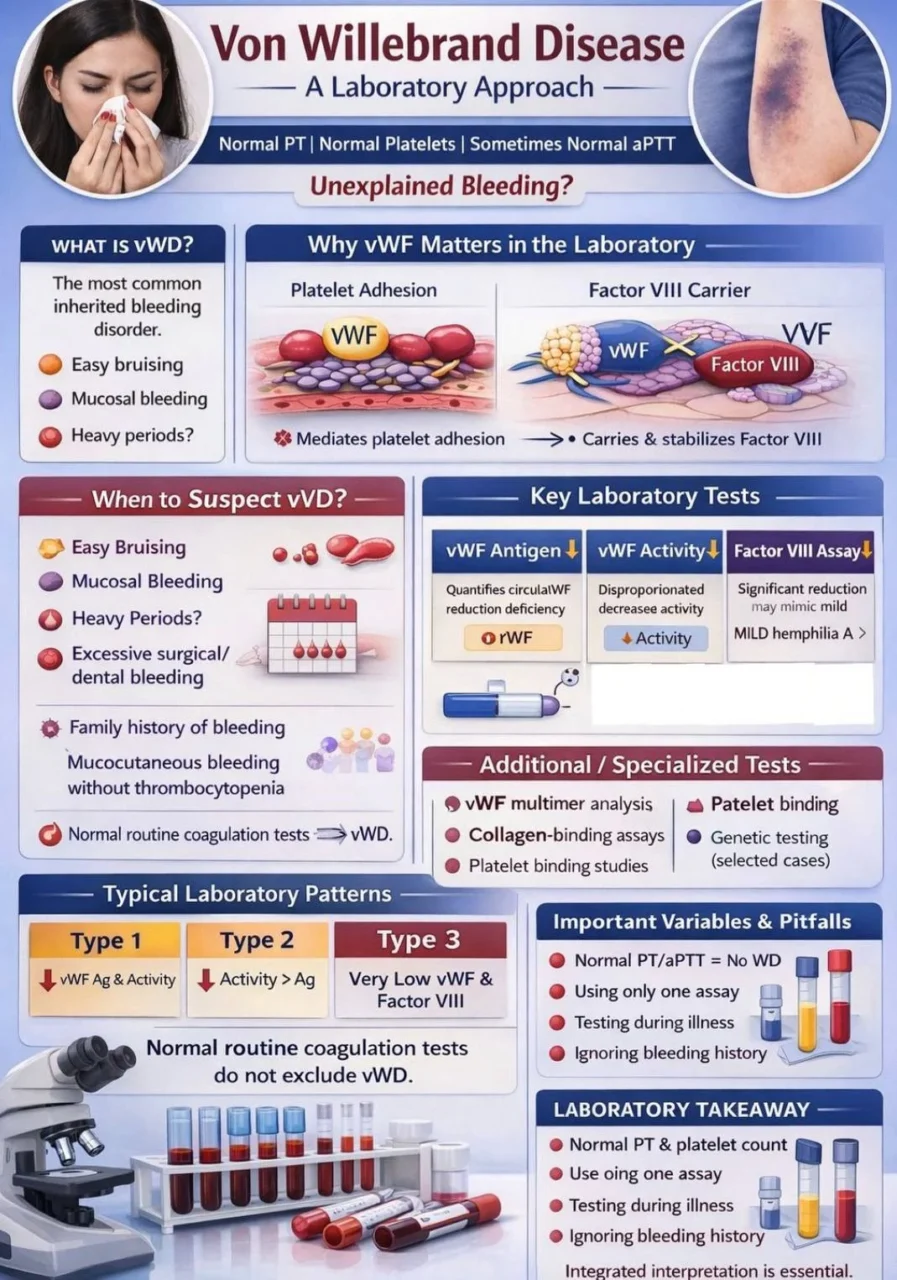
”von Willebrand Disease – A Laboratory Approach to the Most Common Inherited Bleeding Disorder
A patient presents with easy bruising, mucosal bleeding, heavy menstrual bleeding, or prolonged bleeding after a routine procedure.
PT is normal.
Platelet count is normal.
Sometimes even aPTT is normal.
Yet an inherited bleeding disorder may still be present.
This is where the laboratory should consider von Willebrand disease (vWD).
vWD is the most common inherited bleeding disorder, but it is often missed because routine screening tests may appear normal.
Why vWD Matters in the Laboratory
von Willebrand factor (vWF) has two major functions:
- Mediates platelet adhesion at sites of vascular injury
- Carries and stabilizes Factor VIII
Because of this, vWD can affect:
- Primary hemostasis, specifically platelet plug formation
- Secondary hemostasis, specifically coagulation through Factor VIII
Initial Laboratory Clues
Routine findings may include:
- Normal PT
- Normal platelet count
- Normal or mildly prolonged aPTT
aPTT may prolong when Factor VIII is reduced.
Normal PT/aPTT do not exclude vWD.
This is a common diagnostic pitfall.
When Should the Lab Suspect vWD?
Consider vWD in patients with:
- Recurrent epistaxis
- Easy bruising
- Gingival bleeding
- Heavy menstrual bleeding
- Excessive surgical or dental bleeding
- Family history of bleeding
- Mucocutaneous bleeding with normal platelet count
Bleeding history is often the first clue.
Core Diagnostic Tests
- vWF Antigen (vWF:Ag)
- Measures the amount of vWF present.
- Low level suggests deficiency.
- vWF Activity
- Measures function of vWF in platelet adhesion.
- Low activity out of proportion to antigen suggests qualitative dysfunction.
- Factor VIII Assay
Because vWF protects Factor VIII:
- Reduced vWF may lower Factor VIII levels.
Significant reduction can mimic mild hemophilia A.
Type 1 vWD
- Decreased vWF antigen levels
- Decreased vWF activity
- Proportionate reduction of antigen and activity
- Partial quantitative deficiency (most common)
Type 2 vWD
- Normal or mildly reduced vWF antigen
- Markedly reduced vWF activity
- Qualitative (functional) defect
Type 3 vWD
- Very low or absent vWF antigen
- Very low vWF activity
- Reduced Factor VIII levels
- Severe quantitative deficiency
Additional Tests (when needed)
- vWF multimer analysis
- Collagen-binding assays
- Platelet binding studies
- Genetic testing
Usually reserved for subtype clarification.
Important Variables and Pitfalls
vWF is an acute phase reactant and may rise with:
- Stress
- Infection
- Exercise
- Pregnancy
- Estrogen use
This may temporarily normalize results.
Common errors include:
- Excluding vWD because PT/aPTT are normal
- Using only one assay
- Testing during acute illness
- Ignoring bleeding history
- Not comparing antigen with activity
- Diagnosis requires integrated interpretation.
Clinical Significance
Accurate diagnosis supports:
- Surgical planning
- Treatment of heavy menstrual bleeding
- Prevention of recurrent hemorrhage
- Appropriate DDAVP or factor therapy
- Family screening.”
Other posts featuring Simon Senanu on Hemostasis Today.
-
Sep 30, 2026, 01:52Javed Anees: DADA2 – When a Young Stroke Is More Than a Stroke
-
Sep 30, 2026, 01:51How a Venous Thrombus Becomes Revascularized – ISTH
-
Sep 29, 2026, 22:45Victor Agunyego: Paracetamol – The Most Common Drug We Underestimate
-
Sep 29, 2026, 22:42Nova Sinclair: Advancing the Future of Hematology – Meet Our 2027 Organizing Committee
-
Sep 29, 2026, 22:41Lorenz Räber: Intracoronary Imaging in PCI – Why, When, How, and Which Modality?
-
Sep 29, 2026, 22:31Selma Turkovic: Pleased to Deliver the Opening Presentation at Kingston Hospital
-
Sep 29, 2026, 22:31Miguel Teran: Ultrasound and Simulation in Arterial Blood Sampling
-
Sep 29, 2026, 22:28Mohammad Refaei: Navigating Your Career in Hematology From Training to Practice
-
Sep 29, 2026, 22:27Matteo Foschi: 10 Clinical Pearls for Antithrombotic Therapy in Secondary Stroke Prevention