


Smitirupa Mishra: Standardizing RBC Morphology Reporting – Why ICSH Guidelines Matter?
Smitirupa Mishra, Consultant Pathologist at Sparsh Hospitals and Lab Head at Pathkind Labs, shared a post on LinkedIn:
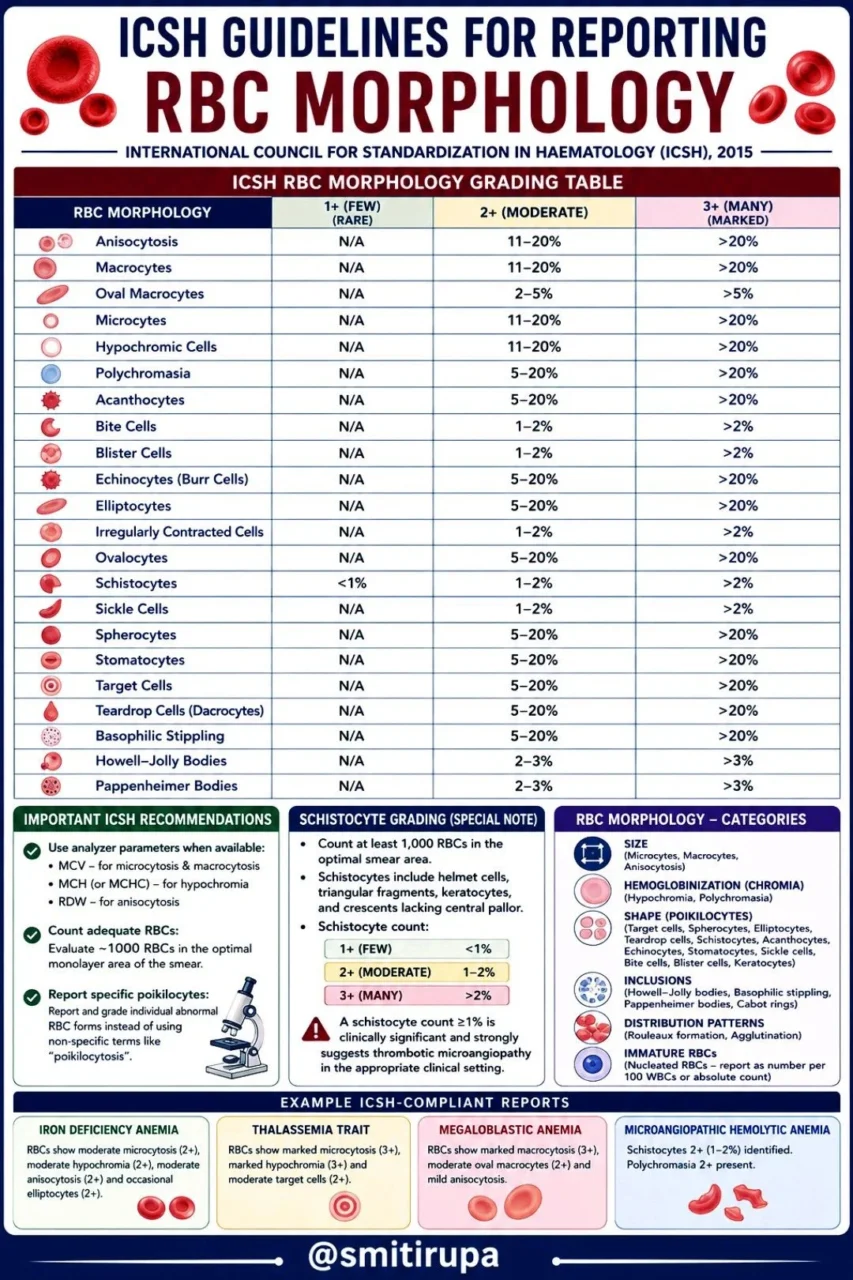
“Standardizing RBC Morphology Reporting: Why ICSH Guidelines Matter
Red blood cell morphology remains one of the most valuable components of peripheral smear examination.
However, it is also one of the areas where significant inter-observer variability exists.
Terms such as ‘few’, ‘occasional’, ‘mild’, or ‘moderate’ may mean different things to different observers, leading to confusion among clinicians and inconsistency across laboratories.
This is where the International Council for Standardization in Haematology (ICSH) guidelines play a crucial role.
The ICSH recommendations provide a standardized framework for reporting RBC morphological abnormalities, including:
- Anisocytosis
- Microcytosis and Macrocytosis
- Hypochromia
- Target cells
- Elliptocytes
- Spherocytes
- Schistocytes
- RBC inclusions and other poikilocytes
By defining percentage-based grading criteria, the guidelines help:
- Reduce subjectivity in reporting
- Improve inter-laboratory consistency
- Enhance communication with clinicians
- Facilitate better patient management and follow-up
- Strengthen quality assurance practices in hematology laboratories
One particularly important aspect is the reporting of schistocytes, where even small percentages can have significant clinical implications and may point toward life-threatening thrombotic microangiopathies.
As laboratory professionals, adopting standardized reporting systems is not merely about compliance—it is about improving diagnostic accuracy and ensuring that every morphology report conveys clear, reproducible, and clinically meaningful information.
The next time you report an RBC morphology, ask yourself:
Are we describing what we see, or are we reporting it in a standardized manner that others can interpret consistently?
Standardization transforms morphology from an art into a reproducible science.”
Stay updated with Hemostasis Today.
-
Oct 20, 2026, 06:45Grant Garcia: Why Does a Blood Clot Diagnosis Immediately End an Athlete’s Season?
-
Oct 20, 2026, 06:35Parag Tamhankar: Landmark Study Reveals Genetic Spectrum and Targeted Therapies for ALPS in the Indian Population
-
Oct 20, 2026, 06:26Nina Houben: Neonatal Blood Transfusion Symposium and PhD Defense
-
Oct 20, 2026, 05:46Jan T. Kielstein: DNP Poisoning and Hemoadsorption The Limits of Rescue Therapy
-
Oct 20, 2026, 05:33Giulia Di Paolo: Connecting Plasma Donation to the Patients Who Depend on It
-
Oct 20, 2026, 05:20James Knowles: Exploring Plasma Manufacturing and Strengthening Industry Collaboration
-
Oct 20, 2026, 05:11Giuseppe Lippi։ Understanding Liver Test Abnormalities After AAV Gene Therapy
-
Oct 20, 2026, 05:02Sanam Loghavi: Test Your Hematology Knowledge at ASH 2026!
-
Oct 20, 2026, 04:13Ifeanyichukwu Ifechidere: DOACs Are Not the Answer to Every Anticoagulation Question