

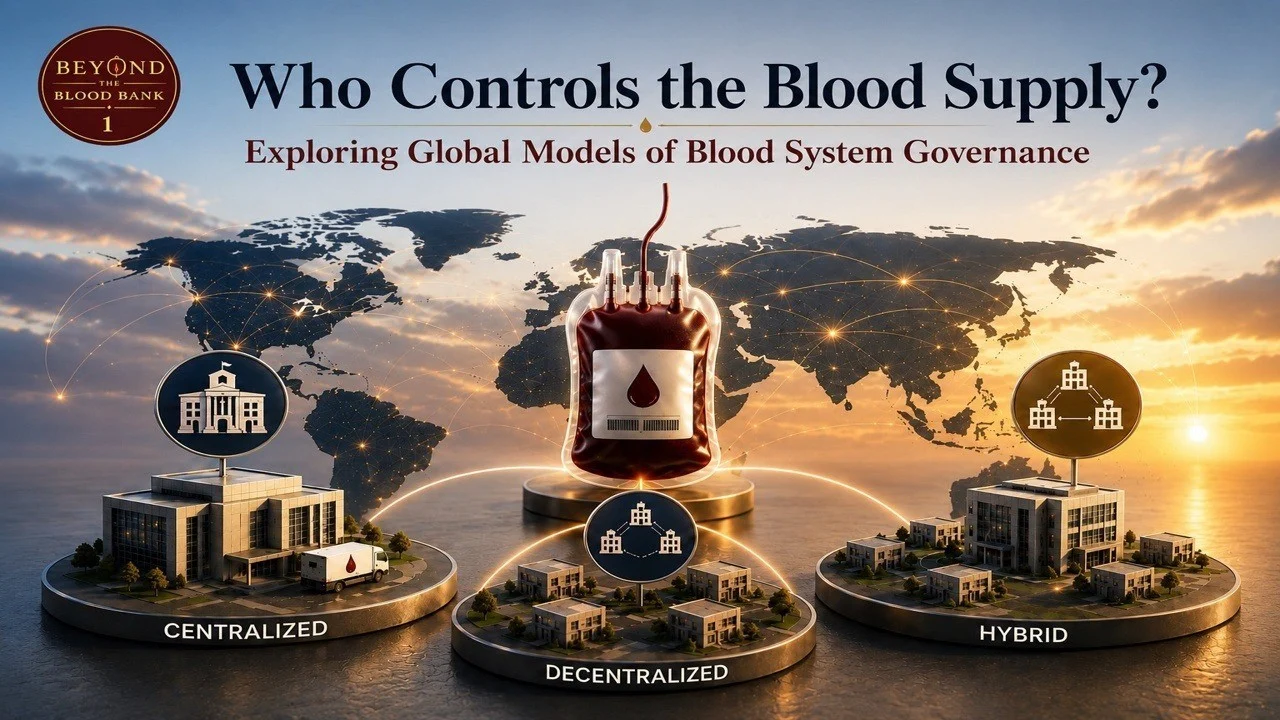
Tagreed Alkaltham: Building Blood Systems for Both Efficiency and Resilience
Tagreed Alkaltham, Transfusion Medicine Lab Supervisor at KSMC, shared a post on LinkedIn:
“Why This Matters?
‘The true strength of a blood system is not revealed during routine operations. It is revealed when the unexpected happens.’
When discussing blood systems, conversations often focus on donors, testing, inventory, and transfusion practices. Yet behind every unit of blood lies a larger question:
How should a nation organize its blood supply system?
The answer influences patient safety, emergency preparedness, resource utilization, financial sustainability, and healthcare resilience.
Understanding blood system models is not merely an administrative exercise. It is a strategic discussion about how healthcare systems protect patients when it matters most.
Introduction:
Every day, millions of blood components move silently across healthcare systems around the world. Behind every unit of blood lies a question rarely discussed:
Who should control the blood supply?
Should a nation operate under a single centralized blood authority responsible for collection, testing, processing, and distribution? Or should hospitals maintain independent blood banks with direct control over their inventory and readiness?
The answer is not merely administrative. It influences patient safety, emergency preparedness, resource utilization, financial sustainability, and ultimately the ability to save lives when seconds matter.
While most discussions in transfusion medicine focus on laboratory practices, donor recruitment, or clinical transfusion decisions, far less attention is given to the architecture of blood systems themselves.
Yet the way a nation organizes its blood supply may be one of the most important strategic decisions in healthcare.
The three primary models of blood system governance:
Despite differences across countries, most blood systems can generally be categorized into three primary governance models: centralized, decentralized, and hybrid. Each model offers distinct advantages, challenges, and approaches to balancing efficiency, standardization, local responsiveness, and system resilience.
Model One: The Centralized Blood System:
In a centralized model, blood collection, testing, processing, and distribution are coordinated by a national or regional organization. Hospitals become recipients of blood products rather than primary managers of the blood supply chain.
This model is commonly seen in countries such as Canada, the United Kingdom, and Australia.
Strengths:
- Standardized policies and procedures nationwide.
- Consistent quality and safety practices.
- Economies of scale that reduce duplication of resources.
- Greater visibility of national inventory levels.
- Easier redistribution of blood products between regions.
Challenges:
- Heavy dependence on a central supply network.
- Potential delays during urgent local demands.
- Reduced flexibility at the hospital level.
- Vulnerability if disruptions occur within the central system.
- Centralization creates efficiency, but efficiency alone does not always guarantee resilience.
Model Two: The Decentralized Blood System:
In a decentralized model, hospitals maintain greater autonomy over their blood inventory and operational decisions. Each institution assumes a larger role in ensuring local readiness and managing supply.
Strengths:
- Faster operational response.
- Greater flexibility in addressing local clinical needs.
- Increased autonomy in inventory management.
- Strong local preparedness during emergencies.
Challenges:
- Variability in practices between institutions.
- Higher operational costs.
- Duplication of resources and infrastructure.
- More complex quality oversight.
- Decentralization often strengthens local responsiveness. However, it may also create fragmentation across the broader healthcare system.
Model Three: The Hybrid Model:
The hybrid model combines the strengths of both centralized and decentralized blood systems.
Under this approach, a national or regional authority provides overall governance, establishes standards, oversees quality and safety, coordinates inventory at a broader level, and supports strategic planning.
At the same time, individual hospitals maintain their own blood bank operations, local inventories, and the ability to respond rapidly to routine and emergency transfusion needs.
Rather than relying entirely on a central supply structure or granting complete independence to each hospital, the hybrid model seeks to create a balance between national coordination and local readiness.
This approach allows healthcare systems to benefit from standardization and oversight while preserving the flexibility and responsiveness required at the hospital level.
For this reason, many experts consider the hybrid model one of the most resilient approaches to blood system governance, particularly in environments where both efficiency and emergency preparedness are essential.
Strengths:
- Balanced governance and flexibility.
- Improved emergency preparedness.
- Better coordination during shortages.
- Enhanced local responsiveness without losing national oversight.
Challenges:
- Requires sophisticated coordination.
- More complex accountability structures.
- Dependence on strong communication and data systems.
The hybrid model recognizes an important reality:
Healthcare systems must be both efficient and resilient. One without the other is insufficient.
Comparative overview
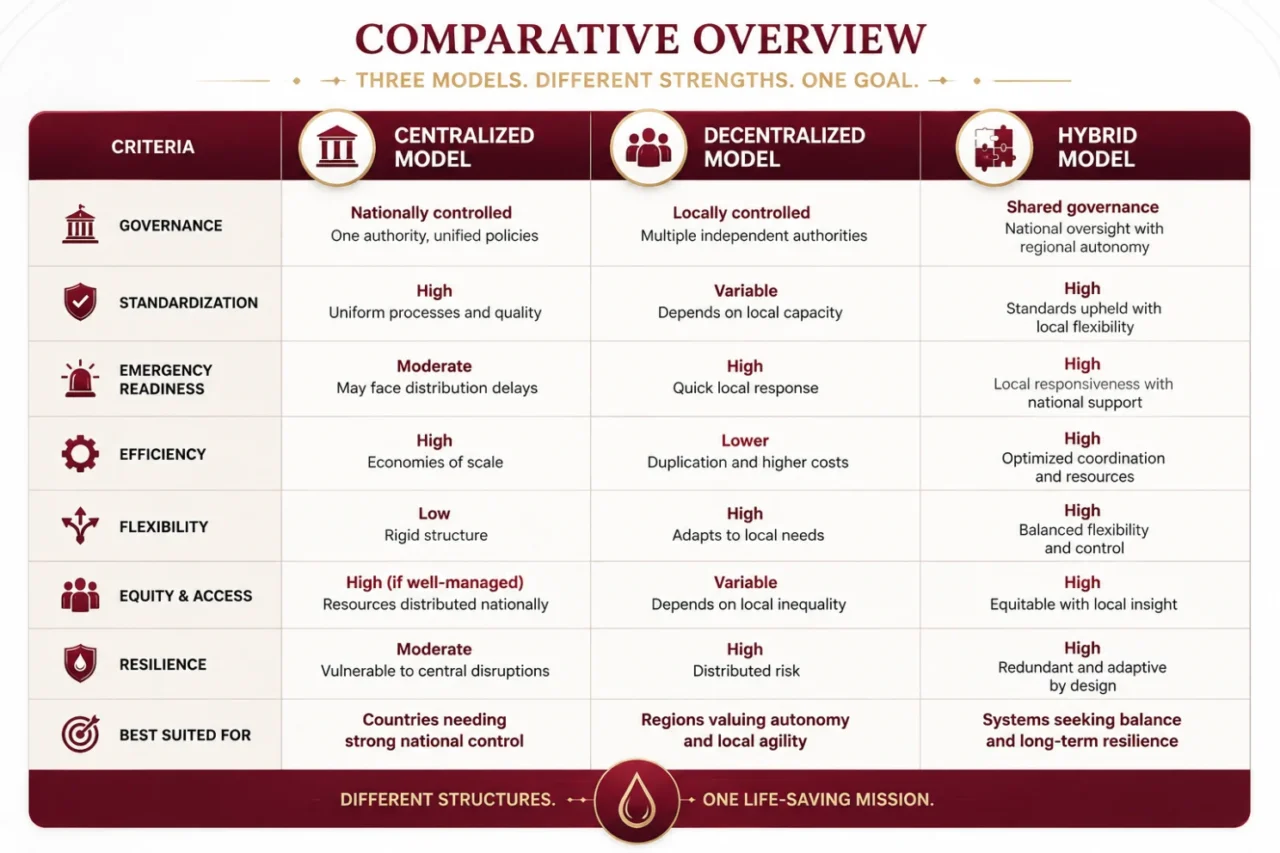
“The debate is not about centralization versus decentralization. The real debate is how to balance efficiency with resilience.”
Can a blood system be too centralized?
Centralization has transformed blood systems around the world by improving standardization, strengthening quality oversight, and optimizing resource utilization. However, an important strategic question deserves attention:
Can a blood system become too centralized?
While centralized models often achieve remarkable efficiency, excessive dependence on a single supply structure may introduce vulnerabilities that become visible only during periods of stress.
Natural disasters, pandemics, transportation disruptions, cyberattacks, sudden surges in demand, or supply chain interruptions can place significant pressure on highly centralized systems.
In such situations, hospitals may find themselves dependent on resources, decisions, or logistics beyond their immediate control. This does not suggest that centralization is inherently flawed. Rather, it highlights the importance of balancing efficiency with resilience.
Healthcare systems must not only perform well during normal operations; they must remain functional during extraordinary circumstances.
For this reason, many healthcare leaders are increasingly exploring concepts such as:
- Strategic reserve inventories.
- Regional contingency planning.
- Emergency stock positioning.
- Enhanced hospital readiness capabilities.
- Hybrid governance structures that combine national oversight with local flexibility.
The strongest blood systems are not necessarily those with the largest inventories. They are the systems capable of adapting when conditions change. Because resilience is not measured when everything goes according to plan. Resilience is measured when it does not.
The resilience question:
In transfusion medicine, efficiency is often visible. Resilience is not.
Efficiency can be measured through cost reduction, inventory optimization, and streamlined operations. Resilience is measured differently. It is measured when donor attendance suddenly drops.
When transportation routes are disrupted. When demand unexpectedly surges. When communication systems fail. When a hospital faces a major emergency at the worst possible moment.
Under normal conditions, many blood system models can appear successful. The true test comes during uncertainty. A resilient blood system is not simply one that stores blood. It is one that anticipates risk, adapts to change, maintains continuity, and protects patient care despite disruption.
For healthcare leaders, the challenge is no longer choosing between efficiency and resilience.
The challenge is building systems capable of delivering both. Because the safest blood system is not necessarily the most centralized, the most decentralized, or even the most technologically advanced. It is the system that continues to function when circumstances are at their most difficult.
Beyond Inventory:
Discussions about blood systems often focus on how many units are available. A more important question may be:
How quickly can those units reach the patient who needs them most?
A blood system is not defined solely by inventory. It is defined by governance. By communication. By readiness. By the ability to function under pressure.
A perfectly stocked system can fail if coordination fails. Likewise, a modest inventory can save lives when supported by strong governance and operational agility.
Which Model Is Best?
Perhaps the better question is:Best for what?
If the primary objective is standardization and cost efficiency, centralization offers clear advantages. If the priority is local responsiveness and operational autonomy, decentralization may be attractive.
If the goal is long-term resilience, many experts increasingly look toward hybrid solutions that balance national coordination with local readiness.
There is no universal answer. Healthcare systems differ. Geography differs. Resources differ. Patient populations differ. What succeeds in one country may not succeed in another.
While no single model can be considered universally optimal, many healthcare systems are increasingly moving towardhybrid approaches that combine national coordination with local readiness.
This reflects a growing recognition that effective blood system governance requires both efficiency and resilience. The future may not belong to systems that choose one over the other, but to those capable of integrating the strengths of both.
Looking Ahead:
As healthcare systems continue to evolve, the discussion is gradually shifting beyond the traditional debate of centralization versus decentralization. Increasingly, the focus is turning toward a different question:
How can blood systems achieve both national coordination and local readiness?
A growing number of healthcare leaders recognize that neither extreme centralization nor complete decentralization alone can address every challenge facing modern blood systems. National coordination remains essential for standardization, quality oversight, resource optimization, and crisis management.
At the same time, local readiness remains critical for rapid response, operational flexibility, and emergency preparedness. The future may therefore belong to systems that successfully combine both. Systems that maintain national visibility while preserving local capability.
Systems that achieve efficiency without sacrificing resilience. And systems that recognize that preparedness is not measured only by inventory levels, but by the ability to respond when patients need blood most.
In the end, the strongest blood systems may not be those that choose between centralization and decentralization. They may be those that effectively integrate the strengths of both.
Beyond the Models:
Around the world, blood systems have evolved through different models, structures, and philosophies. Some prioritize national coordination. Others emphasize local autonomy. Many seek a balance between the two. Yet regardless of the model, one principle remains universal:
Patients do not depend on organizational charts. They depend on reliable access to safe blood when they need it most.
The future of transfusion medicine will not be shaped solely by technology, automation, or inventory levels.
It will be shaped by how effectively healthcare systems balance governance, readiness, flexibility, and resilience. Because ultimately, the question is not who controls the blood supply.
The question is whether the system can deliver the right blood, to the right patient, for the right reason, at the right time, every time.”
Find more posts featuring Tagreed Alkaltham on Hemostasis Today.
-
Oct 20, 2026, 16:51Suzan Nakasendwa: A Growing Stroke Challenge in Uganda
-
Oct 20, 2026, 16:38Steve Moon: How Does Smoking Cessation Duration Affect Ischemic Stroke Risk
-
Oct 20, 2026, 16:25Cedrice Mentor: Reducing Platelet Wastage Through Cold Storage
-
Oct 20, 2026, 16:09Thirunavukkarasu Angappan: Can a Purified Fibrinogen Concentrate Replace Cryoprecipitate
-
Oct 20, 2026, 16:01Kalyan Roy: Platelet Conservation Through Evidence-Based Transfusion Practice
-
Oct 20, 2026, 15:28Stacy E. Croteau: 33 Countries, One Mission – Better Bleeding Disorder Care
-
Oct 20, 2026, 15:19Teresa Barnes: What Does a Pulmonary Embolism Mean for Jalen Hurts?
-
Oct 20, 2026, 15:04Laura S.: Could Speaking Up Prevent Maternal Deaths from Thrombosis?
-
Oct 20, 2026, 14:44Pete Stibbs: VTE in Professional Athletes – When Fitness Is Not Enough