


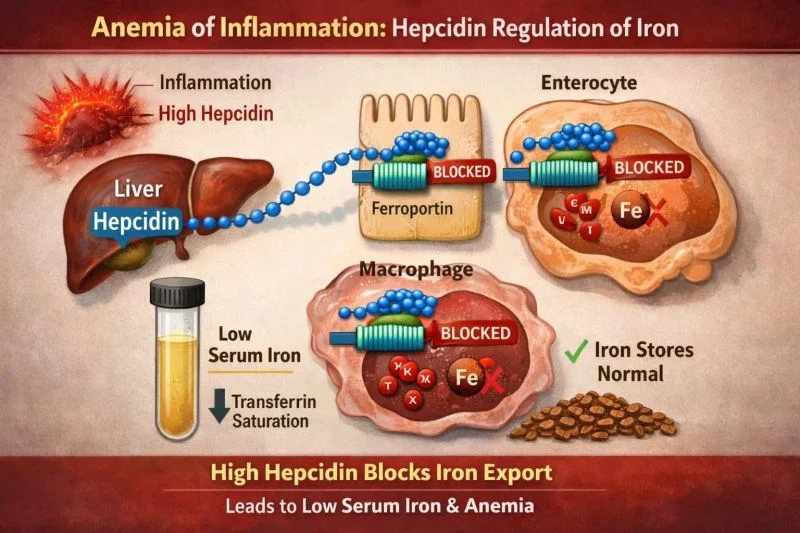
Tareq Abadl: Anemia of Inflammation – Hepcidin Regulation of Iron
Tareq Abadl, Medical Laboratory Specialist and Director of the Blood Bank at Dr. Abdelkader Al-Mutawakkil Hospital, shared a post on LinkedIn:
“Hepcidin – the iron gatekeeper
When hepcidin is high – serum iron and transferrin saturation (TSAT) are decreased — even if total body iron stores are normal.
This is the central mechanism behind anemia of inflammation (functional iron deficiency).
Why laboratories should care
1. Diagnostic power
Hepcidin measurement strengthens the differential diagnosis of anemia:
- Low hepcidin – true iron-deficiency anemia (IDA)
- High or normal hepcidin – anemia of chronic disease (ACD)/functional iron deficiency
This distinction directly determines whether oral iron therapy will succeed or fail.
Recent reviews and cohort studies consistently support hepcidin as a valuable adjunct marker in complex anemia workups.
2.Therapeutic prediction
Elevated hepcidin predicts poor response to oral iron.
It may guide clinicians toward:
- IV iron therapy
- Anti-inflammatory strategies
- CKD-specific management pathways
Assays — What Labs Must Know Before Implementation
Two main methodologies:
1. LC-MS/MS (Mass Spectrometry)
- High specificity
- Better harmonization potential
- Considered reference-grade
2. Immunoassays
- Convenient and commercially available
- Tend to read higher than MS methods
- Greater inter-platform variability, especially in inflammatory states
Do not mix values from different platforms. Know exactly which method your lab is using.
Standardization status
Harmonization is improving – but not perfect.
Proficiency testing shows inter – method variability.
Before offering clinical reporting:
- Perform method comparison with a reference lab
- Participate in external quality assessment (EQA) programs
- Establish internal QC material
Pre-analytical and reporting essentials
Proper pre-analytics are critical for reliable results:
- Use validated specimen type (EDTA plasma vs serum – assay dependent)
- Control time – to – centrifugation
- Avoid hemolysis
- Aliquot promptly
- Store at −80 degrees Celsius for batch analysis
Every report must include:
- Specimen type
- Analytical method
- Reference interval
Clinical interpretation without these details is risky.
Clinical interpretation framework
- Low hepcidin plus low ferritin plus low TSAT
True iron deficiency
Oral iron usually appropriate - High/normal hepcidin plus low TSAT plus normal/high ferritin
Functional iron sequestration (inflammation, CKD)
Consider IV iron or treat underlying inflammation
Oral iron likely ineffective - Borderline cases
Interpret alongside:
- Ferritin
- CRP
- TSAT
Clinical context (infection, CKD, pregnancy, recent transfusion)
Practical rollout checklist for laboratories
- Define the clinical use case (diagnostic reflex? research? clinician-requested test?)
- Select assay method
- Perform method comparison vs reference lab
- Finalize pre-analytical SOPs
- Train phlebotomy and processing staff
- Implement internal QC plus enroll in proficiency testing
- Add LIS interpretative comments to guide clinicians.”
Other posts featuring Tareq Abadl on Hemostasis Today.
-
Sep 30, 2026, 01:52Javed Anees: DADA2 – When a Young Stroke Is More Than a Stroke
-
Sep 30, 2026, 01:51How a Venous Thrombus Becomes Revascularized – ISTH
-
Sep 29, 2026, 22:45Victor Agunyego: Paracetamol – The Most Common Drug We Underestimate
-
Sep 29, 2026, 22:42Nova Sinclair: Advancing the Future of Hematology – Meet Our 2027 Organizing Committee
-
Sep 29, 2026, 22:41Lorenz Räber: Intracoronary Imaging in PCI – Why, When, How, and Which Modality?
-
Sep 29, 2026, 22:31Selma Turkovic: Pleased to Deliver the Opening Presentation at Kingston Hospital
-
Sep 29, 2026, 22:31Miguel Teran: Ultrasound and Simulation in Arterial Blood Sampling
-
Sep 29, 2026, 22:28Mohammad Refaei: Navigating Your Career in Hematology From Training to Practice
-
Sep 29, 2026, 22:27Matteo Foschi: 10 Clinical Pearls for Antithrombotic Therapy in Secondary Stroke Prevention