


Tareq Abadl: When and Why Do We Perform Weak D Testing?
Tareq Abadl, Medical Lab Specialist, shared a post on LinkedIn:
“Weak D Testing: When and Why Do We Perform It?
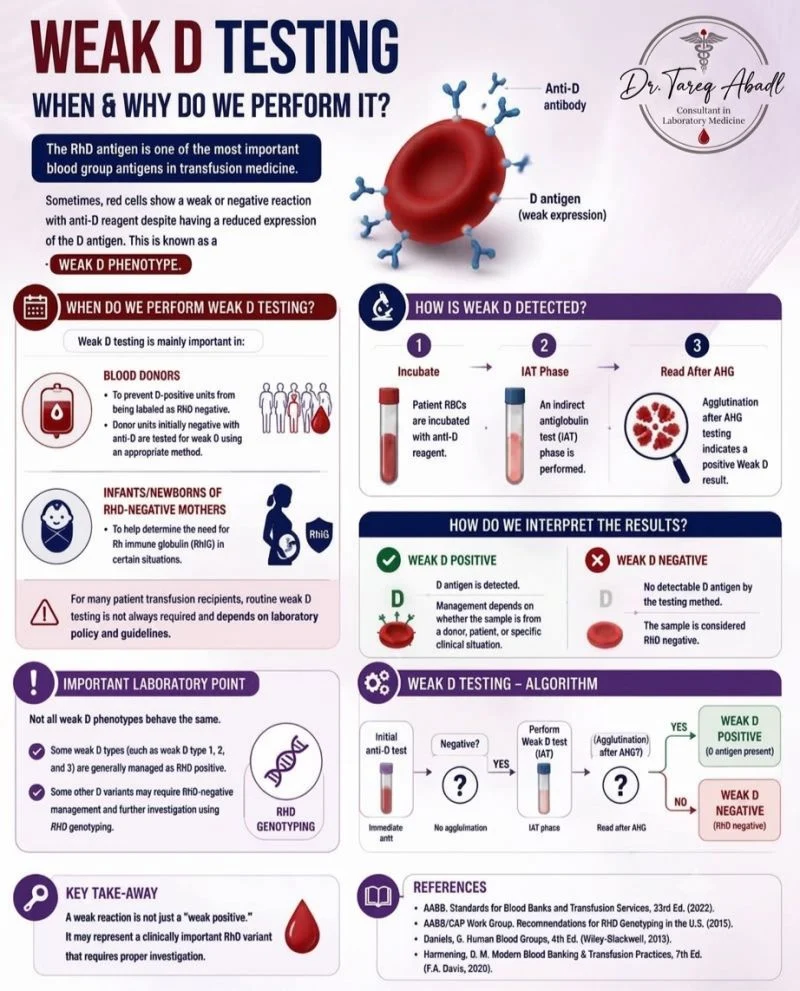
The RhD antigen is one of the most important blood group antigens in transfusion medicine.
But sometimes, a patient’s red cells may show a weak or negative reaction with anti-D reagent despite having a reduced expression of the D antigen.
This is known as a Weak D phenotype.
What is Weak D?
Weak D occurs when the D antigen is present on the red cell surface but expressed in a lower quantity, causing weaker reactions or requiring additional testing methods for detection.
When do we perform Weak D testing?
Weak D testing is mainly important in:
Blood donors.
To prevent D-positive units from being labeled as RhD negative.
Donor units initially negative with anti-D are tested for weak D using an appropriate method.
Infants or newborns of RhD-negative mothers.
To help determine the need for Rh immune globulin (RhIG) in certain situations.
For many patient transfusion recipients, routine weak D testing is not always required and depends on laboratory policy and guidelines.
How is Weak D detected?
If the initial anti-D test is negative:
- Patient RBCs are incubated with anti-D reagent.
- An indirect antiglobulin test (IAT) phase is performed.
- Agglutination after AHG testing indicates a positive Weak D result.
How do we interpret the results?
Weak D Positive
- D antigen is detected.
- Management depends on whether the sample is from a donor, patient, or specific clinical situation.
Weak D Negative
- No detectable D antigen by the testing method.
- The sample is considered RhD negative.
Important laboratory point:
- Not all weak D phenotypes behave the same.
- Some weak D types (such as weak D type 1, 2, and 3) are generally managed as RhD positive, while some other D variants may require RhD-negative management and further investigation using RHD genotyping.
Blood Bank principle:
A weak reaction is not just a ‘weak positive.’
It may represent a clinically important RhD variant that requires proper investigation.”
Other posts featuring Tareq Abadl on Hemostasis Today.
-
Oct 20, 2026, 03:24Chaza Alaji: Diagnosing Protein C and Protein S Deficiency
-
Oct 20, 2026, 03:24Mou Nandi: How Maternal Health During Pregnancy May Shape Infant Development
-
Oct 20, 2026, 03:13Sumyea Kabir: Pre-Analytical Quality in Phlebotomy – Preventing In Vitro Hemolysis
-
Oct 20, 2026, 02:37M. Sekip Altunkan: Can Anticoagulation Be Safely Stopped After AF Ablation?
-
Oct 20, 2026, 02:26Ahmed Ammar: Managing VT Recurrence Post-Ablation
-
Oct 20, 2026, 01:43Oliver Weingärtner: Deprescribing of Lipid Lowering Drug after MI is Associated with Cardiovascular Events
-
Oct 19, 2026, 19:44Where You Live Should not Determine Whether You Receive Care – World Federation of Hemophilia
-
Oct 19, 2026, 19:42Belen Bianco: Prevention, Early Suspicion and an Interdisciplinary Approach Save Lives
-
Oct 19, 2026, 19:40Christina Chrysohoou: Catheter-Based LAAC vs OAC for Stroke Prevention in Atrial Fibrillation