


Mohammed Al Kanan: Early Identification of VTE Risk in Lung Cancer Patients
Mohammed Al Kanan, Director of Research and Studies at Ministry of Health Saudi Arabia, shared a post on LinkedIn about a recent article by Rong Deng et al. published in Frontiers in Molecular Biosciences, adding:
“Pleased to have contributed as a peer reviewer for a newly published original research article in Frontiers in Molecular Biosciences:
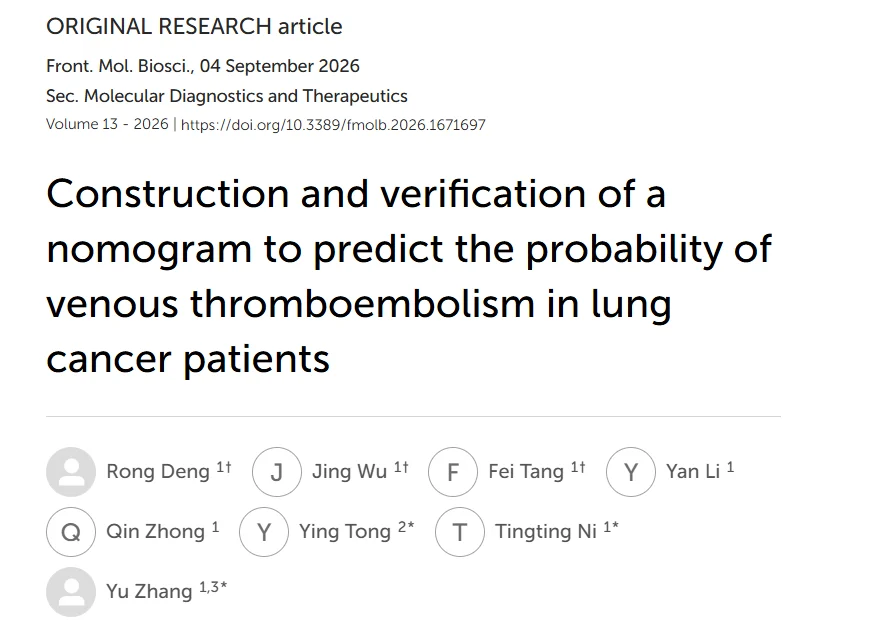
Construction and verification of a nomogram to predict the probability of venous thromboembolism in lung cancer patients.
This study tackles an important challenge in oncology: early identification of lung cancer patients at increased risk of venous thromboembolism (VTE) to support more individualized thromboprophylaxis and clinical decision-making.
Among 676 patients with lung cancer, the investigators developed a lung cancer–specific predictive nomogram incorporating clinically relevant factors such as acute infection, prolonged bed rest, D-dimer, adenocarcinoma, CEA, and COMPASS-CAT score.
What makes the findings particularly interesting is the model’s performance: AUC 0.894, outperforming several conventional VTE risk assessment tools, with favorable discrimination and calibration.
The work represents another step toward moving from generalized risk scores to more disease-specific and individualized prediction models—while prospective validation remains essential before widespread clinical implementation.
Grateful for the opportunity to contribute to the peer-review process and advancement of clinically relevant research.”
Title: Construction and verification of a nomogram to predict the probability of venous thromboembolism in lung cancer patients
Authors: Rong Deng, Jing Wu, Fei Tang, Yan Li, Qin Zhong, Ying Tong, Tingting Ni, Yu Zhang
Stay updated on all scientific advances with Hemostasis Today.
-
Oct 17, 2026, 04:07Weihao Li: Global HEPATIC Registry Findings on Post-Transplant Arterial Thrombosis
-
Oct 17, 2026, 03:56Ghaith Abu-Zeinah: ASH Publishes 2026 Guidelines for Myelofibrosis Management in Blood Advances
-
Oct 17, 2026, 03:48Tristan Siokos: Why Vascular Occlusion Is More Than Just Clots – Breakdown of the 8 Pathways
-
Oct 17, 2026, 02:36Archil Jaliashvili: Oxygen Transport in Capillaries
-
Oct 17, 2026, 02:35Carly Newton: Understanding Access to Red Blood Cell Exchange for People Living With SCD
-
Oct 17, 2026, 02:34Raising Awareness of Blood Clots During and After Pregnancy – Thrombosis UK
-
Oct 17, 2026, 02:33Alaa Salamat: Our Research Accepted for Publication at ASH 2026
-
Oct 17, 2026, 02:32Mohammed Al Sharif: Discussing Factor XIII Testing and Its Clinical Significance
-
Oct 17, 2026, 02:31Joanna Popiolek-Kalisz: Talking about Novel Pharmacotherapy for Hypertension at CV Prevention and Intervention