


M. Ibrahim Siddique: Does Routine Triple Therapy Pay Off After Anterior STEMI?
M. Ibrahim Siddique, MBBS Student Council, Treasurer at Ziauddin University, shared a post on LinkedIn about a recent article he and his colleagues co-authored, published in Sage journal, adding:
“Alhamdulillah.
Pleased to share the publication of our systematic review and meta-analysis:
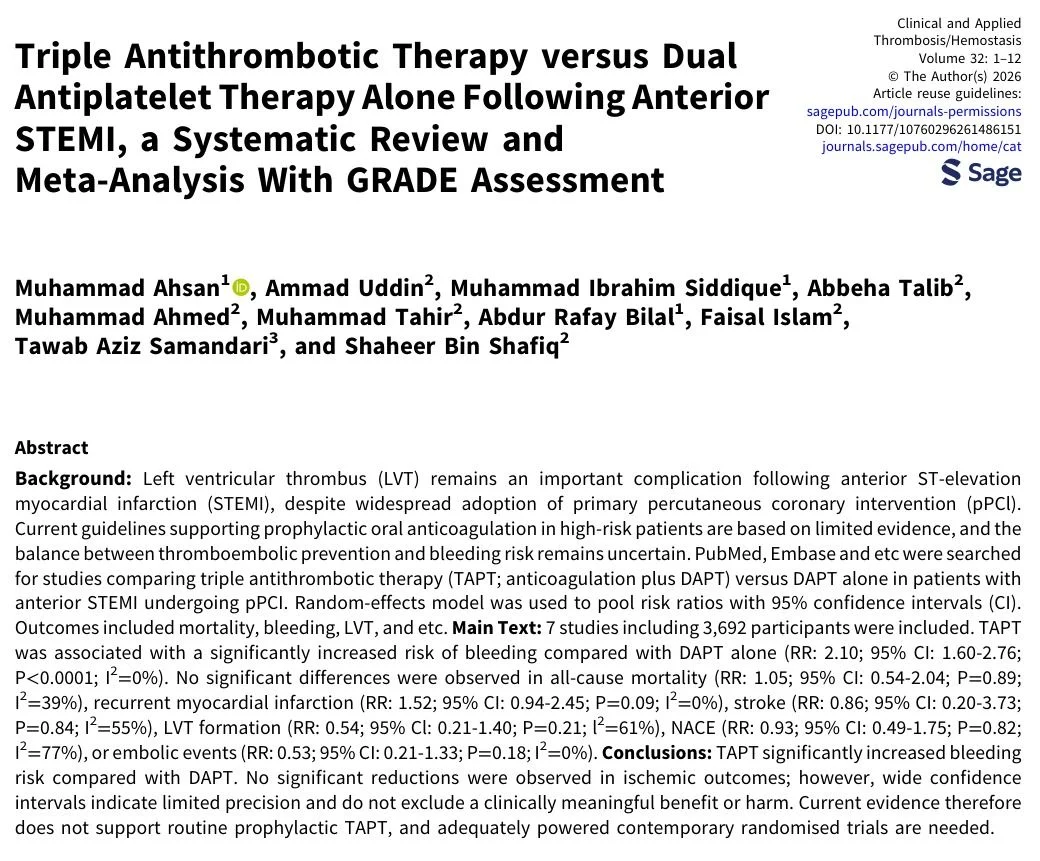
‘Triple Antithrombotic Therapy versus Dual Antiplatelet Therapy Alone Following Anterior STEMI: A Systematic Review and Meta-Analysis With GRADE Assessment’, published in the Sage journal, Clinical and Applied Thrombosis/Hemostasis.
Left ventricular thrombus remains an important complication following anterior STEMI, even in the era of primary PCI.
A key clinical question is whether adding prophylactic anticoagulation to dual antiplatelet therapy provides enough thromboembolic benefit to justify the additional bleeding risk.
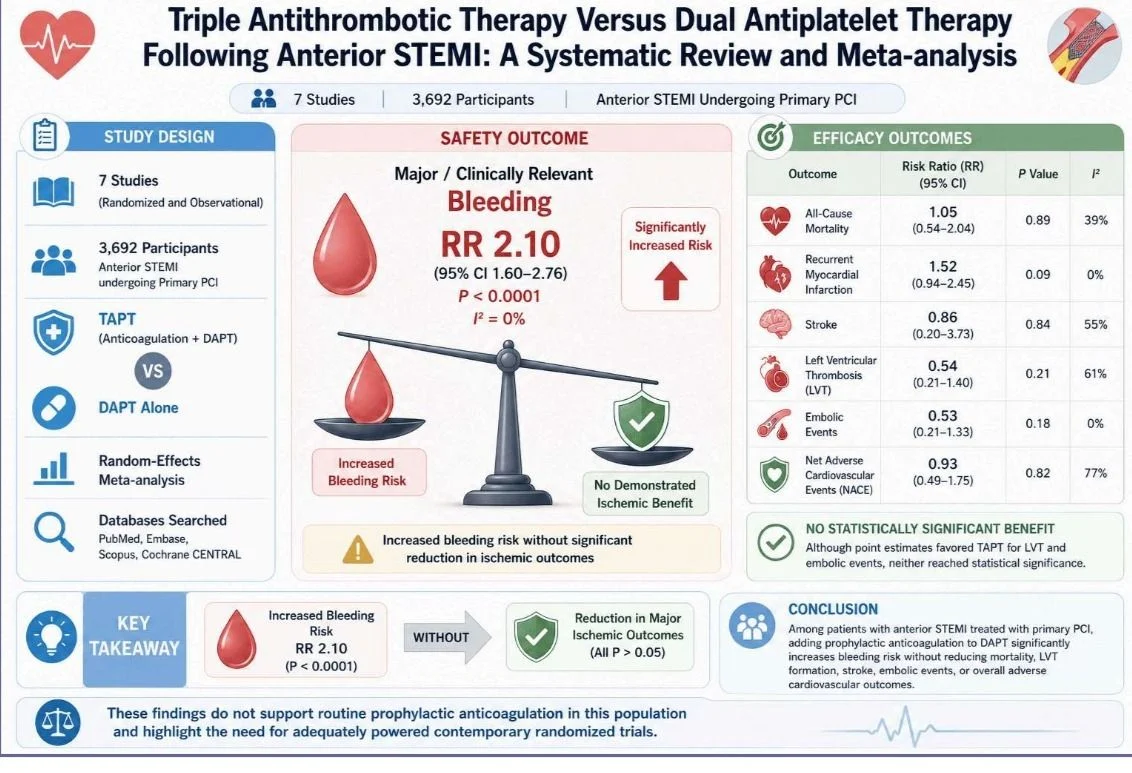
In this meta-analysis, we pooled data from 7 studies involving 3,692 patients undergoing primary PCI for anterior STEMI.
Our findings showed that triple antithrombotic therapy (TAPT) was associated with a significantly increased risk of bleeding compared with DAPT alone (RR 2.10, 95% CI 1.60–2.76).
In contrast, no statistically significant reductions were observed in left ventricular thrombus formation, all-cause mortality, recurrent myocardial infarction, stroke, systemic embolism, or net adverse cardiovascular events.
Overall, the current evidence does not support routine prophylactic triple antithrombotic therapy for all patients following anterior STEMI.
Whether anticoagulation may still have a role in carefully selected patients at particularly high risk of left ventricular thrombus remains uncertain and warrants further investigation.
One part of this project that I particularly valued was performing the GRADE assessment.
It deepened my appreciation for the distinction between the magnitude of an observed effect and the certainty we can place in that estimate.
Assessing risk of bias, inconsistency, indirectness, publication bias and particularly imprecision across outcomes highlighted how seemingly similar pooled results can carry very different levels of confidence.
It was especially interesting to see this reflected in our findings; while the increased bleeding risk with triple therapy was relatively precise and consistent, several thrombotic outcomes had wider confidence intervals and a less certain evidence base.
This reinforced how the value of a meta-analysis lies not only in generating a pooled estimate, but also in critically evaluating how confidently that estimate can inform clinical interpretation and practice.
Grateful to all my co-authors for helping bring this work to publication.
Pleased to have been part of this work, and looking forward to further involvement in meaningful clinical research and evidence synthesis.”
Title: Triple Antithrombotic Therapy versus Dual Antiplatelet Therapy Alone Following Anterior STEMI, a Systematic Review and Meta-Analysis With GRADE Assessment
Authors: Muhammad Ahsan, Ammad Uddin, Muhammad Ibrahim Siddique, Abbeha Talib, Muhammad Ahmed, Muhammad Tahir, Abdur Rafay Bilal, Faisal Islam, Tawab Aziz Samandari, Shaheer Bin Shafiq
Stay updated on all scientific advances with Hemostasis Today.
-
Oct 20, 2026, 16:51Suzan Nakasendwa: A Growing Stroke Challenge in Uganda
-
Oct 20, 2026, 16:38Steve Moon: How Does Smoking Cessation Duration Affect Ischemic Stroke Risk
-
Oct 20, 2026, 16:25Cedrice Mentor: Reducing Platelet Wastage Through Cold Storage
-
Oct 20, 2026, 16:09Thirunavukkarasu Angappan: Can a Purified Fibrinogen Concentrate Replace Cryoprecipitate
-
Oct 20, 2026, 16:01Kalyan Roy: Platelet Conservation Through Evidence-Based Transfusion Practice
-
Oct 20, 2026, 15:28Stacy E. Croteau: 33 Countries, One Mission – Better Bleeding Disorder Care
-
Oct 20, 2026, 15:19Teresa Barnes: What Does a Pulmonary Embolism Mean for Jalen Hurts?
-
Oct 20, 2026, 15:04Laura S.: Could Speaking Up Prevent Maternal Deaths from Thrombosis?
-
Oct 20, 2026, 14:44Pete Stibbs: VTE in Professional Athletes – When Fitness Is Not Enough