

Tom B.: Platelet Transfusion as a Potential Mitochondrial Therapy for Sepsis
Tom B., CEO at Mitrix.Bio., shared a post on LinkedIn:
“Announcing a long-researched potential treatment for Sepsis and other infectious disease, based on platelet transfusions.
Yes…every platelet transfusion ever done in the past century, was by definition, a large-scale mitochondrial transplant.
By simply learning how to optimize this 100-year old treatment, ER doctors could save potentially 70,000 lives per year.
This will be open-sourced to the world community.
In my opinion, all ER, civilian or military hospitals should consider a pilot project.
Pleasanton, CA (August 19, 2026) – In 1928, Dr. Alexander Fleming discovered penicillin, leading to the era of antibiotics in medicine, saving countless millions of lives.
Now, a consortium of top physicians and scientists from the US and Canada, working with startup Mitrix Bio Inc., have announced what promises to be another fundamental breakthrough for infectious disease, especially focused on sepsis.
Sepsis annually causes the deaths of at least 350,000 adults and more than 1,800 children in the US alone, along with $62 billion in hospital costs, according to the Sepsis Alliance.
The new technique, called Platelet-Derived Mitochondrial Transplant, uses components of platelets that have always been present in all blood and platelet transfusions but have remained unrecognized until now.
Canadian scientist Dr. Eric Boilard discovered in 2014 that when platelets age or are intentionally activated, they eject their healthy mitochondria, encased in special extracellular vesicles (‘Mitlets‘).
This is a natural process that results in the transfer of billions of mitochondria to the human bloodstream every day.
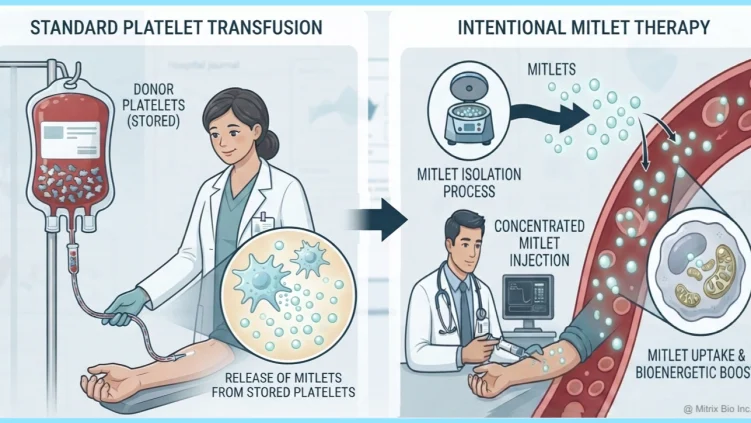
In hospitals and blood banks, donated platelets are commonly kept in storage for several days, ready for emergency use.
During that time, the number of Mitlets floating free in the bag of platelets grows.
Research has found that these Mitlets, when isolated from the platelets using a simple centrifuge spin, can be concentrated in large quantities and injected into patients safely and without bulky extraneous organic matter.
In animal tests, this technique has produced major improvements in mortality and morbidity from sepsis, an otherwise extremely dangerous disease.
This is a potentially powerful treatment for emergency rooms, hospitals, and even military field hospitals.
The process should be tested in pilot studies in these locations.
Michael Snyder PhD, Chair of Genetics and Personalized Medicine at Stanford University, Chief Medical Advisor for Mitrix Bio, says: ‘This is an exciting development, coming after a lot of hard work by many teams, including here at Stanford.
Mitochondrial transplantation is a growing field for many conditions, but sepsis is an especially important target because it’s so dangerous.’
How It Works
After they are separated from donated platelets, the Mitlets are injected intravenously into the target patient.
The Mitlets are quickly absorbed by nearby white blood cells and other platelets.
This leads to a “supercharging” effect, as the transplanted mitochondria boost the energy production of the recipient cell, allowing it to work harder and move faster to fight infection.
Note that this is a natural process that already happens in the human body: platelets emit mitochondria, which are immediately absorbed and put to work by white blood cells.
The transplant process simply isolates a much larger number of these Mitlets from donated platelets, potentially from younger donors, and then injects them into a sick patient to provide an extra immune-system boost.
Tom Benson, CEO of consortium leader Mitrix Bio, described it this way: ‘Imagine that you have a rechargeable drill, you’re working on a project, and the battery runs down.
Your drill slows down.
So, you plug in a freshly charged battery pack and complete the work.
That’s what Mitlets do for immune cells…acting as replaceable battery packs, fresh energy boosts to keep the white blood cells working at top speed.’
This is a simple form of mitochondrial transfusion, an important new technique that has been tested by top researchers all over the world, with coverage in The Economist, Nature, Fortune, and other publications.
Most conventional mitochondrial transfusions use mitochondria that are manually extracted from cells and are therefore fragile and short-lived.
Mitlets, on the other hand, are naturally occurring, target white blood cells, and deliver mitochondria in protective capsules, making them an easier alternative.
Animal and Human Trials
This process was extensively tested in animal trials at the University of Kentucky and in human safety trials in Dallas, Texas. Now the team believes it should be tested more widely.
This technique has been used (albeit inadvertently) for decades, seemingly unknown to science.
All platelet transfusions are, by definition, mitochondrial transplants, since the donated platelets release their Mitlets a few days after the transfusion, and any given unit of platelets contains large quantities of Mitlets in solution.
Also, the practice of PRP (platelet-rich plasma) injections, which are performed at thousands of clinics nationally and internationally, effectively involves the transplant of mitochondria (Mitlets) as well.
‘The new discovery that changes everything is that Mother Nature has been moving and swapping mitochondria around between cells for eons without our knowledge, so it turns out that doctors may have been doing the same without knowing it for a century,’ says Lance Becker, MD, chair of emergency medicine for Northwell Health, a 23-hospital chain in New York, who is also organizing the annual Mitochondrial Transplantation International Conference in early 2027.
‘We hope that transferring or transplanting mitochondria by intention is going to have some important health benefit quickly, if we just figure out how to best use this new cellular and bioenergetic approach.
ERs can start experimenting with it right away.’
Treatment Donated to Public Domain. Likely Pre-approved by Regulators
The isolation of these Mitlets from existing platelet donations is relatively simple, says the group.
The protocol has been described in publications, and since it’s an extension of an existing process, it will be released as an ‘open-source’ public-domain technique.
‘This is a variation of a 100-year-old well-understood platelet donation process,’ says Benson. ‘ER physicians and transfusion specialists have long suspected that platelet transfusions might benefit infections but didn’t fully appreciate the underlying mechanism.
Now that we know it’s mitochondrial transplantation, we hope that clinicians can begin expanding standard-of-practice guidelines and learning how to best use it – a powerful new tool for doctors.’
Because it is an existing, if unrecognized, variation of platelet therapy, it is believed that this technique will likely be ‘grandfathered-in’ by existing regulations.
Mitrix and the consortium members stress, however, that there has been no formal legal determination of regulatory status, and anyone considering the process should consult with their own legal counsel.
Becker says, ‘Ideally, for a new medical treatment of this type, we want to create a small network of specialized research ERs in different parts of the nation to learn how to properly produce and administer the Mitlets, which will drive early human administration pilot studies for safety and feasibility.
If possible, we will include VA and military medical researchers to learn more – faster – and to accelerate the pace of science.
Doctors, clinicians, and patients striving for better health will need to drive it at the grass-roots level.’
The same immune-system boosting technique may also have benefits for many other diseases, including pneumonia, Covid, influenza, hospital-acquired infections, and potentially even cancer.
Additionally, Mitrix Bio’s clinical partners in Right-To-Try 2.0 states will be offering the treatment for some conditions.
A New Approach to Infection Treatment
Eric Boilard, PhD, who is a Full Professor, Department of Microbiology and Immunology, Faculty of Medicine, Université Laval, and a scientific advisor for Mitrix Bio, says: ‘We have been very interested in the content and functions of these Mitlets.
Research in this field is advancing rapidly worldwide, and every new discovery is an exciting step toward understanding these remarkable particles and their potential impact on health and disease.’
Samir Patel, PhD, who is Assistant Professor, Department of Physiology, SCoBIRC at University of Kentucky, and also a scientific advisor for Mitrix Bio, says: ‘Mitochondrial dysfunction is one of the most underappreciated drivers of organ failure in sepsis – cells run out of energy faster than they can be rescued.
Mitlets offer a way to address that energy crisis directly – a genuinely different lever from anything currently in the sepsis toolkit.’
This new approach to infection treatment is not an antibiotic or an antiviral.
It is an entirely new approach to fighting infection by supercharging the body’s own immune system.
It should be especially beneficial in the elderly, who have age-weakened mitochondria.
The addition of new mitochondria from a younger donor can have the effect of making their immune system “younger.’
Note that the energy boost is temporary.
After a few days, the new mitochondria are discarded along with the used-up and battle-damaged white blood cells.
To extend the effect, clinicians may choose to do multiple treatments, perhaps every 2-3 days, until the sick or septic patient can be discharged from the ICU.
Also, note that this technique seems to be perfectly compatible with existing antibiotics, providing the possibility of a synergistic ‘1-2 punch’ for treating sepsis and other infections.
Potential Benefits
Sepsis claims 350,000 lives per year in the US and Canada, and it is one of the more expensive diseases for hospitals to treat.
Assuming only a 20% improvement, a new treatment could potentially save 70,000 lives and $12 billion annually.
What’s Next
There will be a series of webinars for hospitals, ERs, blood banks, and military medical providers.
Stay updated with Hemostasis Today.
-
Aug 26, 2026, 10:09Gemma Figtree: How Well Do We Predict Heart Attack Risk in Women?
-
Aug 26, 2026, 10:06Understanding and Managing Fatigue in ITP – ITP Support Association
-
Aug 26, 2026, 10:04Abdul Muqtadir Abbasi: When a High INR Hides a Thrombotic Cancer
-
Aug 26, 2026, 09:42Mohammed Alo: What’s Wrong With the New Blood Pressure Guidelines?
-
Aug 26, 2026, 09:01Mary Cushman: The Role of IL-6 in Cardiovascular Disease
-
Aug 26, 2026, 07:49Linda Koch: Understanding Ageing Through Biological Transitions
-
Aug 26, 2026, 05:38Elias Lee։ Beyond MCA Stenosis – Recognizing Moyamoya
-
Aug 26, 2026, 03:46Hugo Ribeiro: Which NSAIDs Are Safest for Older Adults?
-
Aug 25, 2026, 19:45Cara T. Hoepner: Omega-3 is Not an Exposure