

Tristan Siokos: Why Vascular Occlusion Is More Than Just Clots – Breakdown of the 8 Pathways
Tristan Siokos, Founder/CEO of Recalibrate, Co-Founder/CTO of PolicyBridge, shared a post on LinkedIn:
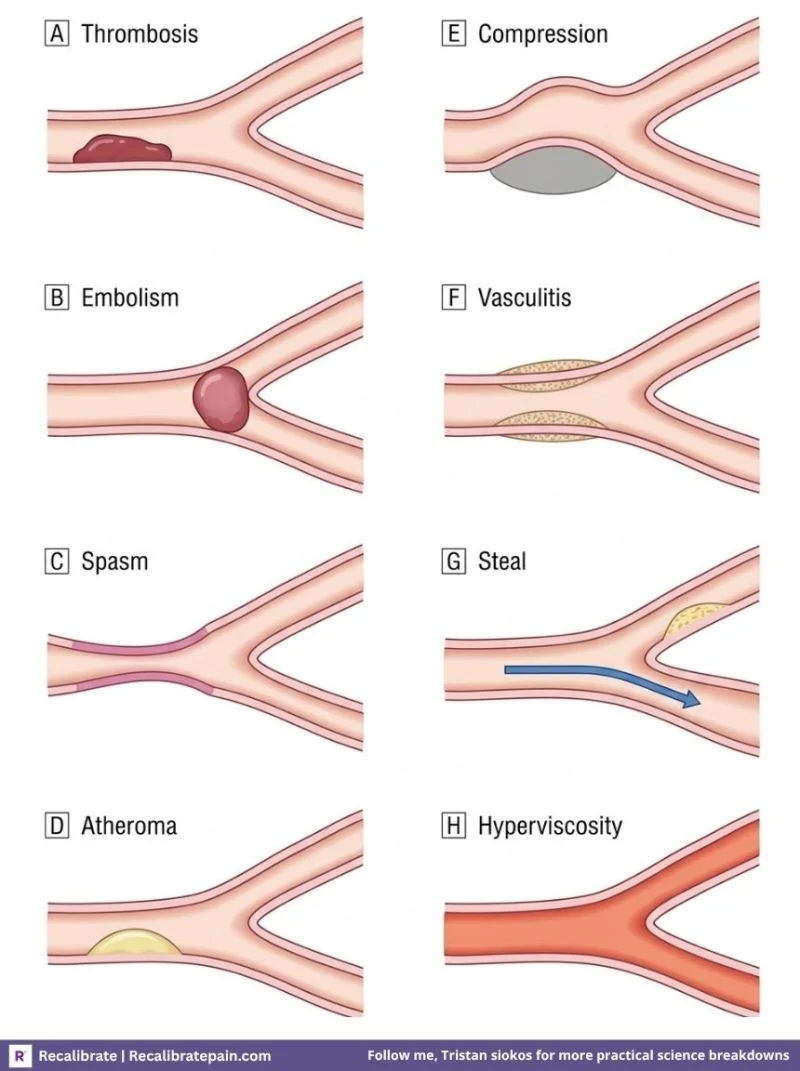
“A blood vessel can stop delivering blood in eight completely different ways, let’s explore the science.
Thrombosis and embolism get confused constantly, but they are not the same event.
Thrombosis is a clot that forms right there in the vessel, usually building up slowly where the wall is already damaged.
Embolism is a clot or fragment that formed somewhere else entirely and traveled through the bloodstream until it hit a narrowing it could not pass. Same end result, completely different crime scene.
Atheroma is the slow one.
Fatty deposits build up inside the vessel wall over years, narrowing the channel bit by bit until flow is already compromised long before anyone notices a symptom.
Compression and vasculitis sit on opposite sides of the same idea.
Compression is something from outside the vessel, a mass or swelling, physically pressing the channel shut.
Vasculitis is the vessel’s own wall being attacked by inflammation from within, no outside force required.
Spasm might be the strangest one on this list because nothing is blocking anything.
The vessel wall is mostly smooth muscle, and that muscle can simply contract hard enough to choke off its own flow with zero clot, plaque or mass anywhere in sight.
Then there is steal, which barely makes sense the first time you hear it.
Blood actually gets rerouted away from where it is needed toward a lower resistance path elsewhere in the system.
Subclavian steal syndrome is the classic case, where using your arm can pull blood away from your own brain and trigger dizziness on the spot.
Hyperviscosity does not touch the vessel at all.
The vessel stays completely open.
The blood itself is just too thick to move through it properly.
At very high concentrations, blood can become roughly ten times as viscous as water, and that alone is enough to starve tissue of flow.
Eight mechanisms, one shared outcome: blood stops arriving where it is needed.
Which is exactly why guessing the cause instead of identifying it is how treatment goes wrong.”
Stay updated with Hemostasis Today.
-
Oct 17, 2026, 02:36Archil Jaliashvili: Oxygen Transport in Capillaries
-
Oct 17, 2026, 02:35Carly Newton: Understanding Access to Red Blood Cell Exchange for People Living With SCD
-
Oct 17, 2026, 02:34Raising Awareness of Blood Clots During and After Pregnancy – Thrombosis UK
-
Oct 17, 2026, 02:33Alaa Salamat: Our Research Accepted for Publication at ASH 2026
-
Oct 17, 2026, 02:32Mohammed Al Sharif: Discussing Factor XIII Testing and Its Clinical Significance
-
Oct 17, 2026, 02:31Joanna Popiolek-Kalisz: Talking about Novel Pharmacotherapy for Hypertension at CV Prevention and Intervention
-
Oct 17, 2026, 02:00How Antiphospholipid Syndrome Can Affect the Adrenal Glands – APS Foundation of America
-
Oct 17, 2026, 01:59Liza-Marie Johnson: How Far Should Clinicians Go to Influence Parents’ Decisions?
-
Oct 17, 2026, 01:54Jim Hoffman: The Importance of Self-Advocacy and Understanding Autoimmune Mechanisms