

Yves Bikorimana: Before Wash vs After Wash in Blood Grouping
Yves Bikorimana, CEO at MedData-Rwanda and Lab Scientist at The University Teaching Hospital of Kigali-Chuk, shared a post on LinkedIn:
“Before Wash vs After Wash in Blood Grouping – Why It Matters
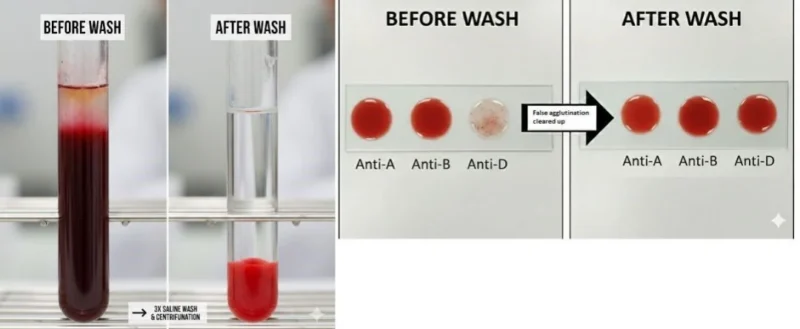
In immunohematology, small technical details can completely change interpretation. This image perfectly demonstrates the importance of the saline wash step during blood grouping and antibody testing.
Let’s break it down
Left Side: Tube Method (Cell Washing)
Before Wash
We see a red cell suspension with plasma and possible interfering substances still present. Proteins, rouleaux formation, or excess antibodies can create pseudo-agglutination or mask true reactions.
After 3× Saline Wash plus Centrifugation
The supernatant becomes clear, and only packed red cells remain at the bottom.
Why is this important?
- Removes unbound antibodies
- Eliminates excess plasma proteins
- Prevents false reactions
- Improves accuracy of antiglobulin testing
Washing ensures we are detecting true antigen–antibody reactions, not artifacts.
Right Side: Slide/Card Agglutination (Anti-A, Anti-B, Anti-D)
Before Wash
Anti-D appears weakly positive — but note the label: False agglutination.
Sometimes:
- Rouleaux formation
- Fibrin strands
- High protein states
- Improper cell suspension
can mimic agglutination.
After Wash
The false Anti-D reaction disappears.
Result interpretation becomes clear and reliable.
- Anti-A: Negative
- Anti-B: Negative
- Anti-D: Negative
Final Blood Group: O Rh(D) Negative
Key Takeaway
In transfusion medicine, accuracy is patient safety.
A simple saline wash step can:
- Prevent mislabeling of blood groups
- Avoid incompatible transfusions
- Reduce risk of hemolytic transfusion reactions
In laboratory science, precision isn’t optional — it’s ethical responsibility.”
Stay updated with Hemostasis Today.
-
Oct 19, 2026, 03:02Neda Horvacki: Using ROTEM to Refine Transfusion Decisions in Acute Trauma
-
Oct 19, 2026, 02:45Diego Escarraman Martinez: MATTERs Study – When a Cohort Gave Us Major Clues about TXA in Trauma
-
Oct 19, 2026, 02:35Brian O Mahony: Promoting Physical Activity and Sport in Haemophilia Care
-
Oct 19, 2026, 02:35Malusi Mtetwa: Tranexamic Acid – What Does the Evidence Tell Us?
-
Oct 19, 2026, 02:34Rishabh Mishra: Does the Evidence Support Tranexamic Acid Formulations in Skincare?
-
Oct 18, 2026, 23:31Rana Al-Hrout: MAHA – More Than Schistocytes
-
Oct 18, 2026, 17:11Owen McCarty: Understanding Prekallikrein and Its Role in Inflammation and Thrombosis
-
Oct 18, 2026, 17:04Emna Gouider Belhadjali: Don’t Miss GPAS 2026 on Bleeding Disorders
-
Oct 18, 2026, 16:53Mehran Ghasemzadeh: Microparticle-Associated Mitochondrial DNA in Stored Platelet Products