


Edward Lee Carter: How Factor XI Inhibition Could Transform Anticoagulation Therapy
Edward Lee Carter, Clinical Pharmacist Practitioner at U.S. Department of Veterans Affairs, stared a post on LinkedIn about a recent article by Dan Chalothorn et al., published in Blood Journals Portfolio, adding:
“Factor Xi Inhibition: The Mechanism May Matter As Much As The Target
Could the next major advance in anticoagulation depend not simply on whether we inhibit factor XI, but how we inhibit it?
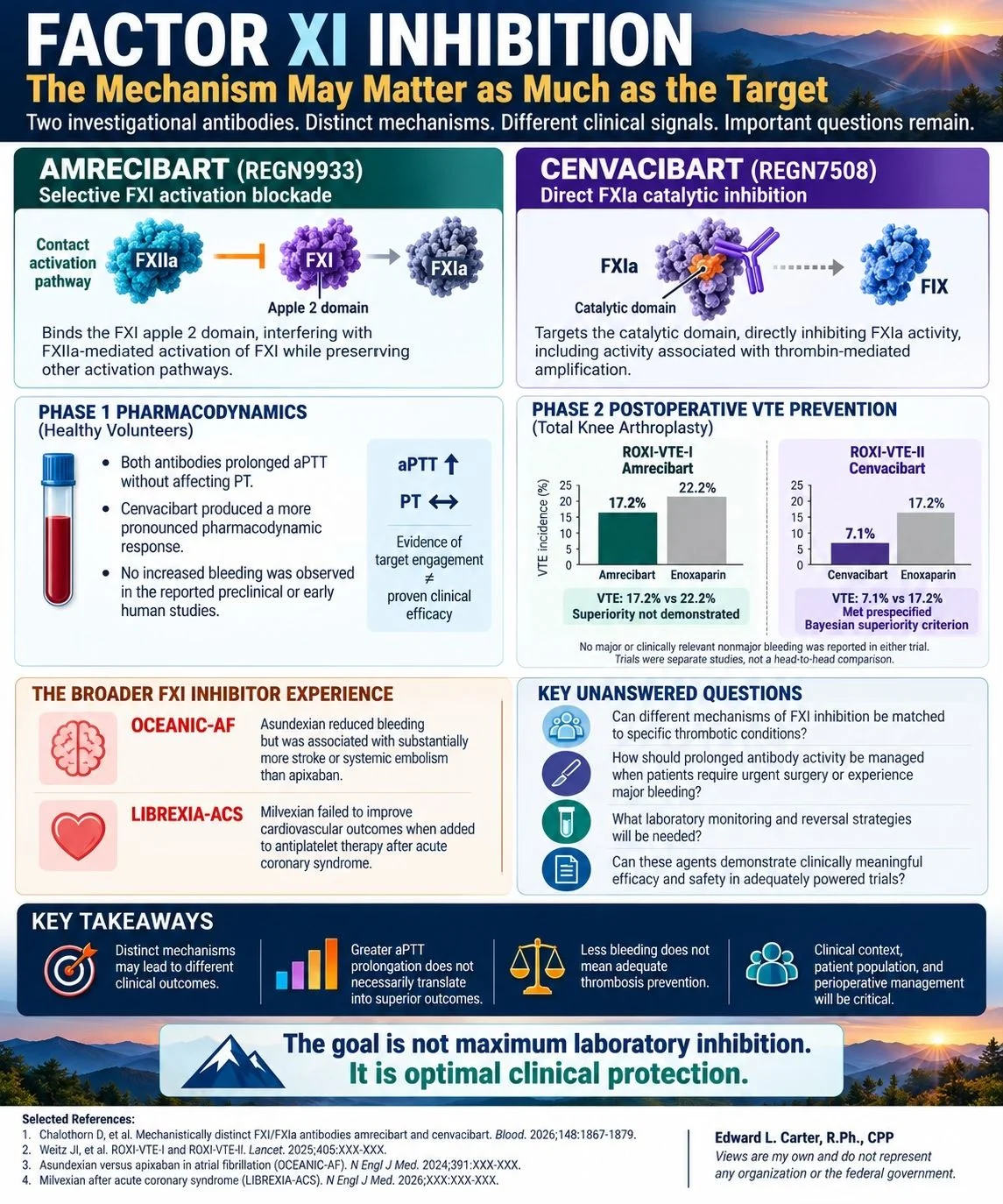
A study in the October 8, 2026 issue of Blood Journals Portfolio examines two investigational monoclonal antibodies with distinct mechanisms:
Amrecibart (REGN9933) interferes with factor XIIa-mediated activation of factor XI.
Cenvacibart (REGN7508) directly inhibits FXIa catalytic activity.
Both prolonged aPTT without affecting PT, although cenvacibart produced a more pronounced pharmacodynamic response.
But the clinical findings deserve even greater attention.
Two separate phase 2 studies evaluated these agents for VTE prevention following total knee arthroplasty:
• ROXI-VTE-I: VTE occurred in 17.2% with amrecibart versus 22.2% with enoxaparin. Superiority was not demonstrated.
• ROXI-VTE-II: VTE occurred in 7.1% with cenvacibart versus 17.2% with enoxaparin, meeting the trial’s prespecified Bayesian superiority criterion.
No major or clinically relevant nonmajor bleeding was reported in either trial.
These are encouraging findings, but the trials were relatively small, included asymptomatic venographic DVT, and did not directly compare the two antibodies.
The broader factor XI experience offers an important caution.
In OCEANIC-AF, asundexian reduced bleeding but was associated with substantially more stroke or systemic embolism than apixaban.
In LIBREXIA-ACS, milvexian failed to improve cardiovascular outcomes when added to antiplatelet therapy.
Less bleeding does not necessarily mean adequate thrombosis prevention.
From an antithrombotic stewardship perspective, the questions extend beyond laboratory inhibition.
Can different FXI mechanisms be matched to specific thrombotic conditions? How will prolonged antibody activity affect emergency surgery? What monitoring and reversal strategies will be necessary?
And most importantly, can these therapies demonstrate meaningful clinical benefits in adequately powered trials?
Greater aPTT prolongation does not necessarily predict better patient outcomes.
The goal is not maximum laboratory inhibition. It is optimal clinical protection.”
Title: Anticoagulation with the mechanistically distinct FXI/FXIa antibodies amrecibart (REGN9933A2) and cenvacibart (REGN7508Cat)
Authors: Dan Chalothorn, Aaron P. Kithcart,Ethan Marin, Selin Somersan-Karakaya, KehDih Lai, Frederic Cauwberghs, Jonathan Ackroyd,Kusha Mohammadi, Anju Shrestha, George Ehrlich, Ashique Rafique, Ishita Chatterjee, Kei Saotome, Matthew C. Franklin, Andrew J. Murphy, William Olson, Benjamin A. Olenchock, Gary A. Herman, David E. Gutstein, Andres Sirulnik, George D. Yancopoulos, Lori G. Morton
Find more posts featuring Edward Lee Carter on Hemostasis Today.
-
Oct 16, 2026, 12:40Marc Carrier: Looking Ahead to ISTH 2027 in Vancouver
-
Oct 16, 2026, 12:30Bob Lempke: How One Blood Donation Can Save Up to Three Lives
-
Oct 16, 2026, 12:30Why VWF Therapies Belong on the EU Critical Medicines List – EHC
-
Oct 16, 2026, 12:17Exploring Endothelial Cells, Genetic Fate Mapping, and Revascularization – ISTH
-
Oct 16, 2026, 10:07Habib Bennaceur: Building a Stronger Care Pathway for Sickle Cell Disease in India
-
Oct 16, 2026, 09:59Tareq Abadl: A Simple Guide to Blood Collection Tubes
-
Oct 16, 2026, 09:50Mona Alfaraj: Distinguishing HCL from SMZL in Bone Marrow
-
Oct 16, 2026, 09:44New International Consensus on Covert Brain Infarction – International Journal of Stroke
-
Oct 16, 2026, 06:17Neha Rastogi Panda: Precision Diagnosis and Organ Preservation in Splenic Abscess