

Obstetric Antiphospholipid Syndrome Beyond Anticoagulation: Toward Precision Obstetric Hemostasis
The Women’s Health and Antiphospholipid Syndrome sessions at the ISTH 2026 Congress highlighted a fundamental shift in how obstetric antiphospholipid syndrome (oAPS) is understood and managed.
Rather than viewing pregnancy complications as the direct consequence of placental thrombosis, researchers presented compelling evidence that immune dysregulation, endothelial injury, complement activation, angiogenic imbalance, and thromboinflammation begin disrupting placental development long before thrombosis occurs.
This evolving biological model challenges the traditional reliance on low-molecular-weight heparin (LMWH) and low-dose aspirin (LDA) alone and points toward a future in which treatment is guided by biomarkers, disease mechanisms, and individualized risk.
Beyond Thrombosis: Rethinking the Biology of Obstetric APS
While thrombosis remains the hallmark of antiphospholipid syndrome, pregnancy complications appear to arise much earlier at the maternal-fetal interface.
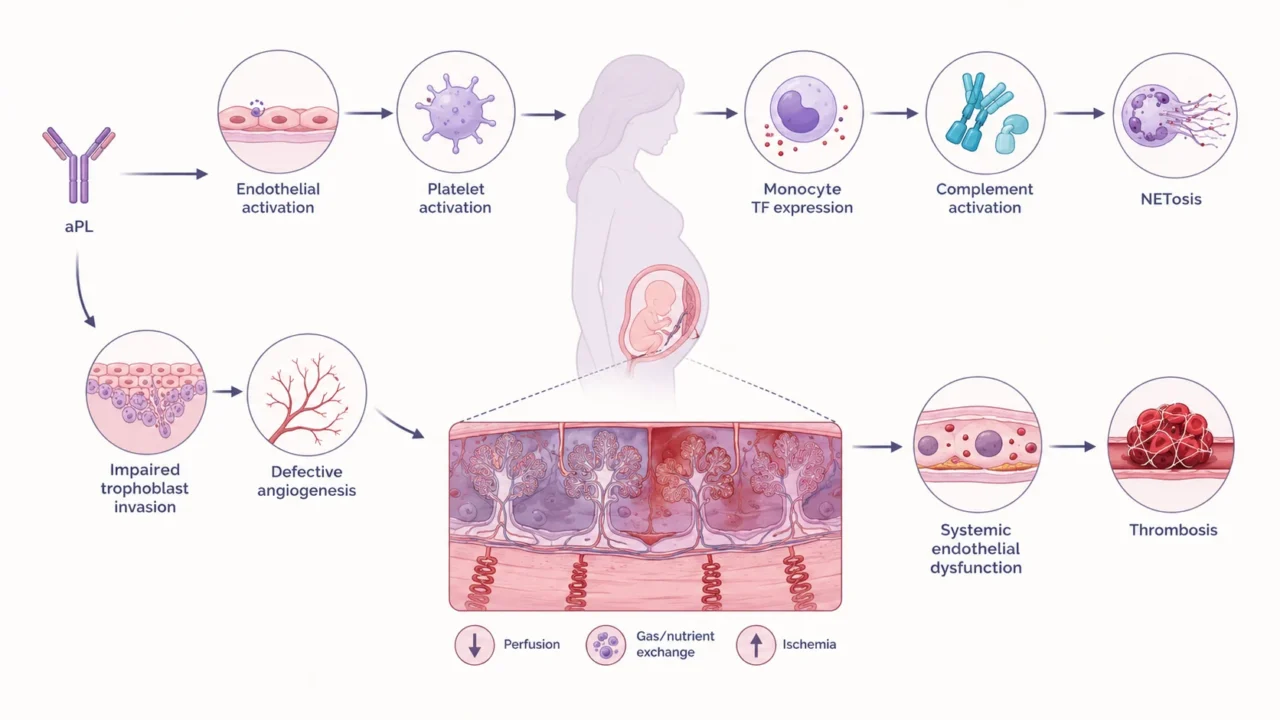
Presentations at ISTH described a complex network of interacting mechanisms initiated by antiphospholipid antibodies, including endothelial and platelet activation, monocyte tissue factor expression, complement activation, NETosis, impaired trophoblast invasion, defective placental angiogenesis, and placental vascular malperfusion.
Together, these processes culminate in systemic endothelial dysfunction and thrombosis.
This integrated model explains why some women continue to experience severe placental complications despite receiving appropriate anticoagulant therapy.
The key message was clear: placental disease begins before placental thrombosis.
Angiogenic Biomarkers Reveal Placental Dysfunction Early
One of the most compelling studies presented at the congress analyzed 513 women with obstetric APS receiving standard treatment with LMWH and aspirin.
Investigators measured circulating placental growth factor (PlGF) and soluble fms-like tyrosine kinase-1 (sFlt-1)before treatment and again after only four days of therapy.
Pregnancy outcomes were then monitored for preeclampsia, fetal growth restriction, placental insufficiency, and fetal loss.
Women who later developed placenta-mediated complications consistently demonstrated:
- higher sFlt-1 concentrations,
- reduced angiogenic response,
- persistent imbalance in the sFlt-1/PlGF pathway,
- despite receiving identical antithrombotic therapy.
These findings suggest that impaired placental vascular adaptation can be detected weeks before clinical complications become apparent.
Can the sFlt-1/PlGF Ratio Identify Women Who Need More Than Anticoagulation?
Among the most clinically relevant observations was the predictive value of angiogenic biomarkers.
Changes in the ΔPlGF/ΔsFlt-1 ratio independently predicted adverse pregnancy outcomes, achieving an area under the curve (AUC) of 0.745 for identifying women at increased risk.
Rather than waiting until placental insufficiency becomes clinically evident, clinicians may soon be able to identify pregnancies that are failing to respond biologically despite standard therapy.
Such biomarker-guided risk stratification represents an important step toward personalized management of obstetric APS.
Hydroxychloroquine: Expanding Its Role in Obstetric APS
Hydroxychloroquine (HCQ) also emerged as an increasingly important component of the evolving therapeutic landscape.
Experimental and translational studies presented during the session demonstrated that HCQ may:
- improve endothelial migration,
- restore endometrial angiogenesis,
- enhance vascular tube formation,
- reduce antiphospholipid antibody-induced endothelial dysfunction,
- suppress complement-mediated inflammation.
Clinical data further suggest potential reductions in recurrent pregnancy loss, placental complications, preeclampsia, and selected fetal cardiac complications.
Although robust randomized trials remain limited, the biological rationale supporting HCQ continues to strengthen, particularly for women at high obstetric risk.
Looking Beyond LMWH and Aspirin
Speakers also explored future therapeutic strategies for women who continue to experience pregnancy complications despite conventional treatment.
Emerging approaches include biomarker-guided treatment intensification, hydroxychloroquine in selected patients, complement inhibition, therapies targeting endothelial dysfunction, and interventions aimed at restoring placental angiogenesis.
While these strategies remain investigational, they reflect a growing recognition that correcting vascular and immune abnormalities may ultimately become as important as preventing thrombosis itself.
Pregnancy as the First Sign of Lifelong Vascular Disease
One of the most thought-provoking concepts discussed was that obstetric APS may represent the earliest manifestation of systemic vascular disease rather than an isolated pregnancy disorder.
Researchers proposed a biological continuum in which antiphospholipid antibodies initiate endothelial activation, complement signaling, and NETosis, leading first to placental vascular injury and later to persistent endothelial dysfunction that increases the risk of future venous and arterial thrombosis.
If validated, pregnancy complications could become an early warning sign of a lifelong thrombo-inflammatory phenotype, emphasizing the importance of long-term cardiovascular and thrombotic surveillance.
Toward Precision Obstetric Hemostasis
Collectively, the presentations reflected a major evolution in obstetric APS management.
Historically, treatment has relied on a standardized anticoagulation strategy for nearly all patients. Increasingly, however, research supports a more individualized approach based on molecular profiling, angiogenic biomarkers, immune mechanisms, and vascular biology.
The goal is no longer simply to prevent thrombosis, but to identify women at greatest risk early, understand the biology driving placental dysfunction, and tailor therapy accordingly.
Take-Home Message
The ISTH 2026 Congress underscored that obstetric antiphospholipid syndrome is far more than a thrombotic disorder. Placental vascular dysfunction, immune activation, complement signaling, and impaired angiogenesis appear to drive pregnancy complications from the earliest stages of gestation.
Emerging biomarkers such as the sFlt-1/PlGF ratio may help identify women who remain at high risk despite conventional LMWH and aspirin therapy, while therapies such as hydroxychloroquine offer promising opportunities to address the underlying biology rather than thrombosis alone.
Together, these advances signal a transition from empirical anticoagulation to precision obstetric hemostasis, where biomarker-guided care and targeted therapies have the potential to improve maternal and fetal outcomes.
Written by Heghine Khachatryan, MD, PhD, Editor-in-Chief at Hemostasis Today.
-
Oct 19, 2026, 10:57Jesmond Dalli: How Erythroblasts Shape Neutrophil Development and Function
-
Oct 19, 2026, 10:41Hisham Fahmi: SCD – Should Gene Editing Begin Before Organ Damage?
-
Oct 19, 2026, 10:33Pallavi Madhiraju: YARTEMLEA Faces Another European Rejection Despite FDA Approval
-
Oct 19, 2026, 10:28Brig Tathagata Chatterjee: Acute Leukemias in AYAs at the Japanese Society of Hematology Conference
-
Oct 19, 2026, 10:27Heather M. Johnson: Join the Discussion on Optimizing the CTEPH Diagnostic Pathway
-
Oct 19, 2026, 10:18Flora Peyvandi: Unravelling the Complexity of VWF Through Genetics
-
Oct 19, 2026, 09:55High DOAC Adherence in Patients With Ischemic Stroke and AF – International Journal of Stroke
-
Oct 19, 2026, 08:20Cory Dugan: The IRONWOMAN Trial Individual Responses to IV Iron Therapy in Active Women
-
Oct 19, 2026, 07:36Johannes Kaesmacher: Cerebral No-Reflow After Thrombectomy Toward a Standardized Definition