


Edward Lee Carter: First Factor XIa Inhibitor Approved Worldwide – U.S. FDA Decision Expected in November
Edward Lee Carter, Clinical Pharmacist Practitioner at U.S. Department of Veterans Affairs, stared a post on LinkedIn:
“Breaking: First Factor XIa Inhibitor Approved Worldwide – U.S. FDA Decision Expected in November
October 26, 2026, Antithrombotic Stewardship
A major milestone in stroke prevention.
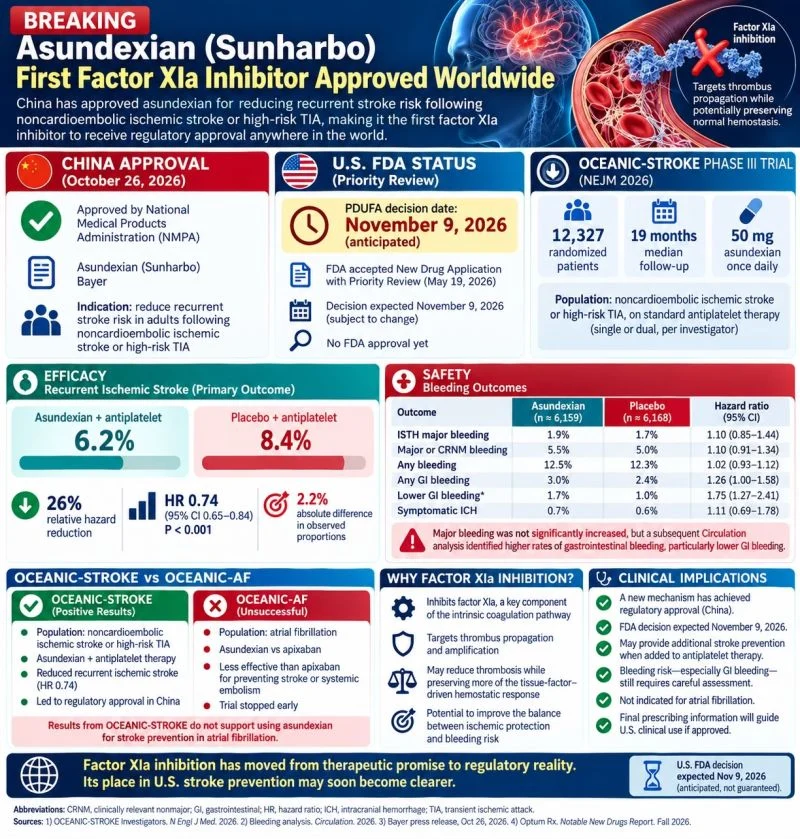
China has approved Bayer’s asundexian (Sunharbo), making it the first factor XIa inhibitor to receive regulatory approval anywhere in the world.
And the United States may be next.
The FDA accepted Bayer’s New Drug Application under Priority Review, with a decision anticipated November 9, 2026.
The approval is supported by the pivotal Phase III OCEANIC-STROKE trial, published in the New England Journal of Medicine.
12,327 patients, Median follow-up: 19 months
Asundexian 50 mg once daily was added to standard antiplatelet therapy following noncardioembolic ischemic stroke or high-risk TIA.
Recurrent ischemic stroke:
- Asundexian: 6.2%
- Placebo: 8.4%
- HR 0.74 (95% CI 0.65–0.84)
- 26% relative hazard reduction
ISTH major bleeding:
- Asundexian: 1.9%
- Placebo: 1.7%
- HR 1.10 (95% CI 0.85–1.44)
The major bleeding difference was not statistically significant, although subsequent analyses identified increased gastrointestinal bleeding, particularly lower GI bleeding.
Why is this important?
Factor XIa inhibition targets coagulation amplification involved in thrombosis while potentially preserving more normal hemostasis.
For decades, antithrombotic treatment has required balancing ischemic protection against bleeding complications.
Asundexian may represent an important advance in that balance.
But indication matters.
The earlier OCEANIC-AF trial was stopped because asundexian was less effective than apixaban for preventing stroke or systemic embolism in atrial fibrillation.
OCEANIC-STROKE evaluated a different strategy: adding factor XIa inhibition to antiplatelet therapy after noncardioembolic stroke or high-risk TIA.
These findings do not support replacing established AF anticoagulation.
What comes next?
The FDA’s anticipated November decision will be especially important for U.S. clinicians.
If approved, the prescribing information—including eligible patients, antiplatelet combinations, bleeding precautions, and renal considerations—will determine how this treatment enters clinical practice.
Factor XIa inhibition has moved from therapeutic promise to regulatory reality. Its place in U.S. stroke prevention may soon become clearer.
The views expressed are my own and do not represent the official positions or policies of the U.S. Department of Veterans Affairs or the U.S. government.”
Find more posts featuring Edward Lee Carter on Hemostasis Today.
-
Oct 27, 2026, 22:56Anne Troldborg: Preventing Thrombosis in SLE Before the First Event
-
Oct 27, 2026, 22:53Shadi Tabibian: Tazehnameh November 2026 Covers Key Developments in Hemophilia Care
-
Oct 27, 2026, 22:52Danny Hsu: THANZ Makes History With Its First Dedicated HHT Symposium at Blood 2026
-
Oct 27, 2026, 22:51Nathan Connell: Applications Open for Global Hematology Research Training at Mass General Brigham
-
Oct 27, 2026, 16:28Rose Agor: Celebrating Two New Publications in Haematology Research
-
Oct 27, 2026, 16:21Pregnancy and Thrombosis-What Clinicians Need to Know – World Thrombosis Day
-
Oct 27, 2026, 16:13Lesley Van Wyk: DIC vs TTP vs HUS – The Key Diagnostic Clues
-
Oct 27, 2026, 16:02Ahmad G. Alzahrani: AF and Vascular Risk Factors – Should We Add Antiplatelet Therapy?
-
Oct 27, 2026, 16:02Iron Deficiency and Thrombocytosis: How Iron Availability Shapes Hematopoietic Lineage Decisions