


Matthew Walls: CARDIO inCode-Score Presented at AHA25
Matthew Walls, Chief Executive Officer at GENinCode, shared on LinkedIn:
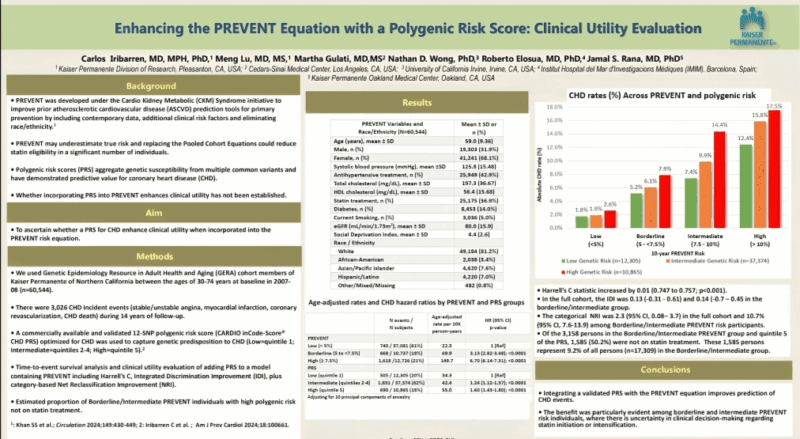
”We are delighted to announce another milestone for CARDIO inCode-Score (polygenic risk score) presented at this weekend’s American Heart Association (AHA) Scientific Sessions Conference in New Orleans. The presentation from Kaiser Permanente showed the latest ASCVD clinical prediction tool ‘PREVENT, was enhanced by the inclusion CARDIO inCode-Score (PRS) providing improved accuracy in personalised risk assessment for prevention of coronary heart disease (CHD). The ASCVD risk prediction tool ‘PREVENT’ estimates a persons risk of developing heart disease.
The presentation showed that integrating CARDIO inCode-Score with PREVENT improves prediction of CHD events. The benefits were particularly evident amongst borderline and intermediate PREVENT risk individuals, where there is uncertainty in clinical decision-making regarding statin initiation or intensification.
We have been working with Kaiser Permanente on the clinical research and development of CARDIO inCode-Score (PRS) for over 15 years. This multi-ancestry population study on over 60,000 individuals, 30-74 years of age with follow up over 14 years, is the latest in a series of clinical utility publications from Kaiser Permanente Departments of Research and Cardiology. Our thanks to Dr. Jamal Rana and Dr. Carlos Iribarren for leading this clinical research and to co-authors Dr. Meng Lu, Dr. Martha Gulati, Dr. Nathan Wong, Dr. Roberto Elosua and our clinical advisory team for championing the inclusion of genetic risk assessment in CHD risk assessment.
CARDIO inCode-Score is a clinically validated, commercially available polygenic risk score using DNA extracted from a simple saliva or blood sample. The test has been designed and optimized for multi-ethnic population-based risk prediction and primary prevention of CHD across international healthcare systems.”
Stay updated with Hemostasis Today.
-
Oct 10, 2026, 09:52Yuria Ito: Should Ferritin Testing Become a Routine Part of Prenatal Care in Japan?
-
Oct 10, 2026, 09:48Ahmed Alotaibi: Can We “Remove” the ABO Problem from Group O Platelets?
-
Oct 10, 2026, 09:31Help Shape the New ASH Iron Deficiency Guidelines – American Society of Hematology
-
Oct 10, 2026, 09:05Wolfgang Miesbach: Moving from Bleed Control to Comprehensive Joint Health
-
Oct 10, 2026, 07:59Leila Caroline Souza Reis: Enoxaparin Dosing for VTE Prevention in Adults With Obesity
-
Oct 10, 2026, 07:41Adeeb Bazuhair: New Evidence for Catheter Directed Thrombolysis in Acute PE
-
Oct 10, 2026, 07:22Poppy Clarke: Turning Steps Into Support for Thrombosis Awareness
-
Oct 10, 2026, 07:12Hamzah Khan: The Role of Genuine Curiosity in Driving High-Impact Academic Research
-
Oct 10, 2026, 06:58Nita Radhakrishnan: Turning Evidence Into Action for Hemophilia Care in India