


Ahvie Herskowitz: Beyond Weight Loss – Lessons From the GLP-1 Era
Ahvie Herskowitz, Founder and Medical Director at Anatara Medicine, President at American College for Advancement in Medicine, shared a post on LinkedIn:
“What the GLP-1 Era Is Teaching Us About Health, Resilience, and the Limits of Conventional Metrics
A case study that fundamentally changed the way I think about metabolic success.
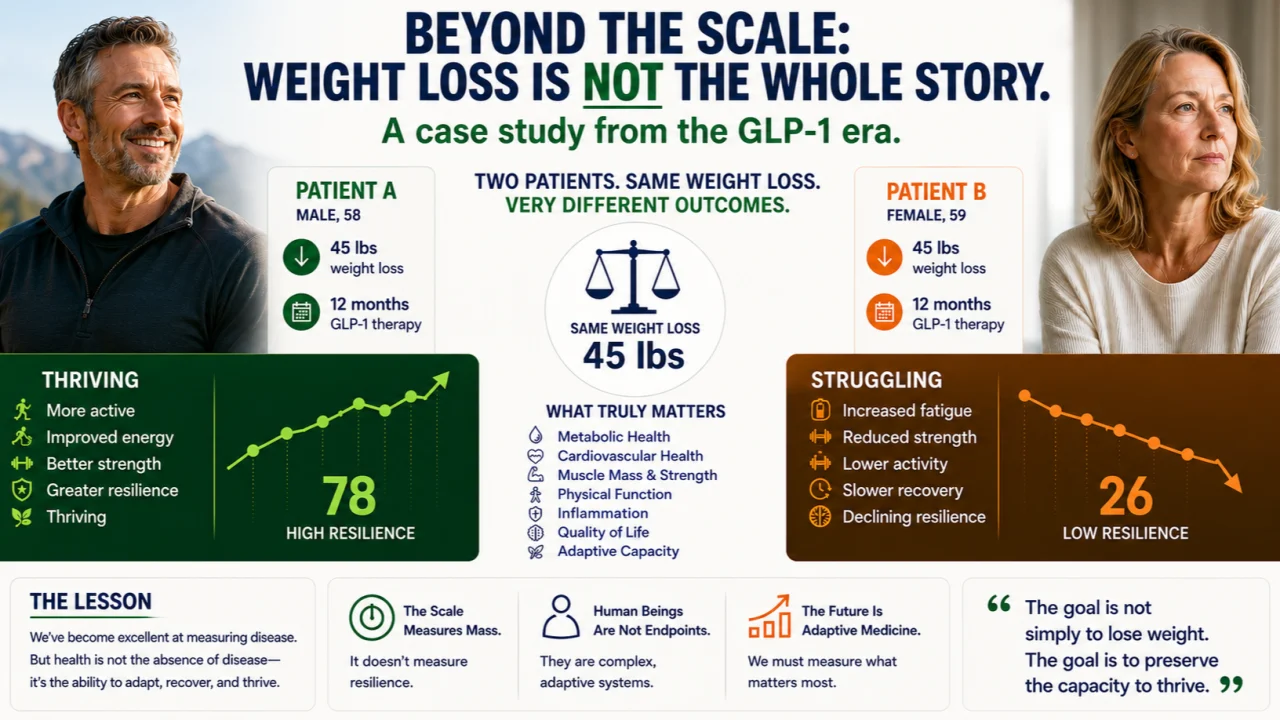
Two patients, both in their late fifties, had spent years struggling with obesity, insulin resistance, and many of the metabolic abnormalities that frequently accompany excess weight.
Both eventually began treatment with a GLP-1 medication.
Over the following year, both experienced significant improvements in blood sugar control. Both lowered blood pressure.
Both lost approximately 45 pounds.
By conventional medical standards, both were success stories.
Yet their outcomes could not have been more different.
The first patient appeared to regain his life.
As the weight came off, he became more active. He returned to hiking.
Exercise became easier.
Energy improved.
Confidence returned.
The weight loss seemed to unlock a cascade of positive biological adaptations that extended far beyond the number on the scale.
The second patient had a very different experience.
Despite achieving nearly identical weight loss, she became progressively more fatigued. Strength declined.
Physical activity became more difficult.
Recovery slowed.
Friends commented that she appeared older despite losing a substantial amount of weight.
While many laboratory markers improved, her overall resilience appeared to be moving in the opposite direction.
Both patients lost the same amount of weight.
So which patient was the success?
That question highlights what I believe is one of the greatest challenges facing modern medicine.
We Have Become Excellent at Measuring Disease
The diagnostic capabilities available to modern medicine are more advanced than at any point in history.
We can quantify blood sugar, lipoproteins, inflammatory biomarkers, coronary calcium scores, genetic variants, body composition, and thousands of additional biological variables with remarkable precision.
Yet despite our technological advances, we remain surprisingly poor at measuring health itself.
Health is not merely the absence of disease. Nor is it simply the normalization of laboratory values.
Health is the ability to adapt and recover.
The ability to maintain strength, mobility, cognition, energy, and physiological reserve as we age.
Over time, I have increasingly come to think of this as adaptive capacity.
The Obesity Discussion Is Often Too Narrow
Obesity is frequently discussed as though it represents a single problem requiring a single solution.
In reality, obesity is often accompanied by:
- Chronic inflammation
- Hormonal dysregulation
- Insulin resistance
- Altered gut function and microbiome changes
- Mitochondrial dysfunction
- Sleep disruption
- Loss of muscle mass
- Declining mobility and physical performance
These systems interact continuously and influence one another in ways that no single biomarker can fully capture.
This is why two individuals can achieve identical weight loss and experience dramatically different physiologic outcomes.
The scale measures mass, not resilience.
The real opportunity of GLP-1 therapy
This is not an argument against GLP-1 therapy.
The benefits of these medications are substantial and increasingly well documented.
The improvements observed in weight reduction, glycemic control, cardiovascular risk factors, and long-term outcomes represent one of the most important advances in metabolic medicine in decades.
But what happens alongside the weight loss?
What happens to muscle mass, exercise capacity, physical function, nutritional status, mitochondrial performance, and long-term resilience?
These questions are becoming increasingly important as GLP-1 therapies move into mainstream medicine.
Human beings are not endpoints
Randomized clinical trials remain among the greatest achievements in modern science-helping us answer critically important questions.
But they do not answer every question. In fact, they more often answer a very limited number of highly specific questions.
Human beings are not endpoints. They are biological systems.
A reduction in weight may represent an important therapeutic victory.
But if that weight loss is accompanied by declining strength, diminished reserve, reduced functional capacity, and accelerated frailty, we should be asking deeper questions about what constitutes true success.
The next frontier: measuring resilience
Perhaps the most important lesson of the GLP-1 era is that it has exposed a larger gap in our understanding of health.
The future will belong to clinicians and researchers who reach beyond measuring disease alone and standardize how to quantify resilience, adaptive capacity, recovery potential, and functional reserve with the same precision that we currently measure glucose and cholesterol.
Because the ultimate goal is not simply to lose weight, but to preserve the capacity to thrive long-term.”
Stay updated with Hemostasis Today.
-
Sep 27, 2026, 15:49Rana Al-Hrout: Iron Deficency – Is Ferritin 15ng/mL or Less Still the Cutoff?
-
Sep 27, 2026, 15:49Ayushi Sharma: What I Thought Transfusion Medicine Would Be vs What It Actually Is
-
Sep 27, 2026, 15:48William Wallace: How Much Human Research Is Behind the Supplements We Take?
-
Sep 27, 2026, 15:46Franck Perraudin: Lp(a) Lowering Alone May Not Be Enough
-
Sep 27, 2026, 15:41Ahmed Hamandi: Sharing Real-World HSCT Experience at the Iraqi Society of Haematology Conference
-
Sep 27, 2026, 15:39Co-creating Digital Support With Young Stroke Survivors – European Stroke Organisation
-
Sep 27, 2026, 15:39Eleri Schiavone: Celebrating 80 Years of the Welsh Blood Service
-
Sep 27, 2026, 15:38Jessica Garcia: Standing Where VWD Was First Recognized 100 Years Later
-
Sep 27, 2026, 15:37Heghine Khachatryan: A Meaningful Step Forward for Inherited Blood Disorders in Africa