


Breaking Bias in Clinical Trials: Sabine Oertelt-Prigione and Brandon Turner Share Insights on Diversity, Sex, and Gender Representation
Flora Peyvandi posted on X:
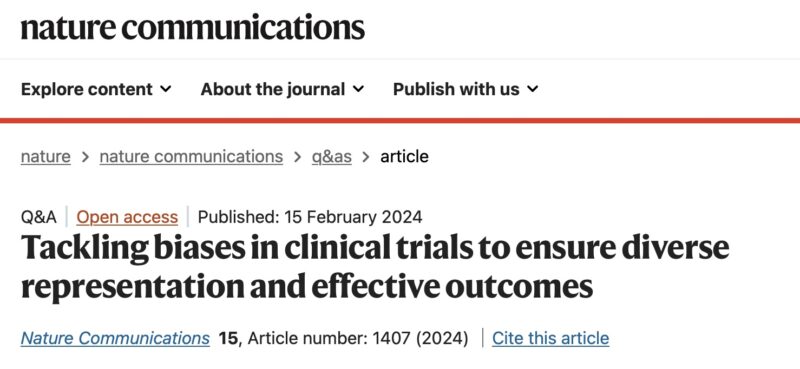
”Tackling biases in clinical trials to ensure diverse representation and effective outcomes.”
Professor Sabine Oertelt-Prigione has been working in the field of sex and gender-sensitive research for the last 15 years. Her current work is focused on trying to understand how sex and gender-sensitive medicine can be successfully implemented in research and practice as well as methods to investigate gender in medical research.
Dr. Brandon Turner is a resident physician in the Department of Radiation Oncology at Massachusetts General Hospital and Brigham and Women’s Hospital. He has conducted and is involved in numerous studies looking to evaluate race and ethnicity reporting and representation in clinical trials.
In this interview for Nature Communications, Sabine Oertelt-Prigione, and Brandon Turner share their knowledge about the biases that can occur in clinical trials and how they can be minimized.
Read the full article here.
Latest news in the world of research featured in Hemostasis Today.
-
Oct 9, 2026, 14:13Jesus Ardila Novoa: Why the WHO’s Historic Essential Medicines List Decision Is Just the Beginning
-
Oct 9, 2026, 14:07Chokri Ben Lamine: Pain After Allogeneic Stem Cell Transplantation in Sickle Cell Disease
-
Oct 9, 2026, 13:55Chandler Purser: AABB 2026 Focuses on Transfusion Safety and Audit-Driven Practice Improvement
-
Oct 9, 2026, 13:48Maxime Dely: Raising Awareness for Blood Donation
-
Oct 9, 2026, 13:48Vera Ghali: Anemia in Myelofibrosis and Its Impact on Treatment Outcomes and Overall Survival
-
Oct 9, 2026, 13:32W David Freeman։ The Mechanical Penumbra in Intracerebral Hemorrhage and Its Potential for Tissue Recovery
-
Oct 9, 2026, 13:11Ayshathul Noora։ Carbetocin vs Oxytocin in Preventing Postpartum Hemorrhage
-
Oct 9, 2026, 13:07The Rebalanced Patient: New Therapies and New Thrombotic Risks in Hemophilia
-
Oct 9, 2026, 12:48Santiago Cepeda Chafla: CereBleed Simplifies Brain Hemorrhage Assessment