


Khurram Nasir: Can Earlier LDL-C Lowering Change the Trajectory of Cardiovascular Disease?
Khurram Nasir, Co-Director Houston Methodist-Rice University Digital Health Institute (HM-Rice DHI) at Houston Methodist, shared on LinkedIn:
“Can Earlier LDL-C Lowering Change the Trajectory of Cardiovascular Disease?
A thought-provoking simultaneous publication by Kausik Ray published in American Journal of Preventive Cardiology presented at European Atherosclerosis Society yesterday revisits one of the central questions in prevention:
Are we intervening too late?
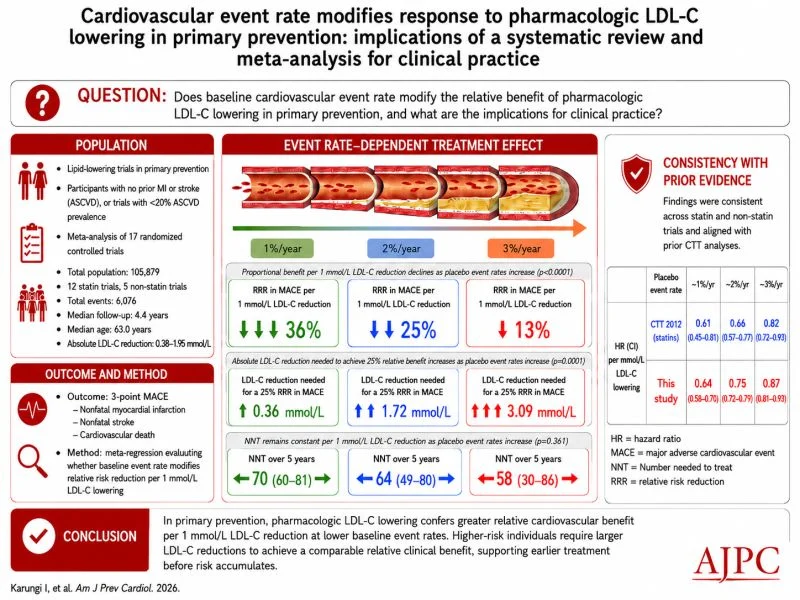
Using data from 17 randomized lipid-lowering trials involving more than 105,000 participants, Karungi and colleagues examined how the relative cardiovascular benefit of LDL-C lowering changes across different baseline risk levels.
The findings are thought provoking.
- Contrary to the traditional assumption that lower-risk individuals derive only modest benefit, the investigators observed that relative risk reduction per 1 mmol/L LDL-C lowering was actually greater in lower-risk primary prevention populations.
- In trial populations with annualized event rates around 1% per year, each mmol/L LDL-C reduction was associated with roughly a 36% relative reduction in events, compared with approximately 13% in populations with event rates near 3% per year.
The paper bring to light an important conceptual framework.
- As atherosclerosis advances, larger LDL-C reductions may be required to achieve the same proportional benefit.
- In lower-risk and presumably earlier-stage disease, even modest LDL-C reductions may yield meaningful relative risk reduction.
This shifts the discussion from simply ‘who is high risk today?’ toward a broader life-course perspective
- Are we waiting long before intervening?
- Can modest but earlier LDL-C lowering alter cumulative vascular exposure before disease becomes biologically irreversible?
- Should early primary prevention become more central to our prevention frameworks?
I think the implications extend beyond statins alone.
For the future we need to think around long-duration therapies, , AI-guided risk prediction, imaging-guided prevention, and cumulative LDL exposure increasingly points toward a future where prevention may begin earlier, become more personalized, and focus more on preserving vascular health before advanced disease develops.
An important extension of the accompanying paper is the editorial by Roger Blumenthal and Alexander Razavi, which frames these findings through a simple but powerful analogy borrowed from Arnold Palmer:
‘Timing is everything in life and in golf.’
For decades, much of our prevention framework has focused on identifying individuals once short-term risk becomes sufficiently high.
What if we can address the cumulative exposure , then when we lower LDL-C may matter just as much as how much we lower it.
Importantly, the authors do not advocate indiscriminate pharmacotherapy.
Instead, they highlight a more personalized strategy integrating PREVENT risk estimation, inflammatory markers, lipoprotein(a), CKM risk factors, and importantly CAC imaging to identify those most likely to benefit from earlier intervention.
In many ways, the editorial captures an important philosophical shift. The future may not simply be about treating advanced disease more aggressively, but preserving vascular health before advanced atherosclerosis develops.
Timing, indeed, may be everything.
Also this news release.”
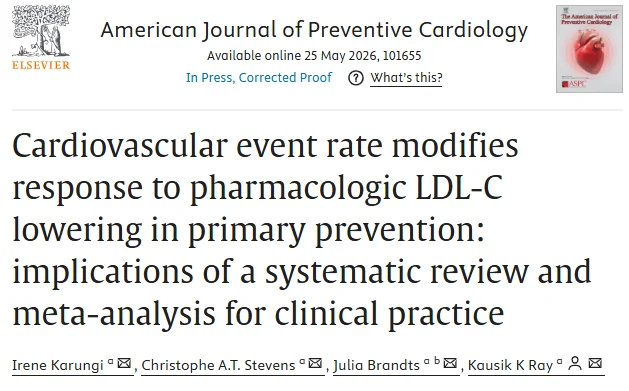
Title 1: Cardiovascular event rate modifies response to pharmacologic LDL-C lowering in primary prevention: implications of a systematic review and meta-analysis for clinical practice
Authors: Irene Karungi, Christophe A.T. Stevens, Julia Brandts, Kausik K Ray
Read the Full Article on American Journal of Preventive Cardiology
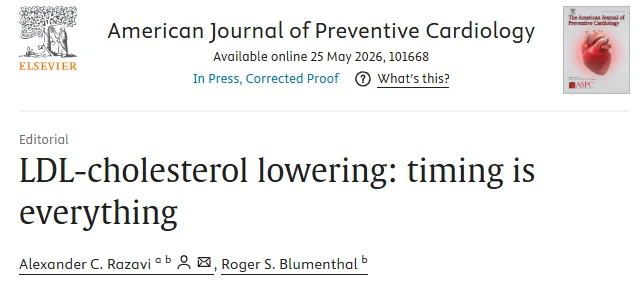
Title 2: LDL-cholesterol lowering: timing is everything
Authors: Alexander C. Razavi, Roger S. Blumenthal
Read the Full Article on American Journal of Preventive Cardiology
Stay updated on all scientific advances with Hemostasis Today.
-
Oct 10, 2026, 10:02Rucha Patil: National Convening Highlights Opportunities for Equitable Hemophilia Care Across India
-
Oct 10, 2026, 09:52Yuria Ito: Should Ferritin Testing Become a Routine Part of Prenatal Care in Japan?
-
Oct 10, 2026, 09:48Ahmed Alotaibi: Can We “Remove” the ABO Problem from Group O Platelets?
-
Oct 10, 2026, 09:31Help Shape the New ASH Iron Deficiency Guidelines – American Society of Hematology
-
Oct 10, 2026, 09:05Wolfgang Miesbach: Moving from Bleed Control to Comprehensive Joint Health
-
Oct 10, 2026, 07:59Leila Caroline Souza Reis: Enoxaparin Dosing for VTE Prevention in Adults With Obesity
-
Oct 10, 2026, 07:41Adeeb Bazuhair: New Evidence for Catheter Directed Thrombolysis in Acute PE
-
Oct 10, 2026, 07:22Poppy Clarke: Turning Steps Into Support for Thrombosis Awareness
-
Oct 10, 2026, 07:12Hamzah Khan: The Role of Genuine Curiosity in Driving High-Impact Academic Research