

Daniel Torrent: A New Path for ‘No-Optional’ Patients – TADV vs Standard of Care in CLTI
Daniel Torrent, Vascular Surgeon at Longstreet Clinic, shared a post on LinkedIn about a recent article by Mounika Naidu Boya et al, published in Journal of Vascular Surgery:
“‘No-option’ CLTI doesn’t have to mean ‘no hope.’
The results of this systematic review and meta-analysis on TADV (Transcatheter Arterialization of Deep Veins) aren’t surprising if you’ve been paying attention to this world. It’s still nice to see it pulled together and peer reviewed.
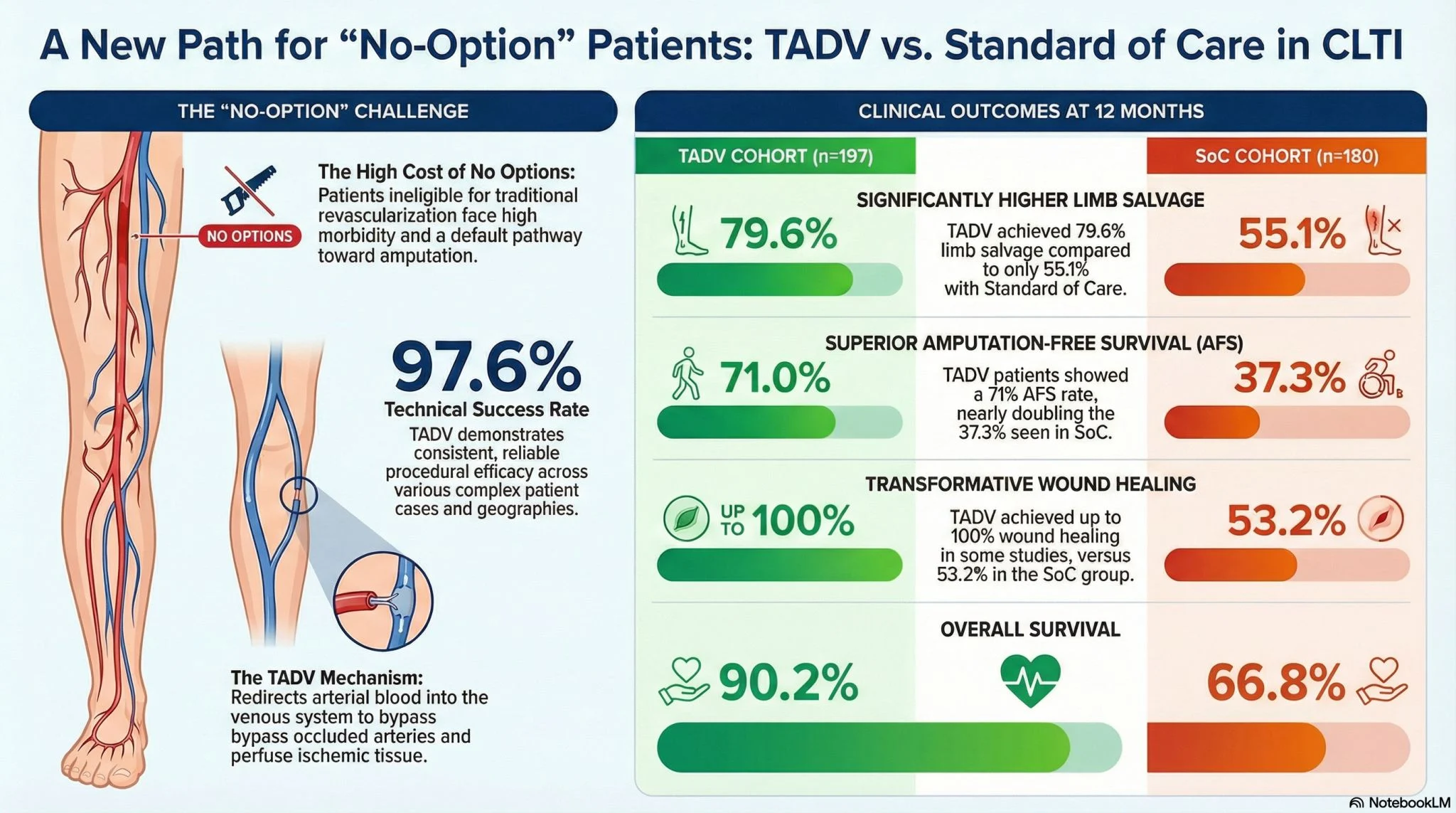
The most striking stat? Survival. Even though the patients undergoing TADV have similar medical issues to those that don’t, there’s a fairly startling difference in mortality. Saving limbs saves lives.
Interpreting Patency: Patency isn’t on the infographic because there isn’t anything to compare to on the Standard of Care (SoC) cohort which comes from a natural history study. However, generally, primary and primary-assisted patency is less than 50% at six months. Despite this, the limb preservation statistics are wonderful. This procedure works differently than a standard revascularization.
Optimizing for Success: I’ve been impressed with how this procedure has been implemented as well. It wasn’t just thrown out into the market. It’s been a thoughtful rollout with mandatory training and program support. Beyond training on the procedure, I’ve had help on training the ultrasound team for pre-operative and post-operative evaluations. CLTI is a process where the full spectrum of care matters.”
Title: Evidence for transcatheter arterialization of deep veins in poor-option chronic limb-threatening ischemia: A systematic review and meta-analysis
Authors: Mounika Naidu Boya,Isabella Ferlini Cieri, Adriana A. Rodriguez Alvarez, Shiv Patel, Peter A. Schneider, Daniel Clair, Mehdi H. Shishehbor, Anahita Dua
Read the Full Article on Journal of Vascular Surgery

Stay updated with Hemostasis Today.
-
Sep 24, 2026, 08:55Andres Gudino: Clot Characterization Through Hounsfield Units in Ischemic Stroke
-
Sep 24, 2026, 06:52Gina Sado: Screening-Detected Atrial Fibrillation Carries High Risk of Heart Failure
-
Sep 24, 2026, 06:33Benjamin Vipler: Optimal Oral Anticoagulation Choice in Atrial Fibrillation and Advanced CKD
-
Sep 24, 2026, 06:08Christopher Salerno: AI-Powered At-Home Anemia Screening Advances Telehealth Access
-
Sep 24, 2026, 05:38Aya Qattan: When a Normal CBC Does Not Mean Normal Iron Status
-
Sep 24, 2026, 05:11Mastering Warm Autoimmune Hemolytic Anemia Diagnosis and Practice – ASH Education
-
Sep 23, 2026, 16:04Monia Ezzalfani: Advancing Patient-Centered Care in Hemophilia A and B
-
Sep 23, 2026, 15:49Bilge Başak: How Activated PRP Modulates Osteoarthritic Chondrocyte Function
-
Sep 23, 2026, 14:50Mbonjo Bitsie Dora: Strengthening Sickle Cell Care Through Education, Awareness and Innovation