


Jason Andrade: A Decade-Long Quest Proves Early Ablation Halves Persistent AF Burden
Jason Andrade, Cardiologist at Vancouver Coastal Health, Clinical Professor at The University of British Columbia, Co-chair of CCS, shared Eric Topol‘s post on LinkedIn about a recent article he and his colleagues co-authored, published in NEJM, adding:
“More than 10 years ago Oussama and I started our journey of investigation, trying to the define the optimal first treatment for patients with atrial fibrillation.
Separately we pursed randomised studies in populations with treatment – naive paroxysmal AF.
Five years ago we presented our RCTs in the paroxysmal AF population, which ended up sitting side by side in the same issue of the New England Journal of Medicine.
Since then we have been working together to examine the same question of optimal initial therapy, but instead looking at patients with more advanced forms of atrial fibrillation.
Today Oussama presented the results of the AVANT-GUARD study, which definitively demonstrated the value of initial catheter ablation in the treatment naive persistent AF population.
Like EARLY-AF, AVAT GUARD used implantable cardiac monitors to evaluate arrhythmia endpoints
Like EARLY-AF – initial catheter ablation reduced recurrences in AVANT GUARD by about 50 percent, which was about 25percent in absolute terms. To put this another way, only 4 patients need to be treated with ablation to prevent a recurrence of arrhythmia.
However, binary recurrence doesn’t tell the whole story. Because we had loop recorders we were able to assess the time spent in AF (or AF burden).
In this regard significantly more patients had none or negligible burden after ablation (less than 0.1 percent change ), with significantly more AAD treated patients having a very high burden (greater than 5 percent).
This is important as AF burden is associated with clinical outcomes such as hospitalisation.
In terms of risk – the rates of any adverse event or serious adverse event were comparable between randomised arms.
Highlighting that persistent AF patients with high CHADS-VASc score are high risk irrespective of treatment provided.
This is important as we reflect on treatment options as part of shared decision – making.
Congratulations to Oussama for the presentation and leadership, to the co – investigators and study sites for their participation and dedication, and a huge thank you to the Boston Scientific team for their support and commitment to advancing science.
To end, I want to acknowledge and thank Oussama for this shared journey, I’m grateful for our collaboration and friendship, and look forward to what we will do next.”
Eric Topol, Founder and Director of Scripps Research Translational Institute, shared a post on LinkedIn:
“New NEJM Group
For persistent atrial fibrillation, first – line pulsed field ablation (PFA) superior to medical therapy (AAD) in an international randomized trial for preventing recurrent atrial arrhythmias Oussama Wazni Cleveland Clinic.”
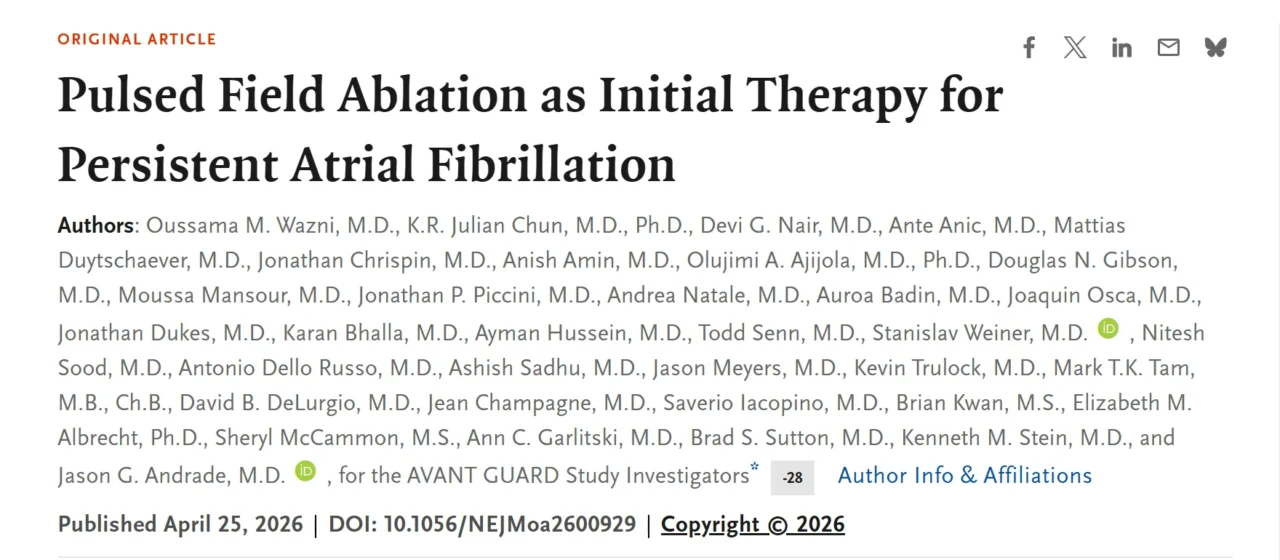
Title: Pulsed Field Ablation as Initial Therapy for Persistent Atrial Fibrillation
Authors: Oussama M. Wazni, K.R. Julian Chun, Devi G. Nair, Ante Anic, Mattias Duytschaever, Jonathan Chrispin, Anish Amin, Olujimi A. Ajijola, Douglas N. Gibson, Moussa Mansour, Jonathan P. Piccini, Andrea Natale, Auroa Badin, Joaquin Osca, Jonathan Dukes, Karan Bhalla, Ayman Hussein, Todd Senn, Stanislav Weiner, Nitesh Sood, Antonio Dello Russo, Ashish Sadhu, Jason Meyers, Kevin Trulock, Mark T.K. Tam, David B. DeLurgio, Jean Champagne, Saverio Iacopino, Brian Kwan, Elizabeth M. Albrecht, Sheryl McCammon, Ann C. Garlitski, Brad S. Sutton, Kenneth M. Stein, Jason G. Andrade.
Stay updated on all scientific advances with Hemostasis Today.
-
Sep 13, 2026, 17:28Jim Hoffman: New Potential Predictive Biomarker for Lupus Nephritis
-
Sep 13, 2026, 17:08W. Alberto Sifuentes Giraldo: Urticarial Vasculitis Clinical Features, Systemic Involvement, and Treatment
-
Sep 13, 2026, 16:58Let’s Debunk Some Myths about Blood in SCD – ASCO
-
Sep 13, 2026, 16:56William Wallace: A Magnesium Ion Decides Whether Your Brain Learns or Not
-
Sep 13, 2026, 16:54Meet NBDF’s 2026 Excellence Fellowship Recipients – National Bleeding Disorders Foundation
-
Sep 13, 2026, 16:52Kaloyan Takov: Native Lp(a) Carries a Distinct Triglyceride Signature Linked to Cardiovascular Disease
-
Sep 13, 2026, 16:51Axay Tomar: How Simulation-Based Education Shapes Safer Transfusion Practices
-
Sep 13, 2026, 16:51Edina Cenko: AZURE-HeFH Highlights the LDL-C Treatment Gap in HeFH
-
Sep 13, 2026, 16:49William Aird: Why Is LDH Elevated In Splenic Infarction?