

Oliver Maracic: Could Co-Targeting ALK with FAK/PYK2 Help Mitigate the High VTE Burden Seen in ALK with NSCLC
Oliver Maracic, Independent Oncology and Metabolic Disease Strategist, shared a post on LinkedIn about a recent article by Caroline Kamali published in JTO Clinical and Research Reports, adding:
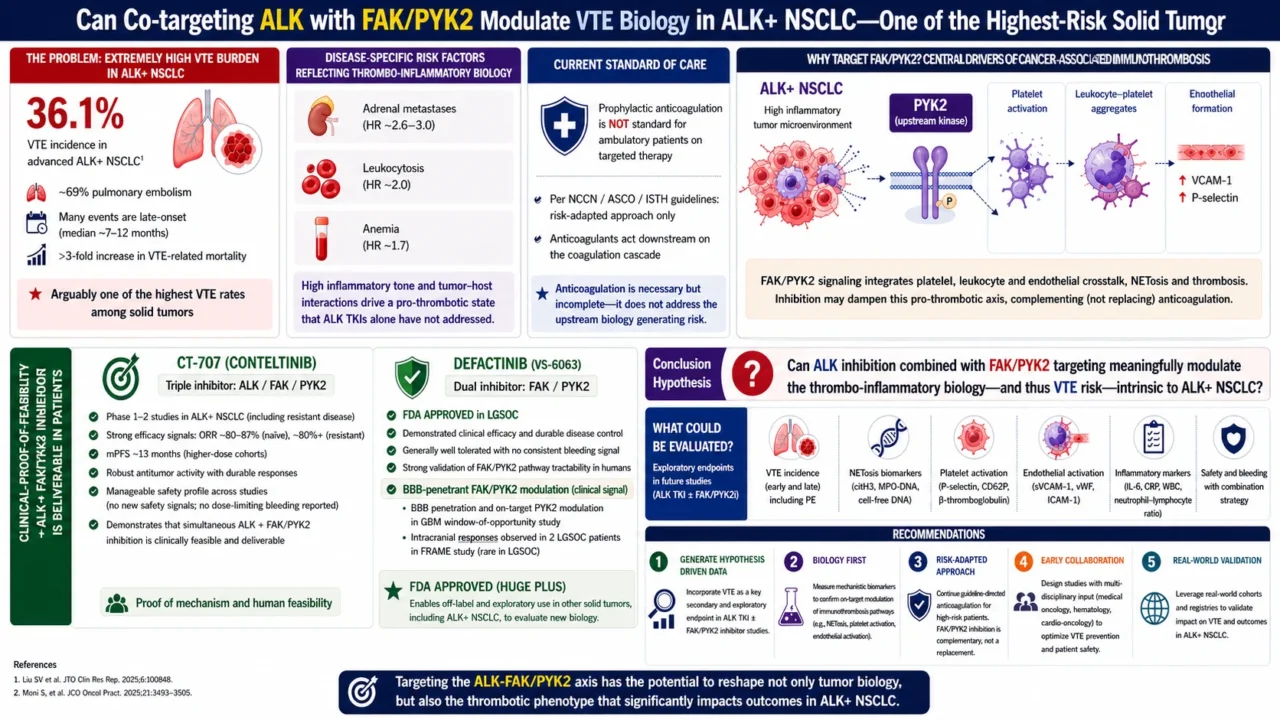
“Could co-targeting ALK with FAK/PYK2 help mitigate the high VTE burden seen in ALK with NSCLC, arguably one of the highest-risk solid tumor settings for thrombosis?
The 36.1% VTE incidence (≈69% PE, many late-onset) in advanced ALK with NSCLC is striking. Risk factors such as adrenal metastases, leukocytosis, and anemia, point to a disease-specific thrombo-inflammatory biology that pure ALK TKIs have not addressed.
Importantly, prophylactic anticoagulation is not standard for ambulatory patients on targeted therapy (per NCCN/ASCO/ISTH; risk-adapted only), so these rates reflect current real-world management.
Notably, the elevated VTE risk appears to be a feature of the disease biology itself, not mitigated by successive generations of ALK inhibitors.
This raises a focused hypothesis: co-targeting ALK with FAK/PYK2 may modulate upstream drivers of cancer-associated immunothrombosis. PYK2 regulates platelet activation, NETosis, leukocyte–platelet aggregates, and endothelial adhesion.
Given the high inflammatory tone of ALK with tumors, FAK/PYK2 inhibition could plausibly dampen the pro-thrombotic state.
Critically, this is not an alternative to anticoagulation, but a complementary approach. Anticoagulants act downstream on the coagulation cascade, whereas FAK/PYK2 targeting addresses the upstream biology generating thrombotic risk, a layer not currently targeted in standard care.
There is already clinical proof-of-feasibility for this biology. CT-707 (conteltinib), a triple ALK/FAK/PYK2 inhibitor, has shown robust efficacy with manageable safety in early-phase studies, demonstrating that simultaneous ALK with FAK/PYK2 inhibition is deliverable in patients.
In parallel, defactinib (dual FAK/PYK2; FDA-approved in LGSOC) supports pathway tractability and safety, making it a feasible partner to test alongside ALK inhibitors in NSCLC.
BBB penetrant plus
Can ALK inhibition combined with FAK/PYK2 meaningfully modulate the thrombo-inflammatory biology, and thus VTE risk, intrinsic to ALK with NSCLC?
Based on dr. Liu X post.”
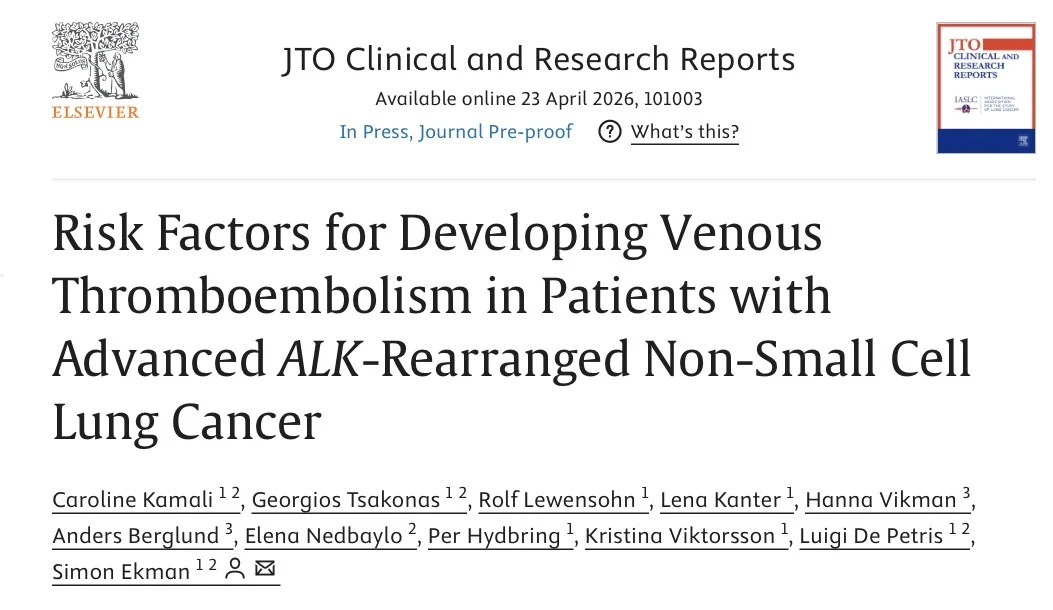
Title: Risk Factors for Developing Venous Thromboembolism in Patients with Advanced ALK-Rearranged Non-Small Cell Lung Cancer
Authors: Caroline Kamali, Georgios Tsakonas, Rolf Lewensohn, Lena Kanter, Hanna Vikman, Anders Berglund, Elena Nedbaylo, Per Hydbring, Kristina Viktorsson, Luigi De Petris, Simon Ekman
Stay updated with Hemostasis Today.
-
Sep 20, 2026, 14:14New Insights Into Platelet Production in Glanzmann Thrombasthenia – Glanzmann’s Research Foundation
-
Sep 20, 2026, 13:29Factor XI Deficiency and the Challenge of Unpredictable Bleeding – EHC
-
Sep 20, 2026, 13:18Cindy Howry: FDA Approves First Treatment for Ataxia-Telangiectasia
-
Sep 20, 2026, 13:08Mohammad Salar Amoli: When Routine Coagulation Tests Miss von Willebrand Disease
-
Sep 20, 2026, 12:55Stelios Andreadis։ Human Salivary Gland Organoids Offer New Potential for Regenerative Medicine
-
Sep 20, 2026, 12:43Obi Light Ogbonnia: Takeaways from the 3rd Global Sickle Cell Disease Conference Nairobi
-
Sep 20, 2026, 12:34Sabrine Mekni: Advancing HSCT for Children With Fanconi Anemia
-
Sep 20, 2026, 12:11Giacomo Buso: Silent Atherosclerosis Begins Earlier Than Expected
-
Sep 20, 2026, 12:0310 Posts Not to Miss This Week