


Murad Ali: An Important Marker of Active Clot Formation and Fibrinolysis
Murad Ali, Medical Laboratory Technologist Alfalah Lab, shared on LinkedIn:
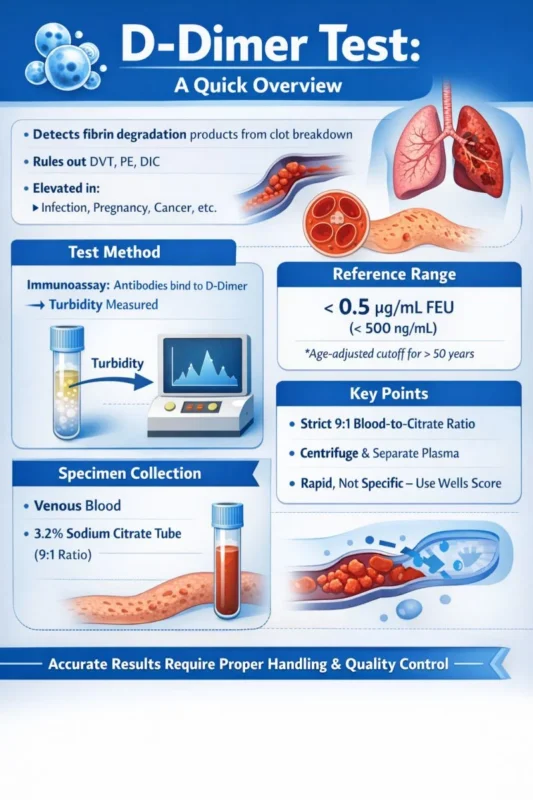
”The D-Dimer test is a coagulation assay used to detect fibrin degradation products formed when cross-linked fibrin clots are broken down by plasmin, making it an important marker of active clot formation and fibrinolysis.
It is widely used to help rule out deep vein thrombosis, pulmonary embolism, and disseminated intravascular coagulation, and is also elevated in conditions such as infection, inflammation, malignancy, pregnancy, trauma, liver disease, and advanced age; therefore, it has high sensitivity but low specificity and must be interpreted alongside clinical assessment tools like the Wells score.
The test is commonly performed using immunoturbidimetric or latex-enhanced immunoassay methods in which monoclonal antibodies bind to D-Dimer fragments, producing turbidity measured photometrically, with results typically reported as less than 0.5 µg/mL FEU (or 500 ng/mL FEU) as normal, though age-adjusted cutoffs may be applied in patients over 50 years.
The required specimen is venous blood collected in a 3.2% sodium citrate tube with a strict 9:1 blood-to-anticoagulant ratio, followed by centrifugation to obtain platelet-poor plasma; samples should be properly filled, gently mixed, centrifuged promptly, and analyzed within a few hours or stored appropriately to maintain stability.
Accurate results depend on correct pre-analytical handling, proper calibration, daily quality control, and adherence to manufacturer guidelines, as underfilled tubes, hemolysis, or improper processing can affect reliability.”
Stay updated with Hemostasis Today.
-
Oct 9, 2026, 15:27Mohamed Hegazi: Geostatistical Modelling Maps Global β-Thalassaemia Carrier Prevalence
-
Oct 9, 2026, 15:15Maha Othman: Uncovering the Consensus on TXA in TBI – Call for Collaboration on a Landmark Umbrella Review
-
Oct 9, 2026, 15:07Daniel D. Han: How Inhalation Product Exposure Impairs Cardiac and Platelet Recovery After MI
-
Oct 9, 2026, 14:58William Toole: How Ultrasound-Guided PRP Therapy Relieves Joint and Tendon Pain
-
Oct 9, 2026, 14:50Shayan Mohammadmoradi: In Corpus Christi for the 20th Midwest Platelet Conference
-
Oct 9, 2026, 14:37Tariq Tramboo: High Platelet Concentrate for Osteoarthritis Knee – Recent Meta-Analyses
-
Oct 9, 2026, 14:26Yousma Khan: Hematology Series – Beyond RBCs, WBCs and Platelets
-
Oct 9, 2026, 14:13Jesus Ardila Novoa: Why the WHO’s Historic Essential Medicines List Decision Is Just the Beginning
-
Oct 9, 2026, 14:07Chokri Ben Lamine: Pain After Allogeneic Stem Cell Transplantation in Sickle Cell Disease