


Vincentius Liong on Nanorobot Swarms vs Blood Clots
Vincentius Liong/Leong, Business Advisor at VL Business Consulting Services, shared on LinkedIn:
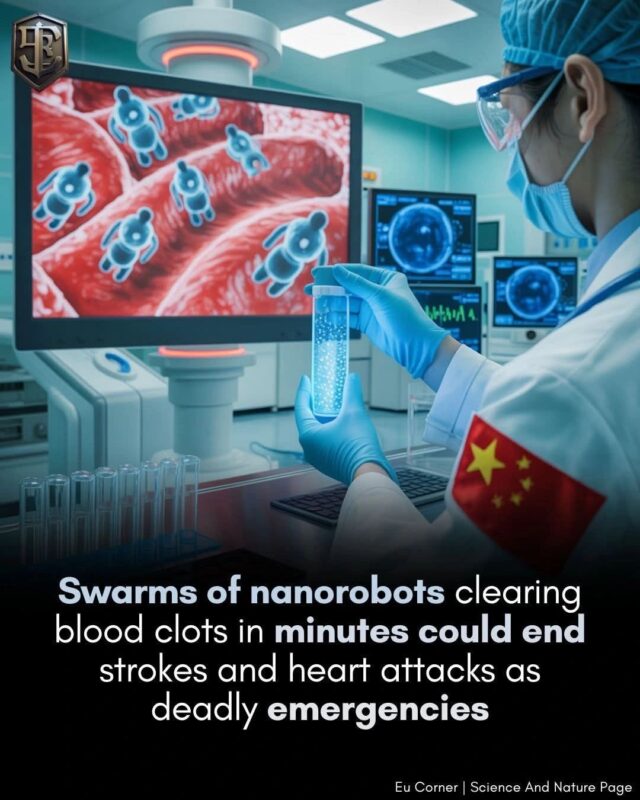
”China designs nanorobot swarms that clear blood clots within minutes
Chinese scientists have created microscopic nanorobot swarms capable of dissolving dangerous blood clots inside veins within minutes.
Built from magnetic nanoparticles coated with enzymes, these tiny machines are guided by external magnetic fields to travel directly to blocked arteries. Once there, they spin and release clot-dissolving chemicals, restoring blood flow almost instantly.
The nanorobots are smaller than red blood cells and are injected into the bloodstream in a liquid solution. Doctors use MRI-like magnetic systems to steer the swarm toward the affected area. Once positioned, the swarm begins rotating, physically breaking down the clot while simultaneously releasing plasmin, a natural enzyme that dissolves fibrin — the protein mesh holding clots together.
Animal trials showed stunning results. Rabbits with blocked arteries regained full blood flow within 15 minutes, compared to hours or days for conventional drug treatments. Unlike clot-busting drugs, which spread throughout the body and can cause dangerous bleeding, the nanorobots deliver treatment only at the blockage site, reducing side effects.
One of the greatest advantages is precision. With real-time imaging, doctors can see exactly where the swarm moves, ensuring complete removal of blockages. This is especially critical in stroke patients, where every minute of delayed treatment can mean irreversible brain damage.
If human trials succeed, this could replace invasive surgeries and risky drug regimens. Millions who suffer from strokes, heart attacks, or deep vein thrombosis could benefit from a safer, faster therapy. Hospitals might one day keep nanorobot kits ready for emergencies, injecting life-saving swarms within seconds.
China’s innovation represents the merging of robotics, nanotechnology, and medicine — a future where tiny machines patrol our bloodstream to keep us alive.
Peer-Reviewed Scientific Publications:
tPA-anchored nanorobots for in vivo arterial recanalization at submillimeter-scale segments
Rapid Blood Clot Removal via Remote Delamination and Magnetization of Clot Debris
Untethered miniature robots for minimally invasive thrombus treatment: From bench to clinical trials
Application of nanotechnology and micro/nanorobots in thrombotic diseases
Nano-robotic based Thrombolysis: Dissolving Blood Clots using Nanobots
Advances of medical nanorobots for future cancer treatments
Tracking and navigation of a microswarm under laser speckle contrast imaging for targeted delivery
Magnetic Nanoparticles Mediated Thrombolysis–A Review
Credits CTTO”
Stay updated on all the innovations in the field of thrombosis with Hemostasis Today.
-
Sep 24, 2026, 14:22Integrating Thrombosis Risk Into Menopause Care – World Thrombosis Day
-
Sep 24, 2026, 13:41Mahmoud Samir Bayomi: Raise ITP Awareness and Improve Patient Care
-
Sep 24, 2026, 12:56Maria Helena Parrinello: A New Score for Chronic GvHD Risk Assessment at the SIE Congress
-
Sep 24, 2026, 12:44Shehab Mohamed: TP53 Mutations and Outcomes in Myeloproliferative Neoplasms
-
Sep 24, 2026, 12:34Francesca Palandri: Is There Still a Place for Splenectomy in ITP in the Modern Era?
-
Sep 24, 2026, 12:15Cedric Hermans: RPTH Illustrated Review on Von Willebrand Disease
-
Sep 24, 2026, 11:48Factor XII Inhibition and the Future of Contact Pathway Targeting
-
Sep 24, 2026, 08:55Andres Gudino: Clot Characterization Through Hounsfield Units in Ischemic Stroke
-
Sep 24, 2026, 06:52Gina Sado: Screening-Detected Atrial Fibrillation Carries High Risk of Heart Failure